Kim Says Delisting Single-Stock Leveraged ETFs Is ‘Hard to Imagine’
Summary
- Kim Yong-beom, policy chief at South Korea’s presidential office, said the delisting of single-stock leveraged ETFs is hard to imagine.
- The government said it could address side effects from single-stock leveraged ETFs through rules requiring at least 30 million won ($21,700) in cash and a minimum purchase of 20 shares.
- Kim said further discussions are needed on ways to minimize the tracking gap of single-stock leveraged ETFs and reduce their market impact.
Forecast Trend Report by Period


“Curbs should resolve much of the side effects once implemented”
“Tracking gaps in single-stock leveraged ETFs should be minimized”
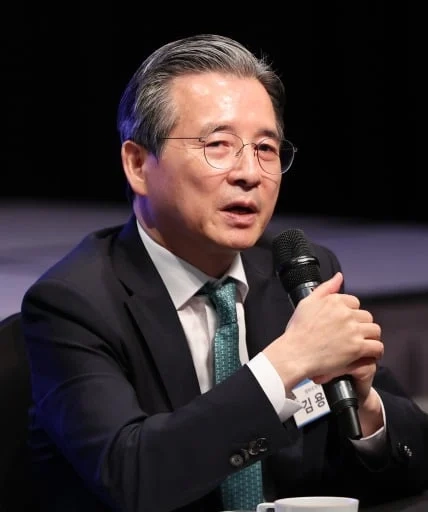
Kim Yong-beom, policy chief at South Korea’s presidential office, said on July 19 that calls to delist single-stock leveraged exchange-traded funds are "hard to imagine." The products, which track more than twice the move of an individual stock, have come under fire amid sharp swings in the local stock market and accusations they are exacerbating volatility.
Speaking on KBS’s “Sunday Diagnosis Live” on July 19, Kim said investors are already holding the products and their assets exceed 10 trillion won ($7.2 billion). Delisting is therefore difficult to envision, he said. Such a move would itself deliver a huge shock to the market and leave authorities to absorb the resulting selling pressure, he added.
Single-stock leveraged ETFs tied to Samsung Electronics Co. and SK Hynix Inc. were launched on May 27. As the two stocks swung sharply, criticism mounted that the products were amplifying market volatility. In response, the Ministry of Economy and Finance, the Bank of Korea, the Financial Services Commission and the Financial Supervisory Service recently announced measures targeting single-stock leveraged ETFs. Under the plan, investors will need to hold at least 30 million won ($21,700) in cash in their accounts to trade the products starting next month. From November, the minimum purchase size for a single order will rise to 20 shares.
Kim said the measures should resolve much of the products’ side effects. Authorities held extensive discussions and adopted steps that reflect many of the concerns raised in the market, he said. Once the rules take effect, many of the issues that have been flagged should be largely addressed.
Still, Kim pointed to the gap between an ETF’s net asset value and its market price. That divergence should be minimized, he said. Authorities can further discuss ways to moderate the selling burden created by efforts to keep those gaps in line.
Leveraged ETFs have an effect that becomes twice as strong in a falling market, Kim said. Further talks are needed among authorities, asset managers and brokerages on how to minimize market disruption. He also noted that volatility in leveraged ETFs tends to increase just before the market close, saying policymakers should consider a range of ways to reduce the products’ impact on the market at specific times.
Kim also apologized over the so-called triple-strength phenomenon in housing, in which home-sale prices, jeonse lease prices and monthly rents are all rising together. "I feel deeply sorry to so many people," he said. "Housing supply and demand, along with other conditions, are very challenging, and I take the issue seriously."
He also addressed remarks he made at a Kwanhun Club forum last month that "we just have to build housing." Kim said he meant that supply cannot be created overnight and that the government must mobilize every possible short-term measure, including buying non-apartment homes for rental use, in an urgent search for solutions. At the time, he mentioned the possibility of using older industrial areas in Seoul such as Yeongdeungpo and Guro.
Kim said the government will mobilize all available housing-supply measures that can produce results in the short term. That includes non-apartment housing, privately developed officetels, and converting land designated for commercial use in third-generation new town projects into residential use.
He said redevelopment and reconstruction are not a cure-all. Such projects do not secure supply in the short term. Procedures can be shortened and floor-area-ratio rules can be discussed, but redevelopment and reconstruction still take at least three to five years. On a housing-supply plan using semi-industrial areas in Seoul, Kim said the issue is not Seoul’s alone and that cooperation with the central government could produce much greater results. He added that he had arranged a separate meeting with Seoul Mayor Oh Se-hoon.
On tax changes aimed at stabilizing the property market, Kim said the government will first distinguish between people who own multiple homes and those who own one, and will also differentiate between owner-occupied homes and those that are not owner-occupied. Even for a single owner-occupied home, very high-end properties may need to be treated differently because of the owner’s ability to bear the tax burden and the burden such homes place on the housing market, he said. That view was raised repeatedly at the forum, and officials have broadly reached a judgment on treating such cases differently, he added. What remains is determining the appropriate level and how to set the threshold.
Asked about claims that raising holding taxes should be paired with lower capital-gains taxes to bring more properties onto the market, Kim said the government is taking that into account. He added that the system could be designed to allow owners to sell within an appropriate period while imposing a heavier burden after that window passes. The framework is being designed with tax fairness in mind. While lowering capital-gains taxes when holding taxes rise is one factor to consider, he said, it is difficult to apply that principle uniformly.
Oh Jung-min, Hankyung.com reporter blooming@hankyung.com

Korea Economic Daily
hankyung@bloomingbit.ioThe Korea Economic Daily Global is a digital media where latest news on Korean companies, industries, and financial markets.