SK’s Chey Says SK Hynix Bonus Dispute Isn’t Yet a Broad Problem
Forecast Trend Report by Period


“It would be a real problem if everyone hated it”
“The concept of excess-profit sharing is unclear”
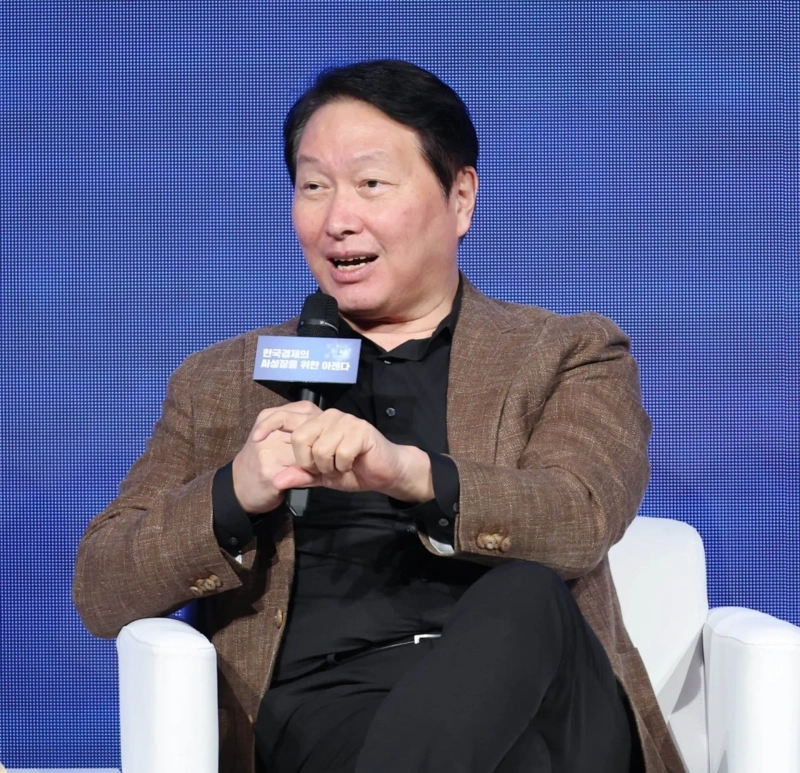
Chey Tae-won, chairman of the Korea Chamber of Commerce and Industry and SK Group, said a dispute over performance bonuses at SK Hynix has not become serious enough to warrant alarm.
“If everyone hated it, that would be a real problem, but I don’t see it that way,” Chey said at a July 18 press briefing held on the sidelines of the Korea Chamber of Commerce and Industry’s Jeju Forum. “Let’s watch a little longer.”
He said he wants to give employees as much happiness as possible, but only if that can be done together with stakeholders.
If employees’ happiness infringes on stakeholders, the issue would have to be addressed to ensure sustainable happiness, he said.
Chey added that some people who do not work at SK Hynix also see the matter positively.
“I think there are, of course, positive effects that come from this as well,” he said.
Addressing criticism that the selection of a site for a new semiconductor cluster reflected government-led decision-making, Chey said the company continues to assess whether conditions are sufficient. He added that neither SK nor others have found another location in South Korea that fully meets the country’s needs.
Infrastructure must be provided by the central government or local authorities, he said. If that is done properly, SK’s position is simple: it will build there.
On applying an exemption to South Korea’s 52-hour workweek system to speed semiconductor development, Chey said he had heard authorities were considering a suspension of the rule for companies relocating to large special zones outside the capital region.
Employers should comply with the 52-hour cap, he said. But if workers want to work longer, they should be allowed to do so. “I hope free will is respected.”
Chey also stressed the need to ease regulations to support economic growth. Asked about revising inheritance taxes, he said the issue extends beyond the tax itself.
South Korea is still operating under systems designed during a high-growth era, he said. The country has now entered a period of slower growth, yet there are not many systems that help companies expand even as policymakers call for growth.
He said the country’s framework remains centered on the idea that small businesses should be helped, the poor should receive support and the wealthy should pay higher taxes.
“As a result, small and mid-sized companies no longer want to get bigger,” he said. “If companies think growth is unnecessary, where will the engine and incentive for growth come from?”
Chey said South Korea should operate with democracy as its political system and capitalism as its economic system. But when growth stalls and one wheel stops turning, democracy also runs into trouble, he said.
“To get both wheels working properly again as they once did, we need to return to growth policies,” he said. “Growth creates the room needed to address distribution issues as well.”
On a proposal by the Ministry of Employment and Labor to distribute excess profits generated by artificial intelligence, Chey said he had no reason to object to how the government uses tax revenue paid by companies.
Still, he said companies may need to do something to make stakeholders happy, but he is not sure excess-profit sharing matches the direction they have in mind.
“I still don’t clearly understand the concept,” he said.
On the crisis facing South Korean manufacturing, Chey said AI has not transformed the sector enough to create a new path to survival.
“The crisis is continuing,” he said.
Demand has risen because companies are riding the AI trend, not because manufacturing competitiveness has improved, he said.
“The market has grown, and that’s why companies are making money along with it,” he said. “There is still no sign that AI has raised productivity or produced better products.”
Chey said the company has drawn up plans for physical AI, but there is still little that has been resolved among the tasks ahead.
Asked which project stood out most during his term, which expires in March 2027, Chey pointed to his work supporting last year’s APEC summit as chair of the Asia-Pacific Economic Cooperation CEO Summit.
He said his biggest disappointment was Busan’s failed bid to host the World Expo.
“I ran around a lot in my own way, but some things just don’t work out,” he said.
Asked about SK Hynix at one point overtaking Samsung Electronics to become South Korea’s most valuable listed company excluding preferred shares, Chey said the country needs to move away from its fixation on who ranks first and second.
“I had no particular feelings about it,” he said. “Stock prices move up and down.”
Park Su-bin, Hankyung.com reporter waterbean@hankyung.com

Korea Economic Daily
hankyung@bloomingbit.ioThe Korea Economic Daily Global is a digital media where latest news on Korean companies, industries, and financial markets.