Trump to Shift From Section 122 to 301 as 10% Global Tariff Nears July 24 Expiration
Forecast Trend Report by Period


U.S. ‘global 10% universal tariff’ expires on July 24
Trump administration prepares Section 301 as next legal basis
Measure could target 60 countries including South Korea and China
Forced-labor tariffs may be set at 10% to 12.5%
Rates would be harder to change than reciprocal tariffs
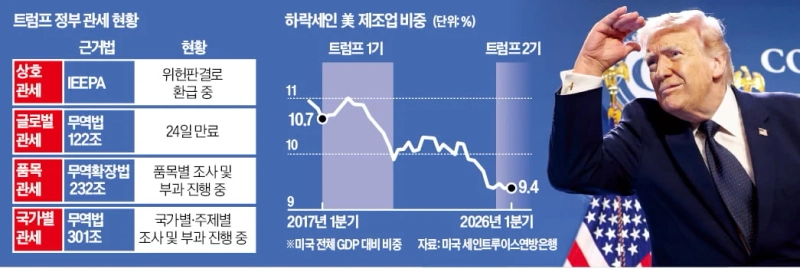
The 10% global universal tariff introduced by President Donald Trump’s second administration in February is due to expire on July 24. After a federal court ruled that Trump’s reciprocal tariffs and fentanyl-related duties imposed under the International Emergency Economic Powers Act were unlawful, the administration quickly introduced the global tariff under Section 122 of the Trade Act, citing balance-of-payments concerns. The measure can remain in force for as long as 150 days. It was intended as a bridge to more tailored country- and sector-specific tariffs under Section 301 of the Trade Act. That has raised the possibility that the administration could announce a new tariff policy around the July 24 deadline.
From temporary tariffs to Section 301
Washington officials said on July 18 that the Office of the U.S. Trade Representative is in the final stages of preparing Section 301 reports on overcapacity and forced labor. Section 301 of the 1974 Trade Act allows the president to impose tariffs and other sanctions in response to unfair or discriminatory trade practices. PBS reported that trade lawyers and analysts are convinced the Trump administration will replace Section 122 tariffs with Section 301 tariffs by the July 24 deadline.
Forced-labor tariffs appear the most likely to come first because they would apply to 60 countries, including South Korea and China. A flat tariff of 10% to 12.5% on those countries would allow the U.S. to keep tariff rates on 99% of imports at or above the current 10% global tariff. The rationale is weak, resting on the claim that those countries are harming the U.S. by failing to do enough to block the circulation of goods made with forced labor. It is also difficult to justify treating China, where numerous forced-labor cases have been reported, the same as other countries. Still, the framework could serve as a second bridge to country-specific tariffs because duties could later be removed if countries sign agreements pledging not to participate in the circulation of forced-labor goods.
Tariffs tied to overcapacity would cover only 16 countries, including South Korea. The claim is that excess production abroad contributes to the U.S. trade deficit. The report is poorly constructed, including arguments that Norway’s large salmon catch contributes to trade imbalances and errors such as classifying Singapore as a surplus country even though the U.S. actually runs a trade deficit with it. The Trump administration has shown little concern. The U.S. government also plans additional Section 301 investigations focused on non-tariff barriers in areas including digital services.
Hard to reverse once imposed
Country-specific tariffs under Section 301 have already begun. Brazil was the first target. After previously threatening a 25% tariff on Brazil, the Trump administration finalized the measure on July 15. It cited Brazilian court orders requiring X, formerly Twitter, Meta and Google to remove certain political content. The administration also pointed to Brazil’s ethanol tariff, illegal deforestation and corruption as grounds for the Section 301 action, arguing that corruption in another country harms U.S. companies and workers.
Taken together, recent developments suggest the Trump administration will set country-specific Section 301 tariffs in a similar fashion. Final tariff rates for each country could come later because the administration still needs justification and procedures to support rates tailored to national circumstances. Trump has signaled that almost anything can be used as a basis for tariffs, including by threatening duties over deteriorating air quality caused by Canadian wildfires.
South Korea secured a pledge capping U.S. tariffs at as much as 15% in exchange for a commitment last year to invest $350 billion in the United States. Trade specialists broadly believe tariffs above that level are unlikely to be imposed on South Korea as a result of Section 301 investigations or other reviews. Trump administration officials have repeatedly delivered that message in meetings with South Korean counterparts, according to people familiar with the matter. Section 301 tariffs, which were used for China during Trump’s first term, are not easy to reverse once imposed. Their structure also makes them harder to adjust frequently than reciprocal tariffs.
It is unclear whether these tariff policies are achieving the Trump administration’s goal of rebuilding U.S. manufacturing. Manufacturing’s share of U.S. gross domestic product has continued to decline. It stood at 10.7% in the first quarter of 2017, when Trump first took office, and fell to 9.4% in the first quarter of this year.
Lee Sang-eun, Washington correspondent, Hankyung.com, selee@hankyung.com

Korea Economic Daily
hankyung@bloomingbit.ioThe Korea Economic Daily Global is a digital media where latest news on Korean companies, industries, and financial markets.