PiCK
US-Iran Conflict Nears Full-Scale War After 2 US Troops Killed, Oil Tops $88
Forecast Trend Report by Period


US launches retaliatory strikes after 2 American troops are killed
The US-Iran conflict is moving closer to full-scale war. Two US troops were killed in Jordan in an Iranian attack, and Iran's supreme leader formally declared last month's provisional ceasefire memorandum void. International oil prices climbed above $88 a barrel, the highest level in more than a month.
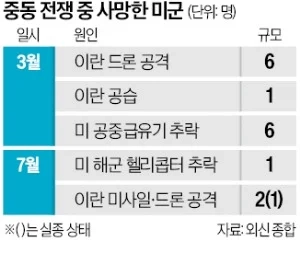
US Central Command said on July 18 that two American troops stationed in Jordan were killed and one was missing while responding to an Iranian attack a day earlier. It was the first time since March that US service members had been killed in a direct Iranian attack. US military deaths since the fighting began in late February have risen to 16.
Iran's latest strike was retaliation for US airstrikes that had continued since July 11. Gulf countries hosting US forces, including Kuwait, Bahrain and Jordan, also came under attack. Mojtaba Khamenei, identified in the article as Iran's supreme leader, said Donald Trump's signature could not be trusted and signaled stronger retaliation.
Energy markets swung sharply. Brent crude settled at $88.10 a barrel on July 17, up 4.6%.
US-Iran war at a crossroads as fears of wider Gulf conflict send oil surging
Retaliatory strikes hit energy hub Qeshm as Iran answers with fresh attacks on Gulf states
The Middle East conflict reached a critical turning point after two US troops were killed in an Iranian attack on July 17. US Central Command responded with retaliatory airstrikes, and Iran widened the conflict to Gulf states hosting American forces. The US attacked Iranian bridges and power facilities, while Iran hit Kuwaiti oil and desalination facilities. The red lines both sides had observed have effectively disappeared.
Retaliation and counter-retaliation
Iran's state-run IRNA news agency and other outlets reported explosions early on July 19 on Qeshm Island, a key Iranian energy logistics hub, and in the port city of Bandar Abbas. The strikes came in retaliation for an attack by Iran's Islamic Revolutionary Guard Corps, or IRGC, on July 17 that killed two US troops and left one missing. Central Command said the operation was intended to swiftly punish the IRGC for its attack on American personnel in Jordan.
This latest round of fighting began with an Iranian drone attack on a cargo ship on June 25. Iran said the vessel had used an alternate route managed by the US. The following day, the US struck Iranian missile and drone bases as well as coastal radar sites. Iran then expanded its attacks to Gulf states hosting US forces, including Kuwait, Bahrain and Qatar.
After Iran repeatedly attacked commercial ships passing through the Strait of Hormuz in July, the US revoked permits for Iranian oil exports and resumed a maritime blockade of ports and crude terminals. Each strike gave way to another reprisal. The latest US troop deaths have heightened concern over Middle East risks. The battlefield in this clash has spread beyond the first confrontation in March. Iran launched simultaneous attacks on US forces in Syria as well as in Kuwait, Bahrain, Qatar and Jordan.
Targets have also shifted from military sites to infrastructure directly tied to civilian life. The US struck bridges, tunnels, power facilities and desalination plants in southern Iran. Iran attacked oil facilities and desalination plants in Kuwait. In Kuwait, where desalination facilities supply about 90% of drinking water, some power-generation equipment also stopped operating.

Oil up 20% in two weeks
There are also concerns that the Red Sea, used as an alternative route for crude exports, could be shut as well. Saudi Arabia has used the route to keep total oil exports at about 4.6 million barrels a day. On July 13, Saudi Arabia and Yemen's government forces bombed Sana International Airport in the Yemeni capital controlled by the Iran-backed Houthi militia.
Houthi rebels launched missiles and drones at Abha International Airport in southern Saudi Arabia. Capital Economics said the global economy could fall into recession if closures in the Red Sea and the Strait of Hormuz persist for a prolonged period or if Saudi pipelines and port facilities suffer heavy damage.
Rising tensions in the Middle East have also shaken global energy markets. September Brent crude futures settled at $88.10 a barrel on July 17 on ICE Futures Europe in London. That was about 22% higher than $71.99 on July 6, just before the US-Iran war resumed.
The outlook is split. One scenario is a return to negotiations. An Iranian delegation is maintaining a mediation channel through Oman. Both sides still have an incentive to prevent a broader war. Another possibility is a prolonged, low-intensity war of attrition. The German Marshall Fund said the US risks being drawn into a deeper quagmire. In that case, crude would likely remain in an $80-to-$90-a-barrel range.
Son Ju-hyung, Hankyung.com reporter handbro@hankyung.com

Korea Economic Daily
hankyung@bloomingbit.ioThe Korea Economic Daily Global is a digital media where latest news on Korean companies, industries, and financial markets.