‘KRW500 Billion Was Supposed to Help’ — Kosdaq Retail Investors Panic After LigaChemBio Sinks 42%
Summary
- The Kosdaq index has fallen 38.56% from its 2026 peak, while daily trading value has dropped into the KRW4 trillion range, deepening concerns over a liquidity drought and weakening price discovery.
- After the launch of single-stock leveraged ETFs, retail money shifted into large semiconductor stocks, worsening Kosdaq flows, while LigaChemBio shares fell 42% despite a KRW500 billion investment from the National Growth Fund.
- The Kosdaq’s rebound remains limited despite support measures including benchmark changes, the National Growth Fund, and tougher delisting rules and a tiered market system, as the market remains structurally overshadowed by large-cap stocks.
Forecast Trend Report by Period


The Kosdaq index’s prolonged slide dragged it on July 21 below the level seen before President Lee Jae-myung took office. Government stimulus measures have failed to revive trading, leaving the market in a liquidity drought where even modest selling can shake prices. Some market participants say the market’s price-discovery function is coming under strain, with daily Kosdaq turnover at less than half the trading value of a single Kospi-listed stock.
The Kosdaq rose 0.49% to close at 753.34 on July 21. Even so, it fell as low as 730.81 during the session, marking its lowest intraday level this year. That was below the 733.97 low on June 2, 2025, the last trading day before Lee took office. On a closing basis, the index is down 38.56% from its 2026 high of 1,226.18 on April 27. That is the steepest drop in a single year since the 2008 global financial crisis, when the index lost nearly 70%.
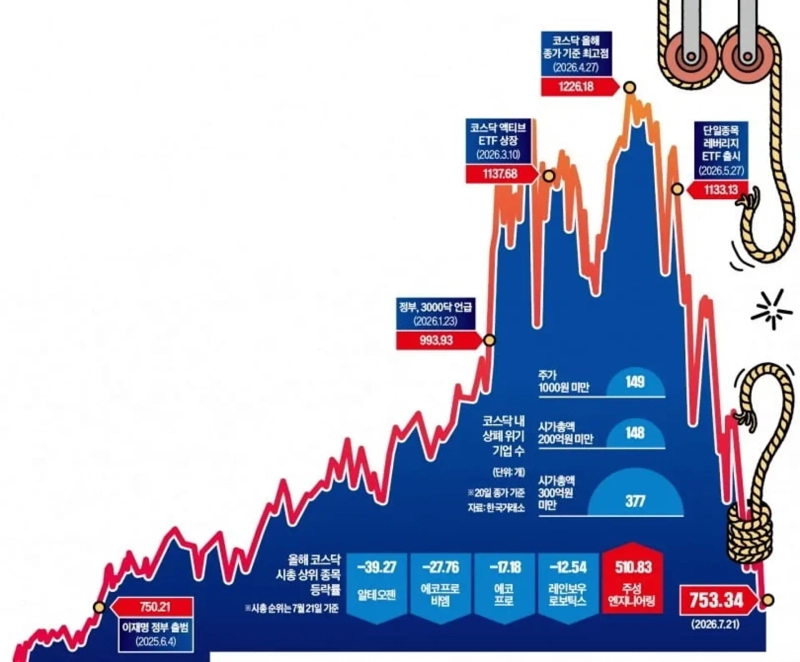
The sharpest pain in the latest downturn has come from shrinking turnover. Daily trading value on the Kosdaq ranged from KRW10 trillion to KRW15 trillion through May. It then fell sharply in June and dropped into the KRW4 trillion range from July 16. That is less than half of SK Hynix’s daily trading value of KRW8.3826 trillion on July 21, even though the chipmaker is only one stock.
Market participants point to the launch of single-stock leveraged exchange-traded funds on May 27 as a key trigger for the breakdown in flows. Retail money chasing high risk and high returns has poured into those products, draining turnover from the Kosdaq.
The steep decline in trading value is also eroding the market’s ability to absorb shocks. Over the past month, the Kosdaq has fallen 22.06%, while trading value has plunged 54.85%.
Even After a Barrage of Stimulus, ‘Kosdaq 1000’ Looks Further Away
Index Down Nearly 40% From Peak, Back Below Pre-Inauguration Levels
The Kosdaq has struggled to recover despite a string of government support measures. Authorities have rolled out steps ranging from benchmark changes to dedicated investment funds, but investors remain focused on large-cap Kospi stocks. In the brokerage industry, the view is that the Kosdaq will remain sidelined unless the market structure funneling liquidity into heavyweight semiconductor shares starts to ease.
According to Korea Exchange, the Kosdaq closed at 753.34 on July 21. That is 38.56% below this year’s high of 1,226.18 reached on April 27. Fueled by a retail-investing boom, the index rose above 1,000 for the first time in four years in late January. It mostly stayed in the 1,000 range until early June, making “Kosdaq 1000” appear to be a new normal. Since then, however, the index has retreated steadily and returned to levels seen a year earlier.
The government has not ignored the Kosdaq. In late January, the government and the Democratic Party first set out a goal of taking the index to 3,000. They later announced and implemented several support measures, including a 5% Kosdaq weighting in the National Pension Service benchmark in January, a March plan for a tiered market system known as the premium segment, and the launch of the National Growth Fund in May.
The market’s response was cold. The Kosdaq briefly rebounded after those policy announcements, only to resume its decline. LigaChemBio is a representative example. The company received a KRW500 billion investment from the National Growth Fund, raising expectations that its shares would rebound. Instead, the stock fell about 42% to KRW90,360 on July 21 from KRW155,800 on June 25, based on closing prices.
Brokerages cite the concentration of money in large-cap stocks as the main reason for the Kosdaq’s weakness. South Korea’s recent stock-market rally has been led by major semiconductor names such as Samsung Electronics and SK Hynix. In particular, those two companies have sharply lifted profit forecasts for the broader Kospi, shifting investor attention from growth potential to proven earnings.
Even on the Kosdaq, semiconductor equipment makers backed by earnings have posted strong gains this year, including Jusung Engineering, up 510.83%, PSK, up 360.70%, and Wonik IPS, up 70.99%. Most of the Kosdaq’s top companies by market capitalization, however, are in biotech and secondary-battery sectors, leaving the market without enough leadership to pull up the broader index.
Single-stock leveraged ETFs launched in May have also drained flows from the Kosdaq. Lee Jae-won, an analyst at Yuanta Securities, said the products let investors take leveraged positions in expensive large-cap stocks with relatively small amounts of money. As a result, even momentum-driven money that had been heading for the Kosdaq has been redirected into individual large-cap semiconductor shares.
What Remains: Tougher Delisting Rules and a Tiered Market
The securities industry expects stricter delisting standards, which began to take effect this month, to improve the Kosdaq’s fundamentals and bolster market credibility. Korea Exchange data show that as of the July 20 close, 149 stocks were trading below KRW1,000 a share and 148 companies had market capitalizations of less than KRW20 billion. A total of 377 companies fall short of the KRW30 billion market-cap threshold that will become a delisting standard next year. Separately, financial authorities plan to introduce the tiered market system in January 2027, giving preferential treatment to stronger Kosdaq companies while allowing general companies to remain in the market.
Even so, market participants say those measures will not be enough to lift the market as a whole. One brokerage official said cases are continuing to emerge in which even large-cap companies damage market trust and move toward delisting. The person added that the new tiered system could concentrate liquidity in the top division while leaving second- and third-tier companies more isolated, raising concerns that companies with strong growth potential could be overlooked.
Jeon Beom-jin and Oh Hyun-ah, Hankyung.com reporters
forward@hankyung.com

Korea Economic Daily
hankyung@bloomingbit.ioThe Korea Economic Daily Global is a digital media where latest news on Korean companies, industries, and financial markets.