PiCK
Foreign Investors Buy 3.5 Trillion Won of Korean Stocks as Retail Traders Sell at Break-Even
Summary
- Foreign investors were net buyers of 3.5147 trillion won on the Kospi market, bringing their cumulative net purchases over the past five trading days to more than 5 trillion won.
- Retail investors were net sellers for a second straight day in near-2 trillion won amounts, led by Samsung Electronics and SK Hynix, limiting the index’s advance.
- Hana Securities said trading that follows foreign buying is appropriate based on past cases, while U.S. Big Tech earnings are poised to shape the market’s next direction.
Forecast Trend Report by Period


Kospi rises for a second straight session but fails to retake 7,000
Korean chip stocks get a lift from rally in U.S. semiconductors
Foreign investors buy 3.5147 trillion won in a day
Retail investors sell nearly 2 trillion won after recouping losses
Big Tech earnings may dictate the market’s next move
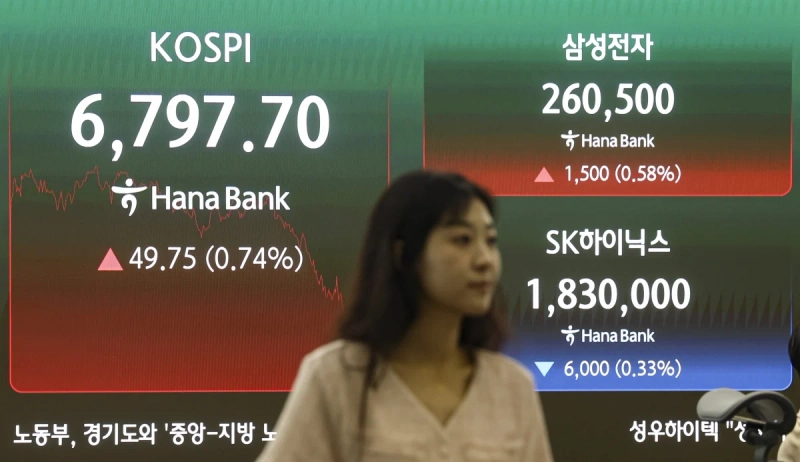
South Korea’s Kospi rose for a second straight trading day, but failed to reclaim the 7,000 mark. Improved sentiment toward global semiconductor stocks drew foreign investors back into the local market, but gains were capped as retail traders battered by the recent selloff moved to sell at break-even levels.
SK Hynix falls despite foreign buying
The Kospi closed 0.74% higher at 6,797.70 on July 22. The benchmark surged more than 6% early in the session, triggering its 20th buy-side sidecar this year and briefly appearing poised to retake 7,000. The rally then lost steam in the afternoon, with the index giving back most of its gains.
Samsung Electronics, which had risen more than 5% and was nearing 280,000 won, finished up just 0.58% at 260,500 won. SK Hynix reversed course late in the session and closed down 0.33% at 1.83 million won. Among the market’s largest companies, Hyundai Motor rose 4.76%, Samsung C&T gained 3.06% and Hyundai Mobis advanced 6.99%.
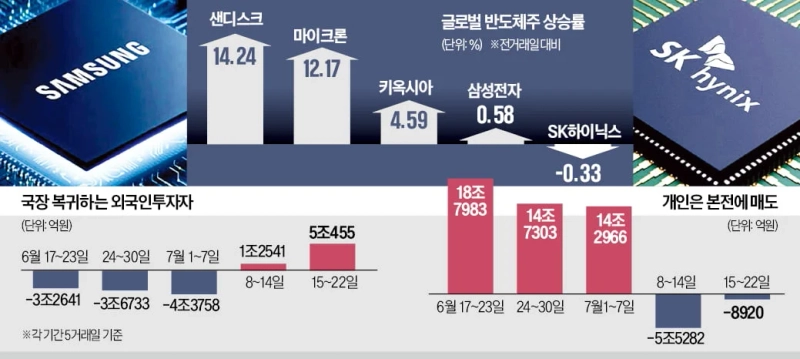
Expectations had been high for a much stronger Kospi rally on July 22 as sentiment toward global semiconductor shares recovered. Micron Technology, which had recently undergone a sharp correction, jumped 12.17% overnight, while SanDisk rose 14.24% and other chip stocks also advanced.
Morgan Stanley and JPMorgan said supply shortages in memory chips would persist and called the recent pullback a buying opportunity, helping revive investor sentiment. Bank of America also said on July 22 that the high-bandwidth memory market would expand sevenfold to $246 billion by 2030, while raising its Micron price target to $1,550.
Foreign investors appeared to embrace that view and stepped up purchases. They were net buyers of 3.5147 trillion won on the Kospi on July 22, extending a buying streak to three straight sessions since July 20. Their cumulative net purchases over the past five trading days exceeded 5 trillion won.
Retail investors log trillion-won selling for a second day
Despite heavy foreign buying, the Kospi ended with only modest gains because retail investors were also strong sellers. Individuals were net sellers of 1.9234 trillion won on the Kospi on July 22, following net selling of 2.2887 trillion won a day earlier. That marked a second straight day of selling near the 2 trillion won level.
The split between foreign and retail investors was especially stark in Samsung Electronics and SK Hynix, two of the market’s bellwether stocks. Foreign investors bought 586.7 billion won of Samsung Electronics and 1.2565 trillion won of SK Hynix, while retail investors sold 113.4 billion won and 222.3 billion won of the two shares, respectively.
The pattern suggests some retail investors who fell into loss-making positions during the recent plunge were trying to avoid losses by selling once share prices returned to their break-even levels.
Similar episodes of foreign buying and retail selling have emerged in past market corrections. Hana Securities said the same pattern appeared during the 2004 China shock and the 2009 Dubai shock. Lee Kyung-soo, an analyst at Hana Securities, said foreign rebalancing purchases and break-even selling by individuals helped the Kospi recover after drops of more than 25%, with the index rising 16% to 26% over the following year. In the current market, he said, trading in line with foreign buying makes sense.
The direction of the Kospi and semiconductor shares may now hinge on U.S. Big Tech earnings, which begin early on July 23 in Korea. Google parent Alphabet starts the reporting cycle that day, followed by Microsoft and Meta on July 30 and Amazon and Apple on July 31.
Lee Kyung-min, an analyst at Daishin Securities, said expectations remain that the semiconductor cycle will continue as investment in artificial intelligence data centers expands. At the same time, concerns persist over whether that spending can be sustained. Investor caution is high ahead of the earnings releases.
Kang Jin-kyu, Korea Economic Daily reporter josep@hankyung.com

Korea Economic Daily
hankyung@bloomingbit.ioThe Korea Economic Daily Global is a digital media where latest news on Korean companies, industries, and financial markets.