Foreign Investors Scoop Up Samsung, SK Hynix as Shares Slump Up to 40%
Summary
- Foreign investors moved in for bargain hunting, snapping up more than 3 trillion won ($2.17 billion) worth of Samsung Electronics and SK Hynix shares on a net basis over three trading days this week.
- As concerns over a peak-out in semiconductor demand and chipflation sent the two stocks down by as much as 39.57% and 31.94%, respectively, some local brokerages cited slowing earnings momentum and rich valuations.
- Morgan Stanley, just two weeks after urging a short-term underweight stance, said the recent share-price weakness in semiconductor stocks was an excellent buying opportunity, highlighting an unusual cycle driven by AI data-center demand.
Forecast Trend Report by Period


SK Hynix down 40% from its June peak
Foreign investors step in to buy the dip
Morgan Stanley shifts from urging lower chip exposure to calling it a buying opportunity in two weeks
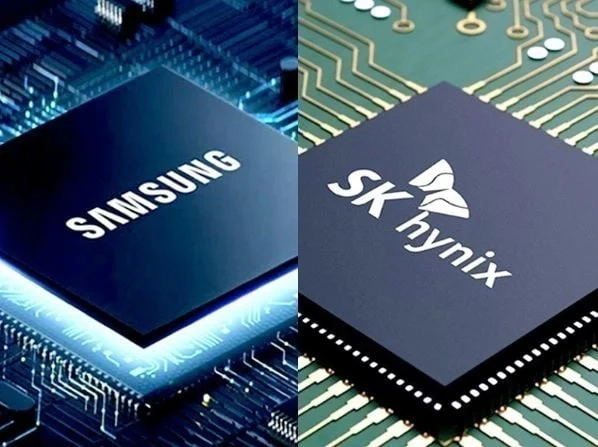
Foreign investors have been net buyers of South Korean stocks each day this week, with most of the buying concentrated in Samsung Electronics and SK Hynix. Semiconductor shares have tumbled on concern that memory-chip demand tied to artificial intelligence investment could peak earlier than expected, but overseas investors appear to be treating the selloff as a bargain-hunting opportunity.
Data from the Korea Exchange showed foreign investors were net buyers of 4.5771 trillion won ($3.31 billion) of shares on the Kospi over the three trading sessions through July 22.
Samsung Electronics and SK Hynix dominated those purchases. Foreign investors bought a net 1.2565 trillion won ($908.5 million) of SK Hynix shares and 586.7 billion won ($424.0 million) of Samsung Electronics stock on July 22 alone. Over the three sessions, net buying totaled 1.5638 trillion won ($1.13 billion) in Samsung Electronics and 1.4819 trillion won ($1.07 billion) in SK Hynix.
The buying spree appears to reflect dip buying after steep share-price declines. SK Hynix fell 39.57% from a closing high of 2.919 million won on June 22 to 1.764 million won on July 20. Samsung Electronics dropped 31.94% from 358,500 won on June 25 to 244,000 won on July 20.
The slide gathered pace after Samsung Electronics reported preliminary second-quarter earnings on July 7 that far exceeded expectations. Strong results prompted a rush of profit-taking.
Robust profitability at Micron Technology and Samsung Electronics also fueled fears that chip demand may be peaking. Micron, which derives most of its earnings from memory chips, posted an 80.4% operating margin in the third quarter of fiscal 2026. Samsung Electronics reported a 52.3% operating margin for the second quarter even though its results include a non-memory chip business that remained in the red through the first quarter.
Concern over so-called chipflation also mounted after Apple raised prices on major products because of surging memory-chip prices and signaled a willingness to buy Chinese-made memory semiconductors. That sharpened worries that higher chip prices could crimp AI investment. Strong investor demand for the initial public offering of Chinese memory-chip maker ChangXin Memory Technologies, or CXMT, added to fears of a shift in semiconductor supply and demand.
Bearish views on chip stocks also emerged from local brokerages. Lee Min-hee, an analyst at BNK Investment & Securities, wrote in a note issued after the close on July 8 that SK Hynix's earnings momentum would weaken after year-end and that the stock was not cheap based on estimates for next year and beyond. He assigned a neutral rating and a target price of 1.85 million won. SK Hynix closed at 2.076 million won that day, making the call tantamount to a sell recommendation.
Sentiment deteriorated further over South Korea's Constitution Day holiday on July 17 after news reports said Chinese AI startup Moonshot's Kimi K3 model delivered performance comparable with frontier models from OpenAI and Claude.
Kim Dong-won, head of research at KB Securities, pushed back on those concerns. He said worries that more efficient algorithms after the release of Kimi K3 could lead to lower AI spending and weaker memory demand would probably prove short-lived, much like concerns that surfaced when DeepSeek and TurboQuant emerged.
He likened the issue to fuel efficiency in cars. Better mileage may appear to reduce gasoline consumption, but lower driving costs can increase how often people use their vehicles and lift overall fuel demand. By that logic, more efficient algorithms are not necessarily a negative for the semiconductor industry.
Kim also disputed concerns about slowing earnings momentum. A rising share of long-term supply agreements, or LTAs, should raise the portion of sales to big tech companies and AI data centers to as much as 70%, he said. That would help smooth earnings volatility and improve profit visibility, supporting higher valuations.
The arguments behind the semiconductor selloff, and the counterarguments, have surfaced repeatedly in past cycles. When shares rise and investors lock in gains, worries tend to dominate. When stocks fall too far and a rebound begins, optimistic views return.
Morgan Stanley said in a July 5 report that the narrow rally led by semiconductor stocks was drawing to a close and that market leadership was beginning to broaden. The bank recommended cutting short-term exposure to chipmakers and raising weightings in hyperscalers.
By July 20, though, Morgan Stanley analyst Joseph Moore called the recent weakness a compelling entry point. The current memory-chip cycle is highly unusual because it is being driven solely by strong demand from AI data centers rather than following the pattern of past cycles, he wrote.
Han Kyung-woo, Hankyung.com reporter case@hankyung.com

Korea Economic Daily
hankyung@bloomingbit.ioThe Korea Economic Daily Global is a digital media where latest news on Korean companies, industries, and financial markets.