Alphabet Boosts 2026 Capex Forecast to $195 Billion-$205 Billion, Easing Chip Peak-Out Fears
Summary
- Alphabet said it raised this year’s capital expenditure forecast to $195 billion-$205 billion on the back of demand for AI infrastructure.
- Alphabet said it will continue AI infrastructure investment even after second-quarter free cash flow fell to negative $5.85 billion, the first deficit since its 2004 listing.
- The market viewed Alphabet’s aggressive AI investment as a positive for semiconductor companies, helping lift shares of Samsung Electronics and SK Hynix.
Forecast Trend Report by Period


Plans More Spending Despite Negative Free Cash Flow
Chip Stocks Rally as Samsung, SK Hynix Gain
Alphabet, Google’s parent, plans to increase capital spending further, citing strong demand for artificial intelligence. The move helped push concerns over a semiconductor-cycle peak into the background.
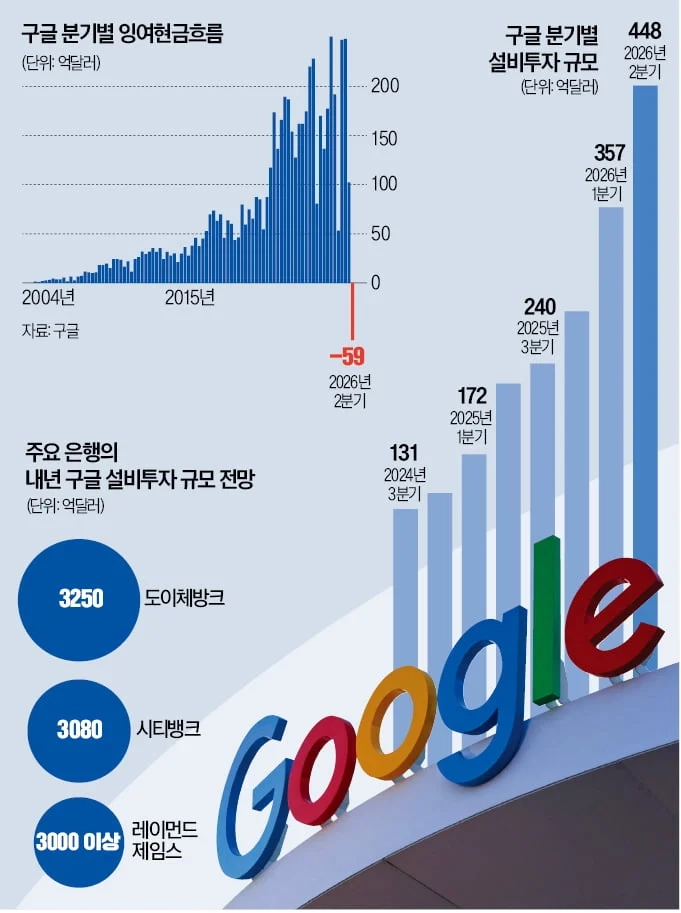
On a conference call after releasing second-quarter earnings on July 22, Alphabet raised its full-year capital expenditure forecast to $195 billion-$205 billion from $180 billion-$190 billion.
Chief Financial Officer Anat Ashkenazi said investment in AI infrastructure next year will be "meaningfully higher." That spending is being supported by growth in cloud computing, where Alphabet sells AI infrastructure to outside customers. Second-quarter cloud revenue jumped 82% from a year earlier to $24.8 billion.
Alphabet plans to keep investing as long as returns remain attractive. The company is expanding spending even as cash flow turns negative. Free cash flow, which was $10.12 billion in the first quarter, fell to negative $5.85 billion in the second quarter. It marked Alphabet’s first negative free-cash-flow quarter since its 2004 Nasdaq listing.
Investors viewed Alphabet with some caution, but its spending outlook was a boon for semiconductor shares. On July 23, Samsung Electronics rose 3.65% to 270,000 won, while SK Hynix climbed 4.86% to 1,919,000 won.
Alphabet CEO Says Conditions Are Better Than a Year Ago
First Free Cash Flow Deficit Since 2004 Listing
"Even the most reliable cash generator is now spending more than it earns."
That was Reuters’ verdict on July 22 after Alphabet posted negative free cash flow of about $5.9 billion in the second quarter, the first such result since its 2004 Nasdaq debut. Free cash flow is the cash left after a company deducts essential investment costs such as expansion and equipment maintenance from operating cash flow generated by its core business.
Google and YouTube Are Still Throwing Off Cash
Alphabet, which owns Google and YouTube, dominates the global online advertising market. Its margins are bolstered by its dominant position and sales strength. As a result, it consistently generates billions, and at times tens of billions, of dollars in cash each quarter.
Alphabet remained highly profitable in the second quarter. Revenue in the business segment that includes search rose 17% from a year earlier to $94.5 billion. YouTube advertising revenue increased 13%, and subscriptions and platforms revenue rose 15%. Total second-quarter revenue climbed 24% from a year earlier to $119.7 billion, topping market expectations of $117.2 billion. Operating cash flow from the core business rose 41% from a year earlier to $39.1 billion.
But capital spending increased even faster. Alphabet spent $44.9 billion on capex in the second quarter, more than double the year-earlier level. Most of it went to AI infrastructure such as data centers.
AI Infrastructure Demands Still More Spending
Alphabet is fully aware that free cash flow has turned negative. But it is not in a position to stop. The company’s strategy is to use AI infrastructure investment to accelerate growth across its businesses. As a full-stack company spanning AI infrastructure, AI models and applications, Alphabet believes it needs more computing resources to defend its market position.
Chief Executive Officer Sundar Pichai said on July 22 that the top priority in resource allocation is AI model development. Building large language models requires buying graphics processing units and constructing more data centers. Developing Google’s tensor processing units, which it has introduced as an alternative to GPUs, also requires heavy spending. Google released three models the previous day, including Gemini 3.6 Flash, but it is still viewed as trailing OpenAI and Anthropic in leading-edge model capabilities.
Infrastructure is also needed for Google Cloud, which leases AI infrastructure, and for improving the efficiency of YouTube and search advertising through AI. Alphabet said it is also considering using so-called neo-cloud providers such as Nebius and CoreWeave, which rent out GPUs, to bridge any gap until its own infrastructure build-out is complete.
‘Better Than a Year Ago’
Alphabet’s cash shortfall underscores the commitment of US Big Tech to AI infrastructure spending. Shay Boloor, chief market strategist at Futurum Equities, said Big Tech had been an asset-light platform business where revenue grew much faster than investment, but is now becoming a hybrid model dependent on data centers and AI infrastructure spending.
It also shows the AI race among Big Tech is becoming a financing race. Alphabet issued $30.5 billion of common stock and $19.1 billion of convertible preferred stock in the second quarter alone. It also raised $24.8 billion through corporate bonds.
Ashkenazi said the company first examined how much spending could be covered by cash generated from operations before turning to borrowing. In other words, Alphabet tapped external financing only after using available cash. Pichai projected confidence: "If anything, I think the situation is better than it was a year ago, so we are investing with confidence."
Kim In-yeop, Silicon Valley correspondent, Korea Economic Daily, inside@hankyung.com

Korea Economic Daily
hankyung@bloomingbit.ioThe Korea Economic Daily Global is a digital media where latest news on Korean companies, industries, and financial markets.