Gold Slumps More Than 20% as Central Banks Boost Holdings
Summary
- Gold has fallen more than 20% from its earlier peak this year, with August gold futures and the gold ETF (GLD) both posting sharp declines.
- Global central bank gold purchases rose to 243 metric tons in the first quarter, while China expanded its gold holdings, pointing to stronger buy-the-dip demand.
- Demand for hedges against U.S. stocks and the need for portfolio diversification are increasing, adding to the case that gold's investment value could rise further.
Forecast Trend Report by Period


Down more than 20% since the Middle East war
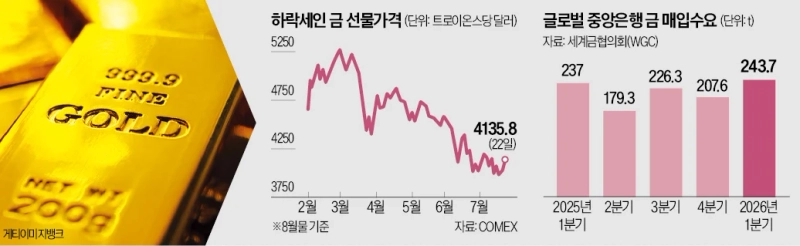
August gold futures at $4,135.8
WSJ: Price slide offers a buying opportunity
Investors increase purchases as a hedge against U.S. stocks
Gold has fallen more than 20% since the outbreak of the U.S.-Iran war in February. Investors accustomed to years of gains in bullion have been rattled. Still, some on Wall Street view the pullback as a buying opportunity. Central banks including China have been increasing gold purchases as they diversify reserve assets.
Central banks including China and Poland buy more gold
August gold futures settled at $4,135.8 a troy ounce on the Comex in New York on July 22. That was about 22% below the record $5,318.4 reached earlier this year. SPDR Gold Shares, the flagship gold exchange-traded fund listed in New York under the ticker GLD, also fell to $379.1, about 23.5% below its peak of $495.9 earlier this year. Analysts have pointed to the U.S.-Iran war as the trigger for the drop in gold prices.
The move runs counter to gold's usual pattern. Geopolitical risk typically drives investors toward haven assets such as bullion. Gold rose sharply after Russia invaded Ukraine in 2022. This time, markets focused more on the possibility that higher energy prices could fuel inflation. That would increase the odds that the Federal Reserve keeps interest rates elevated for longer or raises them further. Gold does not pay interest, so rising rates make it less attractive than Treasuries and other yield-bearing assets. "Gold has performed best when real interest rates, which reflect inflation, decline," Giovanni Staunovo, a strategist at UBS Chief Investment Office, said.
Calls have been growing on Wall Street to treat the correction in gold prices as a chance to buy. A key bullish argument is that central banks around the world have steadily increased purchases this year. The World Gold Council said central banks bought 243 metric tons of gold in the first quarter, up about 17% from the previous quarter. The buying reflects a broader effort by countries including China and Russia to diversify reserves, reduce reliance on the dollar and limit exposure to sanctions. China's State Administration of Foreign Exchange said the country's foreign-exchange reserves stood at $3.4163 trillion as of June, down 0.75%, or $26 billion, from a month earlier. Its gold holdings, however, rose by 480,000 troy ounces from the previous month to 75.44 million troy ounces.
The Wall Street Journal reported that rumors had circulated that some Middle Eastern countries were selling gold to secure liquidity, but Turkey was the only case of large-scale selling that was actually confirmed. The newspaper said rising central-bank gold holdings during a geopolitical crisis underscore the metal's value as a reserve asset.
Countries facing geopolitical threats are also buying aggressively. Poland's central bank led the world in gold purchases in the first quarter. It bought 31 metric tons on a net basis in the quarter as it prepared for the military threat from Russia.
Gold also seen as a hedge for U.S. equities
Some market participants are also raising the possibility that the Fed could delay policy decisions. Earlier this month, Fed Chair Kevin Warsh announced the creation of five task forces to study the causes of U.S. inflation, the effects of artificial intelligence on productivity, employment and prices, and a review of the central bank's large bond holdings and reserve system. Warsh said he expected most recommendations by the end of this year. Some investors, however, think the findings could take much longer. That has prompted scenarios in which the Fed delays policy action and fuels inflation, or confirms a cooling in enthusiasm for AI investment and then moves to cut rates.
Rising demand for hedges against volatility in U.S. equities is also supporting interest in gold. The rally in U.S. stocks driven by the AI investment boom has increased the need for assets that can protect portfolios against an unexpected shock. The Wall Street Journal said portfolio diversification is important in preparing for unforeseen shocks to equities and that gold's investment appeal could grow further.
Kim Dong-hyun

Korea Economic Daily
hankyung@bloomingbit.ioThe Korea Economic Daily Global is a digital media where latest news on Korean companies, industries, and financial markets.