Trump Builds Tariff Bridge With 10% Global Levy, 12.5% Forced-Labor Duties
Forecast Trend Report by Period


The US will begin imposing retaliatory tariffs of 10% to 12.5% on 60 countries, including South Korea, saying they failed to do enough to prevent trade in goods made with forced labor.
The Office of the US Trade Representative said on July 23 it will start levying the duties at 12:01 a.m. Eastern time on July 24 on 60 trading partners that either have not adopted import bans on products made with forced labor or have enforced them inadequately. The measure is being taken under Section 301 of the Trade Act.
Tariff rates will vary depending on how far each country has gone in enforcing bans on forced-labor goods, the USTR said. A 10% tariff will apply to 17 countries, including Canada, Mexico and the UK, that already have such import bans in place or have pledged to adopt them through reciprocal trade agreements. For the European Union and Taiwan, the combined tariff rate will be capped at 10%.
By contrast, the remaining countries, including China, Russia and Vietnam, will face a 12.5% tariff because their import-control frameworks are deemed insufficient. For South Korea, Japan and Switzerland, the total tariff rate will be adjusted so that the most-favored-nation tariff and the Section 301 tariff together do not exceed 12.5%.
The move is part of the Trump administration's effort to put replacement duties in place after the US Supreme Court ruled in February that reciprocal tariffs and fentanyl tariffs were unlawful. The administration then immediately announced a global 10% tariff under Section 122 of the Trade Act instead of relying on the International Emergency Economic Powers Act, or IEEPA, which the court had blocked. But the Section 122 tariff lasts only 150 days, and that period expired on July 24.
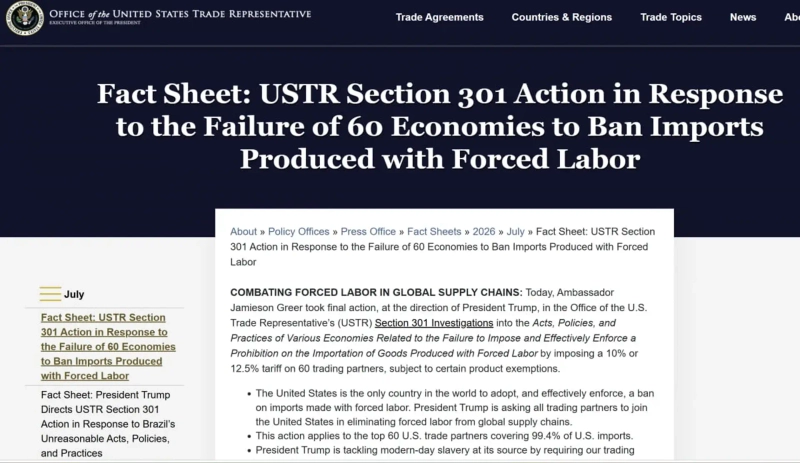
The Trump administration ultimately wants to use Section 301 of the Trade Act to introduce country-specific and sector-specific tariffs. That process takes time. To buy more of it, the administration attached a Section 301 rationale that effectively replaces the global tariff. The forced-labor tariff functions as a temporary bridge. Once additional investigations into oversupply and digital trade are added and country-by-country consultations determine final tariff rates, the forced-labor tariff may lose much of its practical effect as broader caps on combined duties are put in place.
The USTR said more than 471 product categories will be excluded from the tariff action, including raw materials that cannot be sourced in the US and products whose taxation could cause major disruption across the economy. Exemptions include certain animal products, seeds, wood, semiconductor manufacturing equipment and pharmaceutical ingredients.
The announcement also included a three-year temporary tariff-rate quota program for Bangladesh, Cambodia, Indonesia and Malaysia. Under the program, certain apparel products from those four countries will be exempt from Section 301 tariffs if they use US cotton and textile inputs instead of raw materials from other countries deemed to carry high forced-labor risk. US Trade Representative Jamieson Greer said the measure is intended to root out forced labor, which he described as modern slavery, from global supply chains and create a level playing field that protects US workers.
Lee Sang-eun, Washington correspondent, Hankyung.com, selee@hankyung.com

Korea Economic Daily
hankyung@bloomingbit.ioThe Korea Economic Daily Global is a digital media where latest news on Korean companies, industries, and financial markets.