Lutnick Says U.S.-Korea Shipbuilding Project Will Be Judged by Ships Built in America
Summary
- Commerce Secretary Howard Lutnick said the U.S.-Korea Shipbuilding Cooperation Center will be judged by the number of ships built in the United States, capital invested and facilities modernized.
- Lutnick said South Korea's plan to direct $100 billion to shipbuilding cooperation out of its $350 billion investment commitment to the United States is an opportunity to take part in the revival of the U.S. shipbuilding industry.
- Lutnick said the Commerce Department would remove regulatory barriers to help South Korean companies expand in the United States, underscoring Washington's commitment to the MASGA U.S.-Korea shipbuilding cooperation project.
Forecast Trend Report by Period


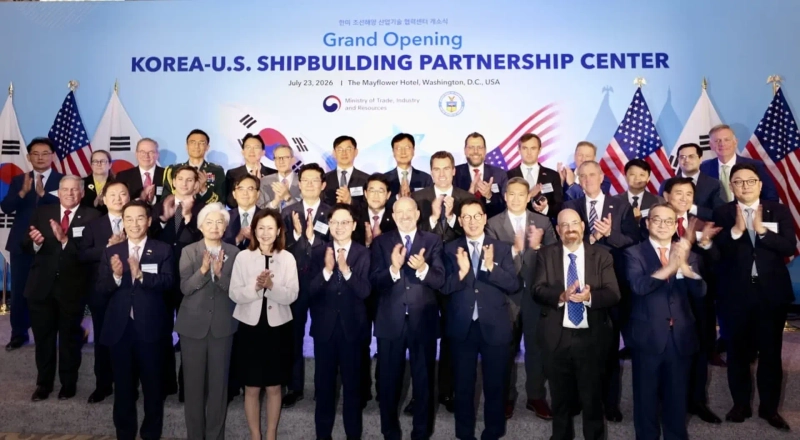
U.S. Commerce Secretary Howard Lutnick said on July 23 that the success of the U.S.-Korea shipbuilding project known as MASGA will be measured by output from U.S. shipyards, as the two countries launched a joint shipbuilding cooperation center to push the initiative forward.
At the opening ceremony at Washington's Mayflower Hotel, Lutnick said the center itself was not the end goal. The priority, he said, is to deliver results in the form of ships actually built. "There is no value in just talking," he added.
What matters most, Lutnick said, is building ships in the United States. The point is not to talk about shipbuilding in America or hold meetings about it. It is to build ships there.
He said President Donald Trump is committed to restoring the United States as a top-tier shipbuilding power. The country must train American shipyard and steel workers, strengthen domestic producers and build a resilient supply chain. It also needs to build every type of naval and commercial vessel at home, he said.
The core of Lutnick's message was pressure to produce tangible results. He said the center would not be judged by the number of meetings it holds, memorandums of understanding it signs or cocktail parties it hosts. Instead, he said, it will be measured by straightforward metrics: capital invested, facilities modernized, workers trained, supply chains established and, ultimately, the number of ships built in the United States through cooperation between the two countries. Lutnick said Trump had set that standard.
Lutnick also referred to South Korea's pledge to direct $100 billion of its $350 billion U.S. investment commitment to shipbuilding cooperation. He said the pledge meant more than a headline number. It is an opportunity to take part in the revival of one of the world's most important industries and in the resurgence of the U.S. shipbuilding business.
He also told South Korean government and business officials at the event to contact the Commerce Department if they encounter obstacles while expanding in the United States or feel the business environment is not fully welcoming. The department would remove regulatory barriers so they can operate in the country, he said.
The U.S. government, however, has not been able to address key restrictions such as the Byrnes-Tollefson Amendment governing warship construction in the United States, saying the matter is up to Congress. For commercial vessels, officials have also not addressed the fact that production costs are four to five times higher than in South Korea or China.
Kim Jung-kwan, South Korea's trade, industry and energy minister, focused on underscoring Seoul's commitment. Kim said South Korea strongly supports Trump's maritime action plan and is ready to work with the United States. MASGA will make American shipbuilding great again, he said, adding that the two countries will build naval vessels and liquefied natural gas carriers in the United States.
Hundreds of officials from both countries attended the event. U.S. participants included Lutnick and Deputy Secretary William Kimmitt from the Commerce Department; Anthony Fisher, chief of staff at the Maritime Administration; acting Navy Secretary Hung Cao; acting Under Secretary William Toti; and Michelle Steel, the new U.S. ambassador to South Korea. Steel was attending her first official event in that role.
The highlight of the ceremony was the signing of about 10 business agreements. Patrick Kelly, chief executive officer of Fraser Industries; Dino Mavrookas, chief executive officer of Saronic Technologies; and Francesco Valente, chief executive officer of Vigor Marine Group, were among the U.S. executives who took the stage. They were joined by South Korean business leaders including Jeong In-seob, president of Hanwha Ocean; Kim Hyeong-gwan, chief executive officer of HD Korea Shipbuilding & Offshore Engineering; Choi Seong-an, chief executive officer of Samsung Heavy Industries; Yoo Sang-cheol, chief executive officer of HJ Shipbuilding & Construction; and Kim Shin, executive vice president of HMM. The executives pledged cooperation and posed for commemorative photos. The event ended with participants from both countries shouting the Korean cheer "Fighting" at the emcee's cue.
Lee Sang-eun, Washington correspondent, Hankyung.com, selee@hankyung.com

Korea Economic Daily
hankyung@bloomingbit.ioThe Korea Economic Daily Global is a digital media where latest news on Korean companies, industries, and financial markets.