$40 Billion Leaves Demand Deposits and Brokerage Cash in a Month as Funds Pour Into Time Deposits
Forecast Trend Report by Period


$39.8 billion in sidelined cash disappears this month
As the stock-market rally cools and rates rise,
money returns to deposits in a defensive shift
Demand deposits at South Korea’s five biggest banks have dropped by more than 40 trillion won so far this month, while investor cash balances at brokerages have fallen by nearly 15 trillion won. The move reflects investors shifting into time deposits after a monthlong stock-market correction and higher deposit rates following the Bank of Korea’s benchmark-rate increase.
According to the financial industry on July 26, demand deposits at KB Kookmin Bank, Shinhan Bank, Hana Bank, Woori Bank and NH NongHyup Bank stood at 681.2585 trillion won ($493.7 billion) as of July 23. That was down 41.0343 trillion won ($29.7 billion) from the end of June. If the trend continues through month-end, it would mark the biggest monthly decline since July 2022, when balances fell 38.2454 trillion won. Personal deposits dropped 14.9242 trillion won ($10.8 billion), while corporate deposits fell 22.8006 trillion won ($16.5 billion). Demand deposits are considered a typical source of cash waiting to be deployed because customers can withdraw them at any time.
Investor cash balances at securities firms stood at 104.2975 trillion won ($75.6 billion) as of July 26, down 17.3365 trillion won ($12.6 billion) this month. The total had climbed to 136.8314 trillion won ($99.2 billion) on June 23, shortly after the Kospi reached a record 9,114.55, but the buildup reversed as the market entered a correction.
Time deposits at the five banks rose 22.3374 trillion won ($16.2 billion) this month to 971.7372 trillion won ($704.2 billion). The shift in cash flows came after the Bank of Korea raised its benchmark rate to 2.75% from 2.50% and banks subsequently lifted deposit rates. “With stock-market volatility increasing, time deposits offering more than 3% have become more attractive,” a banking industry official said.
Time-deposit rates at the five major banks top 3%; investment in fixed-rate products such as bonds also rises
As the benchmark-rate increase coincides with a stock-market correction, household and corporate cash is moving into fixed-rate products such as time deposits and bonds. Demand deposits at the five biggest banks and investor cash balances at brokerages have fallen sharply this month, while more than 22 trillion won ($15.9 billion) has flowed into time deposits. Companies are also pulling money from accounts that allow free deposits and withdrawals and placing surplus funds in products yielding 3% to 4%.
Retail investors turn to interest income
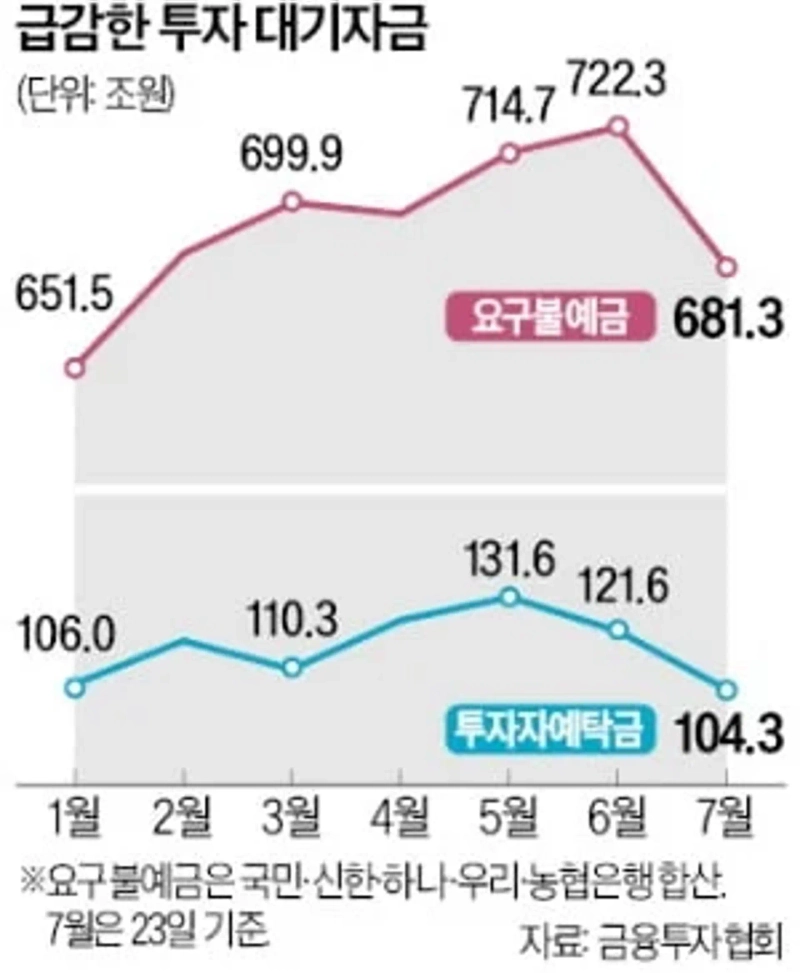
According to the financial industry on July 26, demand deposits at KB Kookmin Bank, Shinhan Bank, Hana Bank, Woori Bank and NH NongHyup Bank totaled 681.2585 trillion won ($493.7 billion) as of July 23, down 41.0343 trillion won ($29.7 billion) this month. Investor cash balances at brokerages, a gauge of money waiting to enter the stock market, also fell 17.3365 trillion won ($12.6 billion) over the same period to 104.2975 trillion won ($75.6 billion).
As the once-surging stock market entered a correction in the second half, cash that had been sitting on the sidelines began moving in earnest. Time deposits at the five major banks rose 22.3374 trillion won ($16.2 billion) this month to 971.7372 trillion won ($704.2 billion). Personal time deposits alone increased by 5.7322 trillion won ($4.2 billion).
After the Bank of Korea raised its benchmark rate to 2.75% from 2.50%, banks also moved quickly to lift deposit rates. NH NongHyup Bank and Hana Bank raised the top rates on flagship time deposits to 3.2% on July 23, putting time-deposit rates at all five major banks in the 3% range. Savings banks, credit unions and Saemaeul Geumgo have also offered products with top rates of about 4.3%.
Companies also shift into deposits and bonds
Companies are also putting sidelined cash to work more actively. Corporate demand deposits at the five major banks stood at 282.4022 trillion won ($204.6 billion) as of July 23, down 22.8006 trillion won ($16.5 billion) from the end of June. Money market deposit accounts, or MMDAs, which pay interest even on one-day deposits, also fell 10.6774 trillion won ($7.7 billion) this month.
In the first half, many companies had parked money in MMDAs while deciding how to invest, taking into account the possibility of further rate increases. But with time deposits now offering rates in the 3% range, more companies are choosing them over demand deposits. Companies placing large sums can secure rates in the mid- to high-3% range even at the five major banks.
Investment in fixed-rate products offering higher yields than bank deposits, including bonds and commercial paper, has also increased. SK Hynix bought several hundred billion won worth of Samsung Securities corporate bonds and Mirae Asset Securities commercial paper this month. The Samsung Securities bonds carried rates of 4.319% to 4.547%, depending on maturity, while the Mirae Asset Securities commercial paper yielded 4.01%. The financial investment industry estimates SK Hynix has invested more than 10 trillion won ($7.2 billion) in bonds over the past one to two months.
Financial industry officials said more money could move into deposits and bonds. “This is not an easy environment for stock-market investing, so more companies are looking for relatively safe fixed-rate products with higher yields,” a senior corporate-banking executive at a commercial bank said. “At current yields, the mood is that these products are worth buying.”
Kim Jin-seong / Bae Tae-woong, Korea Economic Daily reporters jskim1028@hankyung.com

Korea Economic Daily
hankyung@bloomingbit.ioThe Korea Economic Daily Global is a digital media where latest news on Korean companies, industries, and financial markets.