Coupang, Woori Bank Join Forces to Target Won Stablecoin Market
Summary
- Coupang said it signed a strategic business agreement to cooperate on blockchain-based payment technology with Woori Bank, stepping up its push into the won stablecoin market.
- Coupang and Woori Bank said they will continue technical testing in areas including payments, remittances, merchant settlement and conversion between stablecoins and won, a move that could speed cash turnover and reduce fee burdens.
- If won stablecoins circulate within the Coupang ecosystem through payment, settlement and repeat spending, that could reduce payment and settlement costs and help Woori Bank gain an edge in the future competition over won-backed coins.
Forecast Trend Report by Period


Tie-up targets blockchain-based payments
Coupang Eats tests real-time settlement technology
Faster cash turnover could ease merchants’ burden
Fees may drop if customer and seller use expands
Coupang Inc. has joined forces with Woori Bank to enter the won-denominated stablecoin market. The alliance between South Korea’s largest retail platform, which handles more than 77 trillion won ($55.6 billion) in annual payments, and a commercial lender with payments infrastructure pushes the competition for leadership in the won stablecoin market into a new phase.
◇ Coupang Has a Large Payment Network
Coupang said on July 27 that it signed a strategic business agreement with Woori Bank to strengthen cooperation on blockchain-based payment technology. The two companies plan further technical testing in payments, remittances, merchant settlement and conversions between won stablecoins and cash, timed to the formal introduction of rules for won stablecoins.
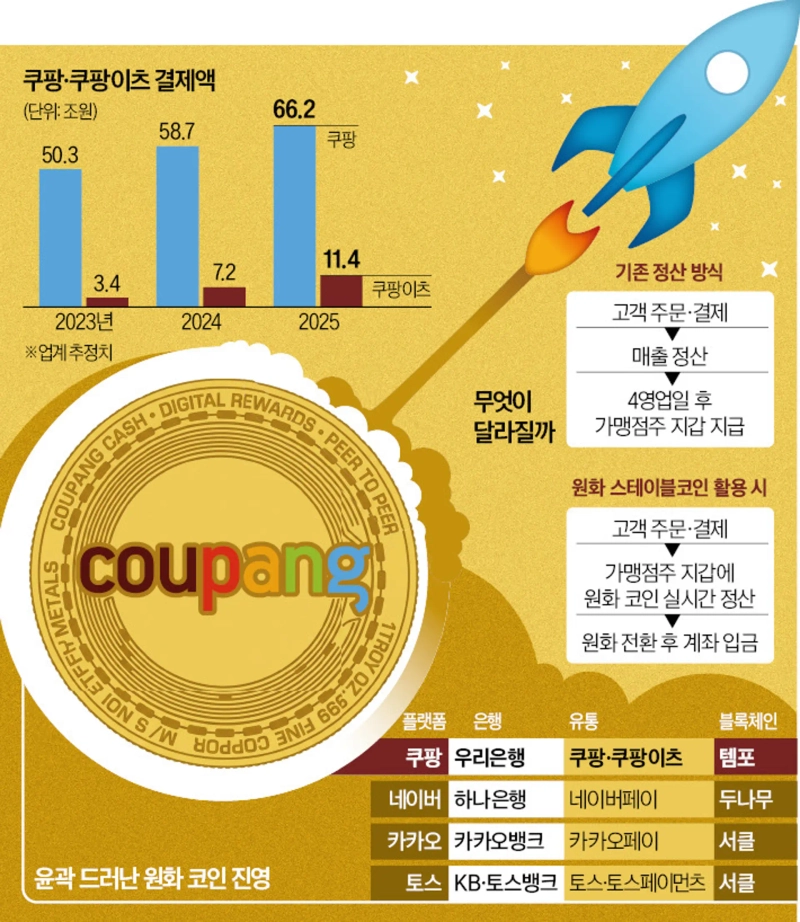
Until now, discussions about won stablecoins have centered on banks, fintech companies and the digital-asset industry, with a focus on who would issue the coins and how consortia would be formed. For stablecoins to take hold in everyday use, however, broad and repeatable payment acceptance matters as much as issuance.
That has made Coupang one of the most closely watched players in the won stablecoin market. The company operates a large transaction network built on recurring purchases of goods and food delivery. Coupang’s estimated payment volume last year was 66.3 trillion won ($47.9 billion). Including Coupang Eats, the total exceeds 77 trillion won ($55.6 billion).
Coupang Eats alone offers a gauge of the potential impact of stablecoin settlement. Merchants on the platform now receive settlement funds only after four business days have passed since a customer places and pays for an order. With stablecoins, settlement could be made almost in real time. That would speed cash turnover for small business owners. Coupang Eats’ estimated annual payment volume of 11.4 trillion won ($8.2 billion) translates to about 31.2 billion won ($22.5 million) a day on a simple basis. Over four days, that amounts to 125 billion won ($90.2 million). That helps explain why Coupang emphasized shared growth and inclusive finance in its announcement. Before signing the agreement, Coupang and Woori Bank tested a process for remitting and settling Coupang Eats order payments to merchants in real time through stablecoins.
◇ Potential to Expand Into Remittances
Coupang’s base of 24 million customers, along with its marketplace sellers and restaurant merchants, is another advantage. If consumers pay with won stablecoins on Coupang and Coupang Eats and sellers receive those same assets in settlement, one platform could handle both payments and settlement.
Sellers and merchants could also use the won stablecoins they receive to pay for Coupang goods or services instead of converting them immediately back into cash. That would create a cycle in which won stablecoins keep circulating within the Coupang ecosystem through payment, settlement and repeat spending. In turn, payment and settlement costs, including fees tied to card networks, could fall sharply. The savings would increase as stablecoins are reused more widely within the ecosystem. Over the medium to long term, if linked to global payment networks, the system could also lower payment and remittance costs among Coupang’s overseas affiliates.
The alliance is also significant for Woori Bank. Until now, the lender had been viewed as lacking a clear partner compared with other financial companies in the race to build won-backed digital-coin alliances. The partnership with Coupang could strengthen its position in that competition. A Woori Bank official said demand is emerging, especially among large companies, for payment and settlement services using stablecoins, and the bank will look for opportunities to work with other businesses.
Cho Mi-hyun, Hankyung.com reporter mwise@hankyung.com, Oh Yu-rim, Hankyung.com reporter our@hankyung.com

Korea Economic Daily
hankyung@bloomingbit.ioThe Korea Economic Daily Global is a digital media where latest news on Korean companies, industries, and financial markets.