CSIS Urges Korea to Shift From Export Powerhouse to AI Ecosystem Leader
Summary
- CSIS said South Korea is facing the limits of its export powerhouse model as it contends with China’s rise and pressure from the US.
- As a solution, it said Korea needs to build a technology, standards and certification ecosystem centered on the AI industry, semiconductors and HBM to become an ecosystem powerhouse.
- CSIS also said Korea should use national capital from the National Pension Service and Korea Investment Corporation, along with a South Korea-US advanced technology joint fund, to build a technology ecosystem the world depends on.
Forecast Trend Report by Period


Avoiding a Decline in Korea’s Chip Industry
Korea Must Shift From Export Powerhouse to Ecosystem Powerhouse
CSIS Report
Export-Led Manufacturing Model Is Reaching Its Limits
Korea Needs to Secure Semiconductor Standards and Certification
What strategy does South Korea need to sustain its current boom as it navigates China’s rise and mounting pressure from the US? The Center for Strategic and International Studies said Korea must evolve from an “export powerhouse” into an “ecosystem powerhouse.”
The report argues that Korea’s manufacturing model, built on volume production, is nearing its limits. To maintain an outsized lead, it says, the country needs to secure core technologies and standards first. That means controlling key chokepoints in the artificial intelligence industry so the global economy becomes dependent on Korea, making a “second Miracle on the Han River” possible.
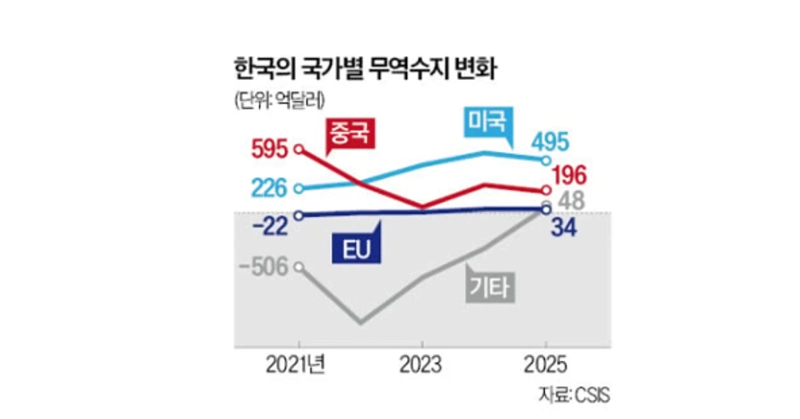
In a recent report titled “Export Nation or Ecosystem Powerhouse: Korea’s Choice in the AI Era,” CSIS said South Korea posted exports of $709.7 billion and a trade surplus of $78 billion last year. Exports reached a record high, while the trade surplus was the largest since 2017. Semiconductor exports rose 22% from a year earlier to $173.4 billion.
CSIS said those headline figures mask risks building across Korean industry. Exports to China, long a pillar of the Korean economy, are steadily shrinking. Korea’s trade surplus with China fell more than 80% to $19.6 billion in 2025 from $99.7 billion in 2018.
Navin Girishankar, head of the Economic Security and Technology Department at CSIS, said Chinese companies are replacing Korean products in major industries including home appliances, batteries, petrochemicals and electric vehicles, eroding Korea’s manufacturing competitiveness.
Pressure from the US, Korea’s largest source of trade surplus, is also a concern. Washington is pressing a manufacturing revival agenda that includes tariff pressure on Korean companies and demands for local production bases. At home, low birthrates pose another challenge. Korea recorded a total fertility rate of 0.75 in 2024, the lowest in the Organization for Economic Cooperation and Development, making it harder to secure the labor force that underpins cost competitiveness.
CSIS said the answer to that three-way challenge is to become an ecosystem powerhouse. Rather than remaining a mass producer of goods, Korea should move first to develop the standards, certification systems and platforms that shape global markets and give it control over key gateways in the AI industry.
CSIS cited high-bandwidth memory made by Samsung Electronics Co. and SK Hynix Inc. as a prime example. Korean companies hold more than 80% of the global HBM market. That dominance helps explain why global big tech companies, amid rising AI investment, are coming to Korea to sign long-term supply agreements.
The report also cited Korea Zinc Co.’s rare-earth processing project in Tennessee and Hanwha Group’s shipbuilding, offshore and defense businesses as holding strategic positions in global markets.
CSIS also said Korea should use its capital strength as a strategic weapon. Major Korean investment institutions, including the National Pension Service and the Korea Investment Corporation, should put to work $1.5 trillion of national capital, according to the report.
It also called for broader cooperation with allied countries that are home to big tech companies through vehicles such as a South Korea-US advanced technology joint fund, and for faster efforts to build a shared technology ecosystem. Korea should create a technology ecosystem that the global economy cannot do without and use it to achieve a “second Miracle on the Han River,” the report said.
Kang Hae-ryeong
Kang Hae-ryeong, Hankyung reporter, hr.kang@hankyung.com

Korea Economic Daily
hankyung@bloomingbit.ioThe Korea Economic Daily Global is a digital media where latest news on Korean companies, industries, and financial markets.