Goldman Says Korean Won Is Asia's Top FX Bet as AI Boom Boosts Exports
Summary
- Goldman Sachs said the South Korean won, Taiwan dollar and Malaysian ringgit are likely to outperform other Asian currencies, supported by AI-related investment and strong semiconductor exports.
- Goldman Sachs said South Korea's AI-driven semiconductor exports will help nearly double the country's current-account surplus this year to 13.9% of GDP, making the South Korean won one of its most favored foreign-exchange investment destinations.
- Goldman Sachs said it is maintaining a bullish three-month outlook on the South Korean won, Taiwan dollar, Chinese yuan and Malaysian ringgit, while keeping a bearish view on the Thai baht and Indonesian rupiah.
Forecast Trend Report by Period


"Asia macro markets driven by AI investment and energy supply shocks"
"Won fundamentals back in focus as foreign outflows slow"
South Korea's current-account surplus seen nearly doubling to 13.9% of GDP this year
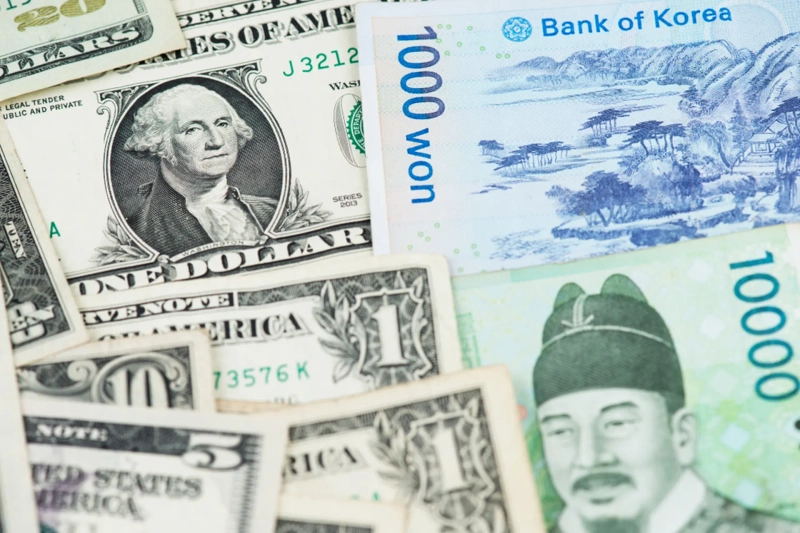
Goldman Sachs said artificial intelligence-related investment is reshaping Asian foreign-exchange markets, with the South Korean won and Taiwan dollar set to outperform regional peers.
CNBC Pro reported on July 27 that Goldman identified two main drivers for Asia's macro markets this year: energy supply shocks and the AI investment boom. Against that backdrop, the won, Taiwan dollar and Malaysian ringgit were among the currencies the bank expects to outperform, supported by their close links to supply chains and a surge in semiconductor exports despite the energy shock.
By contrast, Goldman expects the Thai baht, Philippine peso, Indonesian rupiah and Indian rupee to underperform. Those currencies have less exposure to the AI supply chain and are more vulnerable to higher energy costs.
The US Dollar Index has risen about 3% this year, supported by higher oil prices, the Federal Reserve's hawkish policy stance, yuan stability and the war in the Middle East. Even so, Goldman said exchange-rate moves across Asia will be driven more by AI investment trends than by broad dollar strength as long as the investment boom continues.
Goldman identified South Korea as one of its most bullish foreign-exchange calls. The bank said AI-driven semiconductor exports have lifted the country's current-account surplus to record levels and projected this year's surplus at about $300 billion, or 13.9% of gross domestic product, nearly double from a year earlier.
Foreign selling of South Korean stocks in the first half offset the current-account surplus and weighed on the won, Goldman said. More recently, capital outflows have slowed, bringing the currency's strong external fundamentals back into focus.
Taiwan was also named as a favored market. Goldman expects the Taiwan dollar to remain firm, supported by strong semiconductor exports that have generated Asia's largest trade surplus. The bank estimates Taiwan's current-account surplus will rise 40% to 70% this year to 25% of GDP.
Taiwan is expected to keep rates unchanged. Still, strong technology exports and large dollar deposits should continue to support the currency.
The yuan has also drawn attention as the only Asian currency to strengthen against the dollar this year despite the broader advance in the greenback.
"China's economy is growing on the back of strong performance in advanced manufacturing and related sectors, but overall economic activity remains sluggish," Goldman Sachs said.
Goldman said the yuan remains undervalued and that strong exports and policymakers' push to internationalize the currency should support further gains. It kept its 12-month forecast for the dollar-yuan exchange rate at 6.50.
Goldman, however, took a neutral view on the Singapore dollar. The bank said AI-led growth and contained inflation are supporting the economy, but the currency has limited room for further gains if rates remain on hold. Singapore's central bank unexpectedly tightened monetary policy on July 27.
Goldman remains bearish on the Thai baht and Indonesian rupiah. Thailand is under pressure from falling gold prices and lower real interest rates, while Indonesia continues to face concerns over policy uncertainty and governance despite several measures to attract foreign capital. The Philippine peso is also expected to be sensitive to higher oil prices because of the country's heavy reliance on energy imports.
Overall, Goldman maintained a bullish three-month outlook on the South Korean won, Taiwan dollar, Chinese yuan and Malaysian ringgit, while keeping a bearish stance on the Thai baht and Indonesian rupiah.
Kim Jeong-a, contributing reporter

Korea Economic Daily
hankyung@bloomingbit.ioThe Korea Economic Daily Global is a digital media where latest news on Korean companies, industries, and financial markets.