SK Hynix Outlook Splits Between Solid AI Demand and Oversupply Fears After 2Q Miss
Summary
- Brokerages said SK Hynix’s second-quarter revenue and operating profit came in about 5% below market expectations.
- Most brokerages said the company’s fundamentals remain solid, citing AI demand, long-term supply agreements (LTAs) and favorable supply-demand conditions.
- Some raised oversupply concerns tied to a macro slowdown, reduced capital spending and large-scale capacity expansion.
Forecast Trend Report by Period


Operating Profit Misses Market Expectations by About 5%
Most Analysts Remain Bullish on Steady AI Demand
Some Cite Aggressive Capacity Expansion as a Risk
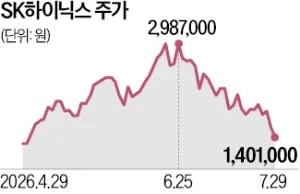
Brokerages were sharply divided over SK Hynix Inc.’s second-quarter results. The dominant view was that the company’s fundamentals remain solid on strong artificial intelligence demand and that the recent drop in its share price was overdone. Others took a more cautious stance, citing weaker macroeconomic indicators and the risk of oversupply from competitive capacity expansion.
According to EpicAI, an AI-based investment platform, the average brokerage estimate for SK Hynix’s second-quarter revenue and operating profit was 83.6253 trillion won ($60.5 billion) and 63.5951 trillion won ($46.0 billion), respectively, on July 29. The company reported revenue of 79.3187 trillion won ($57.4 billion) and operating profit of 60.5426 trillion won ($43.8 billion), both roughly 5% below market expectations.
Most brokerages came within 5% of the actual operating profit figure. The exceptions were Kiwoom Securities, which forecast 71 trillion won ($51.4 billion), for an error of 17.3%, and Hana Securities, which estimated 67.6 trillion won ($48.9 billion), for an error rate of 11.6%. In a report issued after the conference call, Lee Su-rim of DS Investment & Securities wrote that both revenue and operating profit were broadly in line with estimates, while the operating margin exceeded market assessments.
Views diverge more sharply on the outlook. For third-quarter operating profit, the gap between the highest estimate, 90.414 trillion won ($65.4 billion) from Hana Securities, and the lowest, 69.0404 trillion won ($50.0 billion) from Korea Investment & Securities, reaches about 30%.
The prevailing view on the Street was that the earnings release confirmed the AI demand cycle driving SK Hynix’s results remains intact. Han Dong-hee of SK Securities wrote that SK Hynix had finalized long-term supply agreements, or LTAs, with about 10 key customers, securing mid- to long-term business stability. Favorable supply-demand conditions, with demand outpacing supply, should persist for a considerable period, he added.
Lee also wrote that the share of conventional DRAM production will rise in earnest in the second half, helping average selling prices remain firm versus the second quarter. No clear sign of oversupply has emerged yet, and quarterly operating profit growth should continue through the fourth quarter of 2027.
Some analysts raised concerns about a macroeconomic slowdown and weaker corporate capital spending. Lee Min-hee of BNK Investment & Securities wrote that spot NAND flash prices have been falling since late April as consumer demand deteriorates, while the OECD’s leading economic index has also turned downward. Hyperscalers are shifting their AI capital spending toward greater cost efficiency even as manufacturers continue to announce large capacity expansions, heightening the risk of oversupply.
Jeon Beom-jin, Hankyung.com reporter, forward@hankyung.com

Korea Economic Daily
hankyung@bloomingbit.ioThe Korea Economic Daily Global is a digital media where latest news on Korean companies, industries, and financial markets.