Kospi Panic Spreads After First Back-to-Back Circuit Breakers as Leverage Fuels Fears of a Deeper Rout
Summary
- The Kospi recorded its first-ever circuit breakers on two straight days and a historic monthly decline of 28.9%.
- Single-stock leveraged ETFs tied to Samsung Electronics and SK Hynix amplified volatility, with retail investors’ cumulative losses estimated at about $38.7 billion.
- Goldman Sachs and Morgan Stanley said that if the Kospi breaks below the 6,800 and 6,000 support levels, the index could fall further toward the 6,100-to-6,000 range.
Forecast Trend Report by Period


First-ever circuit breakers on two straight days
Monthly slump exceeds IMF-era record
Investors ask how far the market can fall
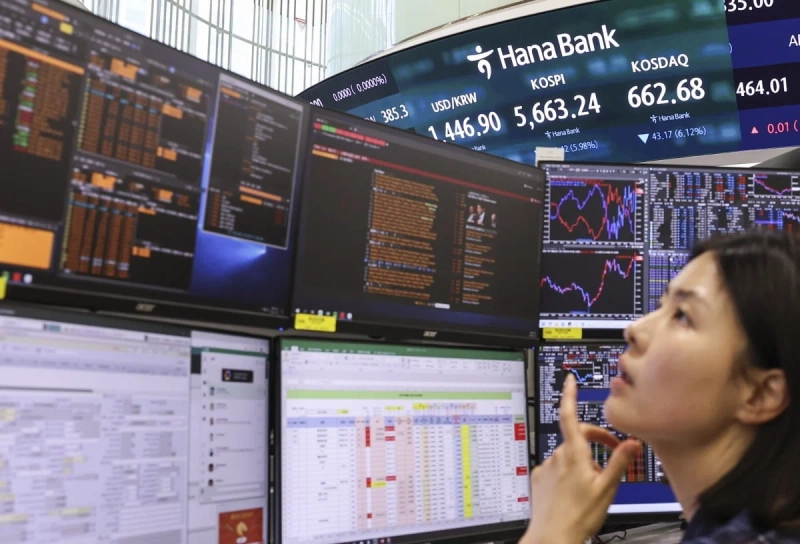
Panic gripped South Korea’s stock market on July 29 after a circuit breaker, which halts trading for 20 minutes, was triggered for a second straight day for the first time in the market’s history. Brokerages attributed the surge in volatility to a mix of single-stock leveraged exchange-traded funds, concerns over China’s semiconductor advances and worries about slowing global artificial intelligence investment. Investors are also struggling to gauge where the market will find a true bottom.
EpicAI, an AI-based investment information platform, said the Kospi closed at 5,663.24, down 5.98% from the previous session. The benchmark fell as low as 5,262.77 intraday after another circuit breaker was triggered, before trimming some of its losses late in the day. It was the first time South Korean stocks had seen circuit breakers on two consecutive trading days.
As of July 28, the Kospi had already posted a monthly decline of 28.9%, the steepest on record. That surpassed the previous record drop of 27% in October 1997. The earlier collapse came as South Korea was pushed to the brink during the Asian financial crisis and an International Monetary Fund bailout, making the current selloff all the more shocking to market participants in Seoul’s Yeouido financial district.
Market participants largely blame the steep decline on single-stock leveraged ETFs tied to Samsung Electronics Co. and SK Hynix Inc., products introduced by the government in late May. South Korea’s cabinet approved the launch on April 21, and the enforcement decree was promulgated on April 28, a week later. On May 27, 16 underlying ETFs tied to Samsung Electronics and SK Hynix, along with two exchange-traded notes, were listed simultaneously.
The government has since announced related measures, but they appear to have done little to cool retail sentiment. From July 1 through July 29, individual investors were net buyers of 1.1584 trillion won ($837 million) of KODEX Leverage.
On July 28, when the Kospi plunged more than 10%, retail investors snapped up leveraged ETFs. They kept buying on July 29 even as the Kospi sank as much as 12% intraday. Individual investors were net buyers of 266 billion won ($192 million) of KODEX Leverage and 64.8 billion won ($46.9 million) of KODEX 200.
Brokerages say the recent surge in volatility has sharply increased losses from leveraged ETF investments. Mohamed Apabai, head of Asia-Pacific trading strategy at Citi Global Markets Securities, estimated in a market commentary for institutional investors that retail investors in leveraged ETFs tied to Korean assets have accumulated losses of about $38.7 billion.
With the Kospi extending its sharp drop for a second day, fear is spreading over where the market’s true floor lies. As recently as last week, investors were looking for a rebound around the 6,800 level. In just two days, however, the index has shed more than 1,000 points, leaving the market scrambling to find a new support zone in the 5,000 range.
Goldman Sachs identified mechanical selling from single-stock leveraged ETFs tied to Samsung Electronics and SK Hynix as a key source of pressure and called 6,800 the Kospi’s most important technical support level. If that level fails, the next support is 6,500. A break below that could send the index down to the 6,100-to-6,000 range. Morgan Stanley said in a recent report that it expects the Kospi to trade in a 6,000-to-9,000 range over the next three to six months, while many local strategists had also viewed 6,000 as the floor.
Yet the Kospi has already broken below 6,000 and is now searching for a new bottom. Market participants cite anxiety over the successful Shanghai listing of Chinese memory chipmaker CXMT, along with fears related to the development of deep ultraviolet lithography equipment by Chinese state-owned companies. They also point to a sharp deterioration in the underlying strength of South Korea’s equity market. Investor sentiment has collapsed after six circuit breakers were triggered across the Kospi and Kosdaq in July alone.
“The growth outlook and earnings of companies remain solid, but vague anxiety in the market is crushing sentiment and keeping stocks from gaining traction,” Kim Yong-gu, an analyst at Yuanta Securities, said. “In this environment, good earnings and corporate value alone are not enough to stop the downtrend.”
“At this point, with the trend so distorted that the 6,000 level can break intraday, the more important question is whether investors should sell now and exit stocks, or hold on and wait for a rebound opportunity later,” Han Ji-young, an analyst at Kiwoom Securities, said.
Kang Kyung-ju, Hankyung.com reporter qurasoha@hankyung.com

Korea Economic Daily
hankyung@bloomingbit.ioThe Korea Economic Daily Global is a digital media where latest news on Korean companies, industries, and financial markets.