PiCK
Kospi Enters Historic Undervaluation as Investors Eye Beaten-Down Large Caps
Summary
- Brokerages said the Kospi's 12-month forward P/E of 4.8 and P/B of 1.2 show valuations have fallen to historic lows, limiting the room for further declines.
- They said curbs on single-stock leveraged ETFs could ease the concentration of funds in Samsung Electronics and SK Hynix, channel money into the Kosdaq market and policy beneficiaries, and reduce stock-market volatility.
- Brokerages advised short-term trading and closer attention to oversold large-cap stocks, semiconductor shares, heavily fallen main-board large caps and the Kosdaq market and small caps.
Forecast Trend Report by Period


12-month forward P/E at 4.8, below Covid-pandemic levels
If single-stock leveraged ETF curbs take effect
Kospi volatility may gradually ease
Funds concentrated in chip stocks such as Samsung, SK Hynix
Policy beneficiaries and Kosdaq shares may attract inflows
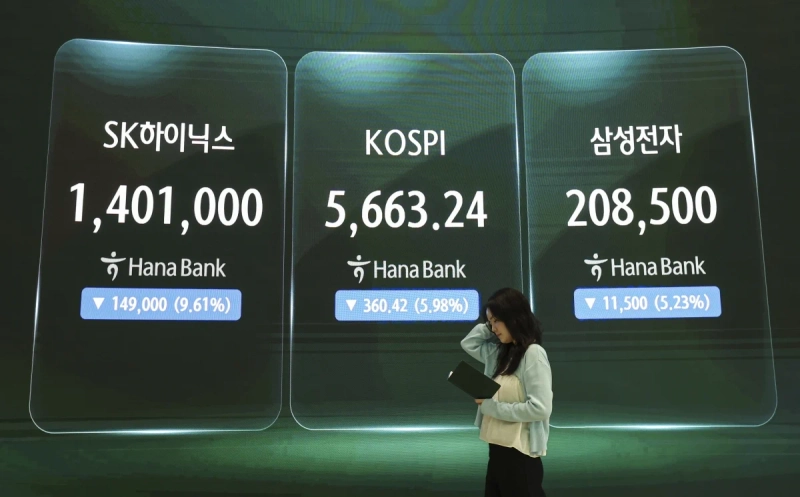
The Kospi has slid from the 7,000 level to the 5,500 range in one week, fueling investor anxiety. Retail investors who had bought in anticipation of a rebound dumped 5.4 trillion won over the past two trading days. Market strategists say the benchmark's valuation has fallen to a historic low relative to earnings, limiting the scope for another sharp selloff.
Kospi Closes at 5,593.56
According to the Korea Exchange, the Kospi closed down 1.23% at 5,593.56 on July 30. The decline was far smaller than the sharp selloff on July 28 and July 29, when circuit breakers were triggered in back-to-back sessions. Retail investors, who had stepped in on dips each time the index fell, turned net sellers of 1.5992 trillion won on the day. Foreigners and institutions were net buyers of 1.489 trillion won and 82.7 billion won, respectively. The index rose as much as 5.5% intraday on bargain hunting after a 16.81% plunge over the previous two sessions, but later reversed and closed lower as profit-taking emerged.
Samsung Electronics, which reported final earnings on the day, fell 0.72%. SK Hynix dropped 5.64%. The decline reflected weaker risk appetite after a surge in long-term US Treasury yields and a retreat in technology stocks, along with a string of brokerage cuts to SK Hynix price targets.
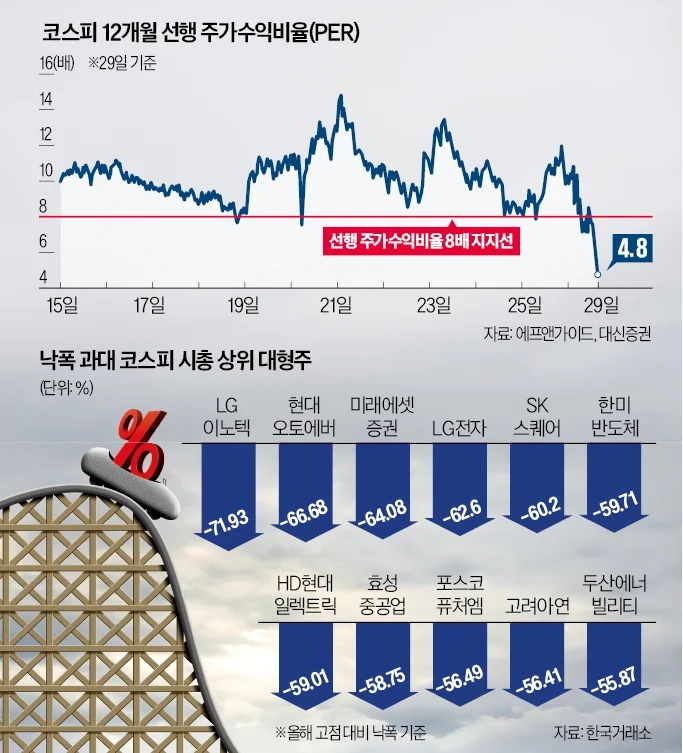
Brokerages say the Kospi's 12-month forward price-to-earnings ratio has fallen to 4.8, below levels seen during the global financial crisis and the Covid-19 pandemic, making the recent decline look excessive. Further downside would be limited unless an economic slump on the scale of the financial crisis is repeated. Lee Jae-won, an analyst at Yuanta Securities, said tensions between the US and Iran should ease from August and international oil prices should also stabilize. He added that if curbs on single-stock leveraged exchange-traded funds are implemented at the end of July, repeated short-term trading and the concentration of flows into large-cap stocks could ease, helping lower market volatility over time.
Valuations also reflect excessive pessimism on a price-to-book basis. Youm Dong-chan, an analyst at Korea Investment & Securities, said the Kospi's estimated 12-month forward return on equity is about 25%, while its 12-month forward price-to-book ratio is 1.2. That suggests market worries have been overdone from a valuation standpoint.
'Short-Term Trades in Oversold Large Caps'
Brokerages say investors should avoid rushing to dump market leaders in a panic and instead focus on semiconductor shares backed by earnings and large-cap stocks that have fallen excessively. If rules on single-stock leveraged ETFs begin to take effect, funds concentrated in Samsung Electronics and SK Hynix could spread into the Kosdaq market and policy beneficiaries, improving flows across the broader market.
Kospi-listed stocks that have fallen sharply from their highs this year include LG Innotek (-72.29%), Hyundai AutoEver (-66.36%), Mirae Asset Securities (-63.96%) and LG Electronics (-62.78%). DB Financial Investment said large-cap stocks on the main board face little risk of delisting and tend to see less price distortion from heavy trading during market shocks because of ample liquidity. Statistically, when a stock's maximum drawdown from its previous peak reaches the 45% to 50% range, shares rose in six out of 10 cases, with average returns of 4.5% to 4.9%, the brokerage said. That drawdown range produced the strongest excess returns compared with other decline bands.
Some strategists also recommend looking at overlooked parts of the market if Kospi earnings momentum slows. Kim Sung-no, an analyst at BNK Investment & Securities, said investors may need to shift attention to the previously neglected Kosdaq market and small-cap stocks if earnings forecasts continue to diverge.
Cho Ah-ra, Korea Economic Daily reporter rrang123@hankyung.com

Korea Economic Daily
hankyung@bloomingbit.ioThe Korea Economic Daily Global is a digital media where latest news on Korean companies, industries, and financial markets.