Samsung Electronics Earnings Call Eases Chip Fears, Offers Basis for Stock Rebound
Summary
- Samsung Electronics said its second-quarter earnings release provided concrete details on HBM4 supply, the status of long-term agreements, and its capital spending stance, helping lay the groundwork for a recovery in investor sentiment.
- Samsung Electronics said contracts covering 60% to 70% of total production capacity through long-term agreements, along with prepayments of up to 25% and price floors, would help improve free cash flow, or FCF, and support the downside in the stock.
- Global investment banks and brokerages said the update helped ease debate over an early end to the semiconductor supercycle, secured demand visibility through 2029, and clarified the direction of shareholder returns, helping revive semiconductor investment sentiment.
Forecast Trend Report by Period


Early rebound fades as stock ends slightly lower
JPMorgan says update may help put a floor under shares
Securities firms described Samsung Electronics Co.'s second-quarter earnings conference call on July 30 as a model response that helped calm uncertainty and fear surrounding the semiconductor outlook. The company provided specific figures and a roadmap on the market's main questions, including supply of sixth-generation high-bandwidth memory, or HBM4, the status of long-term agreements and its capital spending stance. Analysts said that helped lay the groundwork for a recovery in investor sentiment.
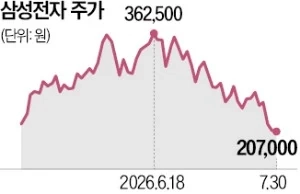
Samsung Electronics closed at 207,000 won, down 0.72% from the previous session on South Korea's benchmark stock market. The shares opened at 214,000 won and rebounded sharply from 10 a.m., when the conference call began, touching an intraday high of 226,000 won at about 10:49 a.m. Late profit-taking sent the stock back into negative territory. Even so, market participants largely viewed the presentation as resolving much of the debate over an early end to the semiconductor supercycle.
Samsung laid out the business visibility investors had been seeking. Management said it had finalized five-year long-term agreements with five global data-center customers and five additional clients. Those contracts cover 60% to 70% of total production capacity. The agreements also specify prepayments of as much as 25% and price floors, terms that should help improve free cash flow.
Global investment banks and domestic brokerages responded favorably. JPMorgan said management's comments on firm supply-demand conditions and steps to build a more stable business structure should provide meaningful downside support for the stock, even if that comes at the cost of some near-term upside. The bank also viewed it positively that Samsung made clear severe memory shortages would continue not only next year but through 2028. Lee Su-rim, an analyst at DS Investment & Securities, said long-term agreements covering 60% to 70% of total capacity secured mid- to long-term demand visibility through 2029.
The company's detailed disclosure on divisional performance, business conditions and shareholder returns also drew positive reviews as an improvement in communication with the market. Lee Kyung-min, an analyst at Daishin Securities, said Samsung helped revive sentiment toward semiconductor investments by providing specific details on HBM4 sales, the size of its long-term agreements, the direction of shareholder returns and utilization at its foundry business, unlike SK Hynix, which reported earnings a day earlier.
Jeon Beom-jin, Hankyung.com reporter, forward@hankyung.com

Korea Economic Daily
hankyung@bloomingbit.ioThe Korea Economic Daily Global is a digital media where latest news on Korean companies, industries, and financial markets.