Exclusive: South Korea, US and Japan Mount Unprecedented Three-Way FX Coordination, Sending Won and Yen Soaring
Forecast Trend Report by Period


Moon Ji-sung says South Korea coordinated with the US and Japan
Seoul and Tokyo sold dollars, while the US backed the move with a rate check
Three-way framework took shape this year before the joint intervention
Won reaches strongest level in nine months; yen jumps into 157 per dollar
"The foreign-exchange authorities of South Korea, the US and Japan are coordinating."
Moon Ji-sung, director general for international economic management at South Korea’s Ministry of Economy and Finance, made the remark in an interview with the Korea Economic Daily on July 31.
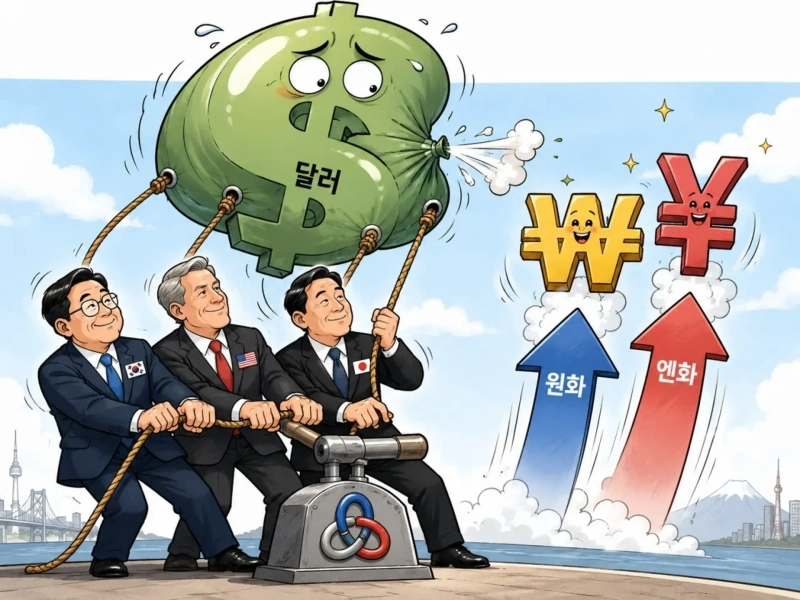
South Korean, US and Japanese currency authorities intervened in the foreign-exchange market simultaneously for the first time under mutual coordination, according to people familiar with the matter. South Korea and Japan sold dollars during the same trading window, while the US supported the move with a rate check. The unprecedented three-way coordination sent both the won and the yen sharply higher against the dollar.
Moon, a vice minister-level official at the ministry, said South Korea is in frequent coordination with the US and Japan and that the three sides stay in contact through hotlines and other channels. That coordination culminated in the simultaneous market intervention, market participants say.
In the foreign-exchange market, the won-dollar and yen-dollar rates fell sharply at roughly the same time the previous night.
The won strengthened from 1,437.40 per dollar at 3:30 p.m. the previous day to 1,419 at 10:44 p.m. It closed at 1,418 at 6 a.m. on July 31, its lowest level since Oct. 16, 2025, when it stood at 1,417.90. That marked the won’s strongest level in about nine months.
The yen also surged. After trading in the 163 range against the dollar the previous afternoon, the yen-dollar rate briefly moved into the 157 range late that night. The Nikkei reported that Japan’s government and the Bank of Japan intervened in the market by buying yen and selling dollars. South Korea’s foreign-exchange authorities also entered the market at around the same time by buying won and selling dollars, according to people familiar with the matter.
US monetary authorities also conducted a rate check around the same time, asking market participants for trading quotes and signaling the possibility of intervention. A rate check is typically interpreted as a strong warning signal ahead of actual intervention. It remains unclear whether the US directly sold dollars, but it effectively tolerated the South Korean and Japanese operations and helped temper the dollar’s strength.
Traders say the three countries viewed the recent parallel weakness in the won and yen as an issue requiring a joint response. One foreign-exchange market official said South Korea’s authorities had been in frequent contact with their US and Japanese counterparts this year, strengthening their coordination. That cooperation materialized in the previous day’s three-way action, the person said.
South Korean and Japanese authorities recently shared concerns over excessive weakness in their currencies and agreed to respond closely together. With the US joining in, what had been bilateral coordination between Seoul and Tokyo expanded into what market participants describe as the first three-way foreign-exchange operation.
Atsushi Mimura, Japan’s vice finance minister for international affairs and a key figure in the country’s foreign-exchange policy, attended the opening ceremony for Korea Investment Corp.’s Tokyo office on July 7. He said he was in especially close contact with his South Korean counterpart and would continue that cooperation. Moon said the same day that South Korea and Japan were in frequent contact, underscoring their willingness to work together.
Earlier, on June 12, Moon visited Washington and met senior US Treasury officials. Market participants say that meeting helped flesh out the framework for three-way foreign-exchange coordination among South Korea, the US and Japan.
The unprecedented coordination is also fueling expectations that the won will remain firm for some time. The won-dollar rate climbed as high as 1,555.80 on July 1, but has fallen by more than 130 won in a month.
Changes in market flows also supported the won. A key factor, analysts say, was the conversion into won of proceeds tied to SK Hynix’s American depositary receipt listing. Increased dollar selling by exporters ahead of August corporate tax prepayments also added to the decline in the exchange rate.
A sharp recent correction in South Korean equities also played a role by slowing foreign investors’ repositioning of their domestic stock holdings. Improved macroeconomic conditions were another factor behind the won’s strength. Stronger-than-expected second-quarter growth and a July interest-rate increase also supported the currency, according to market participants.
Kim Ik-hwan and Jung Young-hyo, Korea Economic Daily reporters, lovepen@hankyung.com

Korea Economic Daily
hankyung@bloomingbit.ioThe Korea Economic Daily Global is a digital media where latest news on Korean companies, industries, and financial markets.