PiCK
[Exclusive] South Korea Tax Agency Report Urges Raising Crypto Tax Deduction to $5,400 From $1,800
Summary
- The report said the basic deduction for virtual assets should be tripled to 7.5 million won a year from 2.5 million won.
- It also concluded that raising the deemed acquisition cost ratio to 75% for cases with total transfer amounts of 10 million won or less could improve the practical benefits of taxation.
- The government said it will press ahead with virtual-asset taxation from next January as planned, while the upcoming tax revision plan and the trajectory of investor tax resistance are drawing attention.
Forecast Trend Report by Period



A research report commissioned by South Korea’s National Tax Service recommended nearly tripling the basic deduction for virtual-asset taxation before the levy takes effect in January. The proposal appears intended to reduce administrative costs and ease the tax burden on small investors.
According to government officials on July 31, the industry-academic cooperation foundation at Changwon National University submitted the report, titled “A Study on the Scope and Calculation Method of Virtual Asset Taxation,” to the National Tax Service in the first half of this year. The foundation conducted the study from November 2025 through March 2026 at the tax agency’s request.
The report recommended raising the basic deduction and reviewing a plan to lift the annual tax-free threshold for virtual-asset gains to 7.5 million won ($5,400) from 2.5 million won ($1,800).
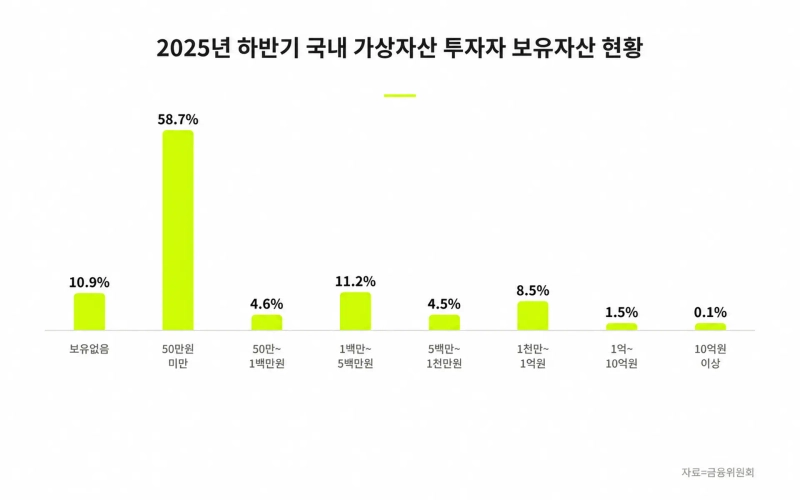
It reached that conclusion because most virtual-asset holders in South Korea are small investors. According to the Financial Services Commission’s survey of virtual-asset service providers for the second half of 2025, only about 10% of roughly 11 million investors using domestic exchanges had invested 10 million won ($7,200) or more, or about 1.12 million people. In other words, nine out of 10 crypto holders in the country had invested less than 10 million won.
Raising Deduction Could Improve Tax Efficiency
The report said keeping the deduction at 2.5 million won could leave tax revenue limited relative to the administrative cost of collection. “In ranges where taxable income is low, the benefits from taxation may be limited relative to the effort required,” the report said. Adjusting the deduction would allow authorities to focus on groups generating enough taxable income to make enforcement worthwhile, it added.
The report also recommended reviewing an alternative approach: raising the deemed acquisition cost ratio used when an investor’s actual purchase price is difficult to verify. Under the amended income tax law set to take effect next year, as much as 50% of a transfer price can be treated as the acquisition cost if the actual acquisition price of a virtual asset is hard to determine.
It concluded that tax efficiency could improve if that ratio is raised to 75% for cases in which the total transfer amount is 10 million won ($7,200) or less. “The two measures above have the same effect in that they reduce the group subject to taxation,” the report said. “They differ only in approach, between directly changing the minimum taxable threshold and raising the ratio used to calculate deemed acquisition cost for the same issue.”
Investor Pushback Persists
Still, raising the deduction or making related changes would require an amendment to the income tax law. That is why investors are watching the government’s 2027 tax revision plan, due in August. With crypto taxation set to begin in January, the plan is expected to include related measures.
Opposition over tax fairness is also growing. Critics say pressing ahead with virtual-asset taxation after the repeal of the financial investment income tax on stock gains would undermine tax equity. A recent public petition calling for the abolition of crypto taxation has drawn support from more than 58,000 people and has been referred to the National Assembly.
Oh Moon-sung, a professor in the tax accounting department at Hanyang Women’s University and former president of the Korean Academic Society of Taxation Policy, said the repeal of the financial investment income tax was the main reason resistance to crypto taxation had intensified. “Even if the government pushes ahead with crypto taxation right away, the revenue effect is unlikely to be significant,” he said.
The government has said it will not delay crypto taxation. Koo Yun-cheol, deputy prime minister and finance minister, told the National Assembly’s Strategy and Finance Committee on July 29 that the government would proceed as scheduled with virtual-asset taxation from next year. “We will implement it next year as planned, and if there are areas that need improvement, we will supplement them as we go,” he said. The National Tax Service has also recently created a Digital Asset Oversight Division in preparation for next year’s rollout.

JOON HYOUNG LEE
gilson@bloomingbit.ioCrypto Journalist based in Seoul