Retirement Savers Piled Into Samsung, SK Hynix ETFs in First Half Before July Shift to US Index Funds
Forecast Trend Report by Period


Most-bought retirement-account ETFs were all tied to Samsung Electronics and SK Hynix
Top three net purchases in first-half retirement accounts were all semiconductor ETFs
Bond-mix funds exempt from risky-asset caps ranked first and second
In July’s stock-market slump, S&P 500 and Nasdaq 100 ETFs climbed the rankings
Lifetime employment has faded, and home prices and financial markets have become harder than ever to predict. The formula that guided earlier generations has also blurred. The future is more uncertain than ever, but one thing is clear: the people reading this article are more likely than any previous generation to live longer lives. Pensions are no longer just an issue for people nearing retirement.
Retirement-account investors overwhelmingly favored Samsung Electronics Co. and SK Hynix Inc. in the first half of this year. At Mirae Asset Securities Co., the three exchange-traded funds with the largest net purchases in retirement pension accounts all centered on the two companies. Six of the top 10 net-bought ETFs were semiconductor-related.
The top two products paired Samsung Electronics and SK Hynix with high-grade bonds, allowing retirement savers to invest as much as their entire account balances. That pattern shifted in July, when a sharp slide in South Korean stocks lifted US benchmark index ETFs to the top of the net-purchase rankings.
Top three ETF net purchases in first-half retirement accounts were all semiconductor funds
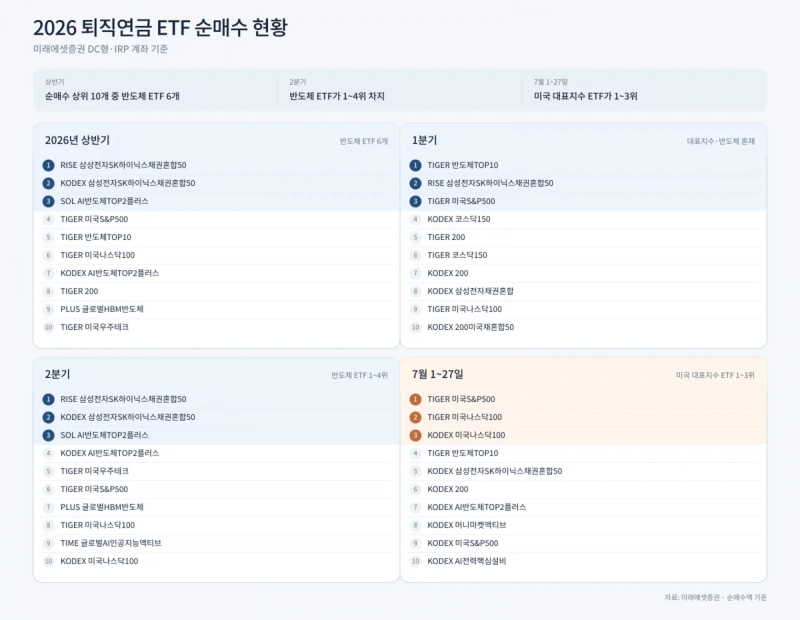
Mirae Asset Securities said on Aug. 2 that the most-bought ETF by net purchases in defined contribution, or DC, and individual retirement pension, or IRP, accounts in the first half was RISE Samsung Electronics SK Hynix Bond Mixed 50. KODEX Samsung Electronics SK Hynix Bond Mixed 50 ranked second, followed by SOL AI Semiconductor TOP2 Plus.
The first- and second-ranked products had similar structures, differing mainly in their asset managers and benchmark indexes. Each allocates as much as about 25% to Samsung Electronics and SK Hynix, with the remaining half invested in high-quality bonds such as South Korean government debt. The structure aims to capture gains in South Korea’s leading chip stocks while reducing volatility through bond holdings.
The RISE product tracks the KAP Samsung Electronics SK Hynix Bond Mixed 50 Index, while the KODEX product follows the Wise Samsung Electronics SK Hynix Bond Mixed Index. The RISE fund listed on Feb. 26 and the KODEX fund on April 7. Even though the KODEX product began trading only in the second quarter, it still ranked second in both second-quarter and first-half net purchases.
A key feature of the two funds is that they are exempt from retirement-account caps on risky assets, allowing investors to put as much as 100% of account balances into them. In DC and IRP accounts, risky assets such as equity ETFs are generally capped at 70% of contributions. Bond-mix ETFs that meet certain requirements, however, can also be included in the remaining 30%.
That can raise a retirement portfolio’s effective equity exposure. If 70% of contributions goes to equity ETFs and the remaining 30% goes to a bond-mix ETF with a 50% stock weighting, total equity exposure can rise to about 85% of the account.
Still, exemption from the risky-asset cap does not mean principal protection or low volatility. Both products are heavily concentrated in Samsung Electronics and SK Hynix on the equity side, meaning investors can still face losses if the semiconductor sector declines.
The third-ranked SOL AI Semiconductor TOP2 Plus is an equity fund that invests in 10 stocks centered on Samsung Electronics and SK Hynix, as well as South Korean companies producing AI semiconductor materials, parts and equipment. Unlike the top two products, it is classified as a risky asset, so retirement accounts can invest only up to 70% of balances in it.
Six of the top 10 net-bought ETFs in the first half were semiconductor-related. Besides the top three, TIGER Semiconductor TOP10 ranked fifth, KODEX AI Semiconductor TOP2 Plus was seventh and PLUS Global HBM Semiconductor was ninth. TIGER US S&P 500 and TIGER US Nasdaq 100, which track major US indexes, ranked fourth and sixth, respectively.
Semiconductor concentration deepened in the second quarter before July buying shifted to US index ETFs
By quarter, the concentration in semiconductor ETFs became even more pronounced in the second quarter. In the first quarter, TIGER US S&P 500 ranked third, and products tracking major domestic indexes such as the KOSPI 200 and KOSDAQ 150 also placed high. In the second quarter, however, semiconductor-related ETFs took the top four spots in net purchases. Products tracking the KOSPI 200 and KOSDAQ 150 fell out of the top 10.
The shift cannot be explained by optimism over the chip cycle alone. Several of the products that moved into the top ranks in the second quarter were newly listed this year, so launch effects may also have played a role. The RISE product ranked second in first-quarter net purchases despite trading for only a little over a month. The SOL product, listed on March 17, still placed third on a cumulative basis for the first half.
The lineup changed again in July. From July 1 through July 27, the ETF with the largest net purchases in retirement accounts at Mirae Asset Securities was TIGER US S&P 500. TIGER US Nasdaq 100 and KODEX US Nasdaq 100 ranked second and third, respectively, putting US benchmark index products at the top of the table.
Over the same period, the KOSPI fell 18.64%, dropping from 8,303.41 to 6,755.75. As South Korea’s stock market tumbled, the center of new retirement-account buying shifted from domestic semiconductor funds to major US index products. The move suggests demand broadened from a specific domestic sector to wider exposure through US benchmark indexes.
KODEX Samsung Electronics SK Hynix Bond Mixed 50, which ranked second in first-half net purchases, slipped to fifth in July. RISE Samsung Electronics SK Hynix Bond Mixed 50, the first-half leader, dropped out of the top 10.
That does not necessarily mean investors abandoned semiconductor funds altogether. TIGER Semiconductor TOP10 ranked fourth in July net purchases, and KODEX AI Semiconductor TOP2 Plus came in seventh, indicating continued buying on weakness. KODEX 200 ranked sixth, while KODEX Money Market Active, which invests in short-term financial instruments, newly entered the list at eighth. Investors split their choices among US benchmark indexes, domestic benchmark indexes, semiconductors and short-term financial products.
‘Exempt from risky-asset cap’ does not mean principal protection
The products still suffered double-digit losses during the market selloff. ETF information provider ETF Check said that as of July 31, the one-month total returns for RISE Samsung Electronics SK Hynix Bond Mixed 50 and KODEX Samsung Electronics SK Hynix Bond Mixed 50 were minus 14.05% and minus 13.29%, respectively.
Experts say investors need to remember that products exempt from retirement-account risky-asset limits are not principal-protected. Even bond-mix ETFs can carry significant price volatility if the equity portion is concentrated in a small number of stocks and a single sector. Investors should check stock weightings, concentration risk and the potential for losses before investing in line with their own risk tolerance.
Jeon Sung-in, a former economics professor at Hongik University, said investors should not treat bond-mix products exempt from risky-asset caps as fully safe vehicles akin to principal-protected products. Samsung Electronics and SK Hynix may be large-cap stocks, he added, but their volatility has risen sharply in recent months, making it hard to regard a product that puts half its assets into the two names as effectively safe.
Kim Yeon-ji, Hankyung.com reporter kongzi@hankyung.com

Korea Economic Daily
hankyung@bloomingbit.ioThe Korea Economic Daily Global is a digital media where latest news on Korean companies, industries, and financial markets.