Yen Holds Gains Near 157 Per Dollar After US, Japan Confirm Joint Intervention
Summary
- US and Japanese authorities confirmed coordinated intervention to halt yen weakness and said they plan to use the FIMA repo facility, helping the yen strengthen to the 155-157 per dollar range.
- Markets increasingly treated a Bank of Japan rate hike in September as a foregone conclusion after the joint action, sending Japan’s two-year government bond yield to its highest level since 1995.
- Analysts said the US-Japan intervention was meant to prevent Japanese sales of US Treasuries and ease pressure for higher bond yields, while arguing that repeated intervention alone will not resolve structural yen weakness without tighter monetary policy.
Forecast Trend Report by Period


US sought to avert concern that Japan would sell Treasuries to fund intervention
Statement also signaled future liquidity could come through the Fed’s FIMA repo facility
“Ultimately, the BOJ needs to raise rates in September”
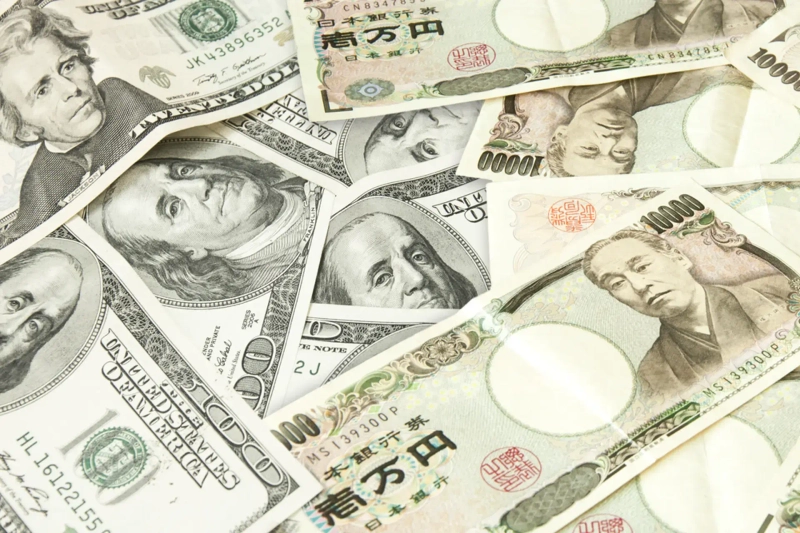
Japan and the US confirmed they jointly intervened over the weekend to arrest the yen’s slide and said they would act again if needed, helping keep the currency in the 157-per-dollar range.
On Aug. 3, Japanese Finance Minister Satsuki Katayama confirmed the joint action and said Tokyo would not hesitate to conduct another coordinated intervention with Washington if necessary. She also said authorities plan to use the Federal Reserve’s Foreign and International Monetary Authorities, or FIMA, repo facility to secure liquidity for future market operations.
Yen strengthens to 155-157 per dollar after joint action
After the announcement, the yen jumped more than 1% to 155.20 per dollar, its strongest level since early May. It later pared some of the gain and was trading around 157.57 per dollar. In the final week of July, the currency had been hovering near 164 per dollar, its weakest level in about 40 years.
Japan’s Ministry of Finance said in a statement that the yen-buying intervention with the US Treasury was meant to respond to excessive volatility and disorderly moves in the currency in recent months. The ministry also said it would use the FIMA repo facility to secure liquidity for future intervention, signaling to markets that Japan could raise cash without selling US Treasuries.
US Treasury Secretary Scott Bessent also confirmed the joint intervention over the weekend. In a post on X on Aug. 3, he said the US strongly supports the Japanese government’s firm market and monetary policy steps to correct the yen’s severe undervaluation, explicitly tying the move to monetary policy and urging the Bank of Japan to raise rates again.
Bessent’s policy emphasis hardens case for a BOJ rate hike in September
That reinforced a market view that another BOJ rate increase in September is effectively a done deal. The shift in sentiment helped extend the yen’s gains from the weekend into Aug. 3.
Japan’s two-year government bond yield, which is highly sensitive to near-term monetary policy, surged to 1.545% on Aug. 3, the highest since 1995, as markets priced in a September rate hike.
Naomi Muguruma, chief bond strategist at Mitsubishi UFJ Morgan Stanley Securities, told Reuters that a September rate increase is effectively settled. Waiting until October only to risk another drop in the yen would make little sense, she added.
The coordinated intervention was the first joint move since action taken after the 2011 Great East Japan Earthquake, when authorities acted together to weaken the yen.
President Donald Trump said on Aug. 2 that US support for a stronger yen was a sign of friendship and a step to help the global economy.
Why Washington backed yen stabilization: to prevent Treasury sales
Most analysts viewed the joint intervention as an effort to avoid a scenario in which Japan would sell US Treasuries to fund foreign-exchange operations. Japan is the largest foreign holder of US government debt.
Louise Loo, lead economist for Asia at Oxford Economics, said any Japanese sale of Treasuries could spread volatility into the US bond market and destabilize the dollar. Treasury yields are already under upward pressure, and additional Japanese selling would push them higher.
The yield on the benchmark 10-year US Treasury has risen nearly 57 basis points since the start of this year.
Masahiko Loo, chief macro strategist at State Street, said continued yen weakness could deepen selling in Japanese government bonds and spread upward pressure on long-term borrowing costs in both Japan and the US, where such pressure is already elevated. Japan’s emphasis on the Fed’s FIMA repo facility helps ease concerns that intervention funding could add stress to sovereign bond markets, he added.
Market reaction to euro sales instead of dollar sales was negative
The Fed’s reported sale of euros rather than dollars to buy yen also drew criticism over a lack of transparency.
Bloomberg and other foreign media reported that the Federal Reserve Bank of New York asked at least two major US banks on July 30 to provide euro-yen exchange rates. The Financial Times also reported that the New York Fed sold euros and bought yen on behalf of the US Treasury.
David Forrester, chief strategist at Credit Agricole CIB in Singapore, said the US maintains a strong-dollar policy and would not want to appear to be weakening its own currency. Such a move would run against the Group of 20 foreign-exchange agreement, he said.
Market participants viewed the use of the euro in the yen intervention as a less transparent approach, Bloomberg reported.
Data from the Bank for International Settlements and the International Monetary Fund show the euro was the world’s second-most traded currency after the dollar in the first half of last year, accounting for about 29% of central bank transaction currency usage on a gross basis, versus more than 90% for the dollar. The euro also made up more than 20% of global foreign-exchange reserves as of May this year, according to the IMF.
“It doesn’t look good for the US Treasury to sell dollars and use euros,” Jason Wong, a currency strategist at Bank of New Zealand, said. The process would likely still end in dollar sales as positions are switched back out of euros, but it is a less transparent way to do it, he added.
Since the latest intervention by Japan and the US, the euro has weakened against Group-of-10 currencies and fallen about 4% versus the yen.
Junya Tanase and Patrick Locke, strategists at JPMorgan Chase, said the US’s net foreign-exchange reserves, excluding gold and special drawing rights, are made up of euros and yen. They interpreted the move as cooperation to curb yen depreciation within the bounds of reserve allocation.
Without tightening, yen strength may prove short-lived
Vishnu Varathan, head of Asia macro research at Mizuho Securities, said the latest intervention had a bigger impact than previous episodes because the US Treasury and the Federal Reserve took part. That gives market participants more reason to believe authorities could step in again.
Still, several analysts warned that this coordinated response could prove even more short-lived than previous interventions unless Japan addresses the structural factors behind yen weakness.
State Street’s Loo said the joint intervention with the US buys Japan time until a rate increase later this year. But for the yen to recover, Japan ultimately needs tighter monetary policy rather than repeated intervention.
“The effect of announcing joint intervention is far greater than unilateral action by Japan,” Tsuyoshi Ueno, chief economist at the National Institute of Library Research, said. “But the underlying drivers of yen weakness have not changed, so the chances are low that the currency will keep rising on the back of this intervention alone.”
Separately, despite the yen’s strength, the won-yen exchange rate in Seoul’s after-hours foreign-exchange market stood at 911.61 won per 100 yen on Aug. 3, extending the won’s strength. If the yen stops weakening against the won, that could help export-heavy South Korean industries.
Kim Jeong-a, guest reporter, Hankyung.com, kja@hankyung.com

Korea Economic Daily
hankyung@bloomingbit.ioThe Korea Economic Daily Global is a digital media where latest news on Korean companies, industries, and financial markets.