SpaceX’s $1 Trillion Revenue Vision Fails to Lift Shares as AI Spending Weighs
Summary
- SpaceX said second-quarter revenue and net loss both improved, but the stock fell in after-hours trading because of the burden of AI investment and a surge in capital expenditure.
- Musk said growth drivers would include reaching $1 trillion in revenue by 2030, expanding AI cloud services and broadening Starlink mobile.
- Deutsche Bank said the employee lockup expiration on Aug. 7 could release as many as 911.5 million new shares, making it a factor weighing on the stock price.
Forecast Trend Report by Period


Elon Musk used SpaceX’s first earnings call since its listing on Aug. 4 to lay out an ambitious roadmap: launch Starlink mobile service by the end of 2027, build lunar rocket-launch infrastructure by 2028 and reach $1 trillion in revenue by 2030. Investors were unimpressed. The vision failed to ease concerns over heavy artificial-intelligence spending and the looming expiration of employee share lockups.
◇ Starlink Subscribers Double
SpaceX reported second-quarter results that topped market expectations. Revenue rose 94.4% from a year earlier to $7.814 billion, 12.8% above the consensus estimate of $6.93 billion. Net loss per share was 9 cents, better than the 26-cent loss expected by the market. Net loss narrowed to $541 million from $1.008 billion a year earlier.
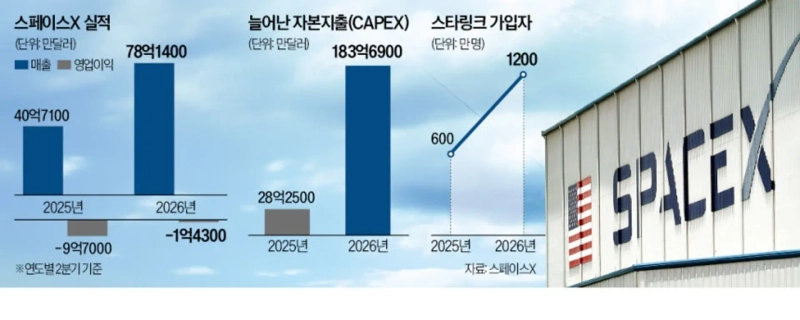
All three main business units beat expectations on revenue. Communications, centered on the Starlink low-earth-orbit satellite service, generated $4.29 billion. AI, including xAI and social-media platform X, brought in $2.56 billion. Space, centered on launch vehicles, posted $962 million. Starlink subscribers exceeded 12 million at the end of June, about double the level a year earlier. In space, the company signed contracts with government customers including NASA. In AI, it is expanding cloud-computing leasing agreements with companies including OpenAI.
◇ Drive Into Computing Leases
Executives used the call to detail the company’s long-term growth plan. Musk said SpaceX would reach $1 trillion in revenue by 2030, moving the target up by one year from its previous goal. Chief Financial Officer Brett Johnson said AI cloud services would be the biggest contributor to that target.
SpaceX is leasing spare computing capacity to outside companies including Google and OpenAI. Musk said AI demand is growing 200% a year and that prices for computing capacity would rise over the same period.
Management also kept up an upbeat tone on Starlink. President and Chief Operating Officer Gwynne Shotwell said Starlink’s penetration in aviation is only 10%, leaving ample room for monetization. She also said the company plans to launch a Starlink-based mobile service by the end of 2027. Shotwell said Starlink mobile would take a substantial number of customers from major wireless carriers including AT&T.
On the space business, Musk said SpaceX plans to install a mass driver on the moon, part of what was interpreted as a plan to launch satellites at high speed from the lunar surface. He added that within a year, SpaceX would launch Starship, its super heavy-lift spacecraft, at least once a day.
◇ Concerns Rise Over Employee Share Sales
Management’s remarks moved other stocks even if they did little for SpaceX. Musk’s comment that the company would use only Nvidia chips in its AI data centers sent AMD shares lower in after-hours trading. The Starlink mobile rollout plan weighed on telecom stocks. And after Musk said demand for memory chips is rising 200% a year while supply is increasing 20%, SK Hynix American depositary receipts advanced in New York trading.
SpaceX investors, however, did not respond positively. The stock fell 7.46% in after-hours trading immediately after the earnings release. One major factor was capital expenditure of $18.369 billion in the second quarter, up 81.7% from $10.107 billion in the first quarter. The company also signaled that second-half investment would remain at first-half levels. The lack of any comment on closely watched issues such as a possible merger with Tesla also weighed on sentiment.
Attention is now turning to the expiration of employee lockups. As many as 911.5 million shares could be released to the market on Aug. 7 alone. That amounts to 6.9% of shares outstanding and 1.4 times the current free float. Deutsche Bank said the lockup expiration is weighing on SpaceX shares, adding that passive-fund buying has been weaker than expected even after the stock was added to the Nasdaq 100 last month.
Hwang Jung-soo, New York correspondent, Korea Economic Daily hjs@hankyung.com

Korea Economic Daily
hankyung@bloomingbit.ioThe Korea Economic Daily Global is a digital media where latest news on Korean companies, industries, and financial markets.