Wall Street Banks Line Up Buy Calls on SK Hynix, Lift Targets for Shares and ADRs
Summary
- Wall Street investment banks issued buy calls across the board on SK Hynix and raised target prices for both its Seoul-listed shares and ADRs.
- Analysts said memory demand is surging as AI spreads, while supply shortages are expected to persist beyond 2027 and, in some forecasts, through 2029.
- Expected shortages in HBM, DRAM, and NAND, along with rising memory prices, are reinforcing the view that the memory cycle is becoming more prolonged as long-term supply agreements (LTAs) take hold.
Forecast Trend Report by Period


Targets for Seoul shares and ADRs raised together
Memory supply crunch seen persisting
Wall Street banks lined up with buy recommendations on SK Hynix, arguing that structural shortages in memory chips are worsening even after a sharp recent selloff in the sector. Memory-chip stocks had fallen on leverage-driven liquidations, a string of capacity-expansion announcements and fears the cycle had peaked. But banks said supply remains far behind demand. Elon Musk also helped bolster sentiment after saying memory demand is growing 10 times faster than supply.
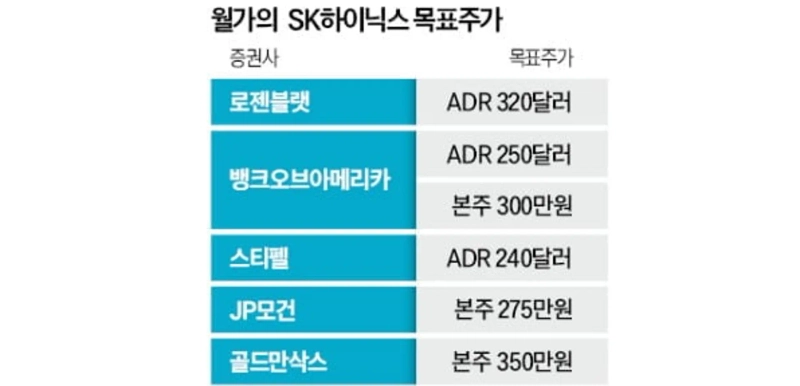
Wall Street firms published a wave of reports on SK Hynix on Aug. 5. Six brokerages initiated coverage and two reaffirmed existing buy ratings. Rosenblatt set a $320 target price for the company’s American depositary receipts, while Bank of America and Stifel set targets of $250 and $240, respectively. JPMorgan and Bank of America also gave target prices of 2.75 million won and 3 million won, respectively, for the Seoul-listed shares. SK Hynix closed up 5.77% at 1.668 million won in Seoul trading that day.
The reports were released at the same time because 25 days had passed since SK Hynix ADRs began trading, allowing underwriting firms to publish their research. The bullish thesis was simple and consistent: AI is driving a surge in memory demand, while shortages of semiconductor equipment and clean rooms will keep supply from catching up even after 2027. Cantor Fitzgerald wrote that shortages in DRAM and NAND would last at least through 2029. That contrasts with investor concern that the memory upcycle may be nearing its peak.
Goldman Sachs said on Aug. 5 that market worries about the memory sector were overdone, reaffirming buy ratings on Samsung Electronics and SK Hynix with target prices of 490,000 won and 3.5 million won, respectively. It said shortages in high-bandwidth memory, or HBM, would become more severe by 2027, driving average prices roughly twofold higher. Goldman cited long-term supply agreements, or LTAs, that favor suppliers as a key reason the memory cycle is becoming more prolonged. The bank also said capacity expansion by China’s ChangXin Memory Technologies, or CXMT, is largely aimed at meeting domestic demand and would have limited impact on the global market.
Industry comments have also reinforced the supply-shortage case. Musk said on Aug. 4 during a SpaceX conference call that “memory is the bottleneck for AI.” Production is rising 20% a year, he said, but demand is increasing 200%, and possibly more, making higher memory prices inevitable. His remarks underscored that even the recent expansion plans cited as a reason for the pullback in memory stocks are not enough to keep pace with surging demand. Spot DRAM prices in Shenzhen’s Huaqiangbei market, a closely watched indicator for China’s electronics distribution trade, jumped 14% over the past week.
Bin Nan-sae, Hankyung.com reporter binthere@hankyung.com

Korea Economic Daily
hankyung@bloomingbit.ioThe Korea Economic Daily Global is a digital media where latest news on Korean companies, industries, and financial markets.