PiCK
Lee Jun-seok Urges South Korea to Make Blockchain a National Strategy to Secure Global Edge [EastPoint: Seoul 2026]
Summary
- Lee Jun-seok said South Korea should foster blockchain as a national strategy and move first to set standards for trading structures, payment methods and financial products.
- He said South Korea should seize leadership in the global digital-asset market through a consolidated order book that separates exchanges and brokerage, cross-border payment use for WonSCO, and adoption of a reference-country system.
- He also stressed that the industry can protect its golden time only by presenting profitable business models, including STO-based real-estate finance, a memory semiconductor futures market, and broader real-world use cases for stablecoins.
Forecast Trend Report by Period


Interview with Reform Party leader Lee Jun-seok
"Separate exchanges and brokerage to open competition"
"WonSCO should target cross-border payments first"
Proposes blockchain finance tied to real estate and semiconductors
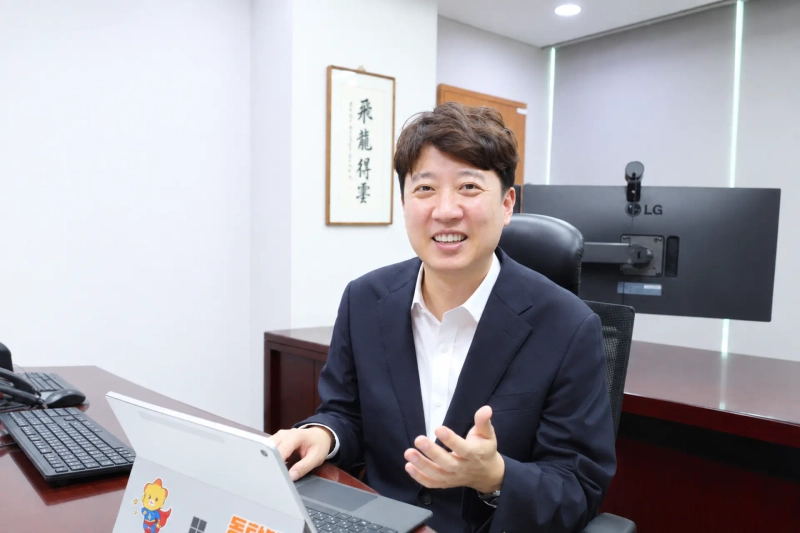
"Blockchain should not be viewed simply as a technology for trading virtual assets. South Korea needs to approach it as a national strategy: design trading methods and payment standards first, then move early to capture new financial and industrial markets."
Lee Jun-seok, leader of the Reform Party, said blockchain should be fostered as a strategic industry at the national level. He argued that South Korea should link digital assets with finance, payments, real estate and semiconductors to seize emerging global markets.
In an interview with Bloomingbit on Aug. 6, Lee said South Korea first needs a national strategy defining what markets it wants to build and dominate through blockchain. Designing trading structures, payment methods and standards for financial products in advance is how the country can secure leadership in the global market, he said.
As specific measures, he proposed building a consolidated order book that separates exchange and brokerage functions, using a won-denominated stablecoin called "WonSCO" for international payments, and introducing blockchain-based financial products tied to real estate and semiconductors.
"Separate exchanges and brokerage to open competition"
Lee said restructuring the trading system is a prerequisite for building new digital-asset markets. Individual exchanges now control both the order book and the customer interface, fragmenting prices and liquidity while making it harder for new entrants to compete.
"In the stock market, the market operator and securities firms acting as brokers are separated, which gives retail investors a smoother and fairer trading environment," Lee said. "By contrast, in the virtual-asset market, exchanges handle both order-book operations and brokerage, creating a structure that disadvantages ordinary investors."
He proposed a "consolidated order book" jointly operated by existing exchanges and financial investors. Under that model, domestic and overseas firms would connect to a single market and compete on customer service, fees and financial products.
"It is effectively impossible for a new entrant to build its own order book and compete under the current structure," he said. "If a unified market is built, not only Korean companies but also overseas exchanges and financial firms could enter South Korea and compete."
Lee also called for more predictable regulation. He proposed a "reference-country system" under which businesses permitted in digital-asset-leading jurisdictions such as Singapore would, in principle, also be allowed in South Korea, instead of leaving authorities to rule on each model case by case.
"You cannot grow an industry by turning cold water on it and then hot water back on it depending on the political situation," he said. "A reference-country system would help create a stable and predictable regulatory environment."
He also stressed the need for a national strategy. "The current government is carried away by the semiconductor boom and mistakenly thinks it is doing well," Lee said. "While it remains focused on defensive policies to prevent problems such as overheating in real estate, the strategy for capturing new digital-asset markets has disappeared. Blockchain now needs to be elevated into a national strategy."
"WonSCO should target cross-border payments first"
Lee said a won-backed stablecoin, or "WonSCO," should not be confined to domestic payments and should instead expand into cross-border settlement. The goal is to secure real-world use cases first by linking overseas payments by Korean users with domestic payments by foreigners on a single blockchain-based payment network.
He identified subscriptions to overseas artificial intelligence services as a priority use case. "What Koreans spend on AI subscriptions could reach tens of trillions of won," he said. "With a level of purchasing power like South Korea's, we could ask overseas AI companies to accept subscription payments through a blockchain method that we designate."
If a payment system is built so Korean users' funds pass through WonSCO before reaching overseas service providers, fees charged by existing card and remittance networks could be reduced. That would also help build an international usage base for the stablecoin.
Lee also said domestic payments by foreigners holding dollar stablecoins should be allowed in phases. At the initial stage, he proposed introducing them as debit payments with set limits so they could be used at restaurants, shops and on transit cards in South Korea.
"If we start with areas where demand is clear, such as overseas service subscriptions and payments by foreign tourists, we can create real use cases for stablecoins," he said. "We can begin with capped payments and gradually expand their circulation in the domestic market."
"Real estate and semiconductors can also become blockchain financial products"
In real estate, Lee proposed allowing tokenized securities offerings, or STOs, beginning with commercial property. He said commercial real estate makes it relatively easy to calculate rental income and asset value, making it suitable for fractional investment and securitized products.
He also proposed a blockchain-based futures market for memory semiconductors. The idea is to standardize memory chips by performance and generation, turn them into futures products like crude oil or grain, and use blockchain for trading infrastructure and WonSCO for settlement.
"Memory semiconductors are standardized under international norms, and their product life cycle is long," Lee said. "They can be made into futures products just like Dubai crude or Chicago grain."
A futures market would allow chipmakers to hedge against price declines and reduce uncertainty in medium- to long-term production and investment plans.
"If a semiconductor futures market is built on blockchain, it could produce a market more advanced than existing commodity exchanges," he said. "If South Korea sets the trading model for memory semiconductors and the settlement standard for stablecoins first, it can make other countries and companies come into that market."
"The industry needs to show models that can make money"
Lee also said the digital-asset industry needs to present business models that can generate actual profit. It first needs to show which businesses are blocked by which regulations, and what kinds of products and markets could be created if the system is opened. That, he said, would give the government momentum to move policy.
"Right now, it seems the industry's only goal is to break through regulation, and I do not hear much about what kind of market it would build or how it would make money once the system is introduced," Lee said. "There needs to be a concrete explanation: this is the business I want to do, and this specific regulation is what prevents it."
He also pointed to STOs tied to music copyrights and intellectual property, and fractional investment in aircraft engines, as possible business models.
"People participating in the blockchain market need a goal beyond hitting the jackpot overnight," Lee said. "South Korea needs to show it has the will to develop digital assets not as speculation but as an industry. That is what would build trust in the market overseas."
He added that at the global Web3 private conference EastPoint: Seoul 2026, scheduled for Sept. 28, the discussion should move beyond regulation and focus on business models that can actually work.
"I hope the companies attending EastPoint will discuss not only what system should be opened, but also how they will build markets and generate real profit once it is," Lee said. "Concrete ideas such as tourist payments and a semiconductor futures market need to accumulate if the industry is not to miss its golden time."

YM Lee
20min@bloomingbit.ioCrypto Chatterbox_ tlg@Bloomingbit_YMLEE