PiCK
South Korea to Start Crypto Tax in January With 22% Levy Above $1,800 and No Break for Long-Term Holders
Summary
- Starting Jan. 1 next year, income from virtual assets in South Korea will be separately taxed at a flat 22% on annual gains above $1,800.
- South Korea offers no tax benefits for long-term holding, unlike the US, Australia, Germany and Portugal, a structure critics say will leave investors with a heavier effective tax burden.
- South Korea’s crypto tax does not allow loss carryforwards, meaning investors who only recover their original principal over two years could still owe 1.65 million won in tax.
Forecast Trend Report by Period


Crypto tax to begin in January
Flat 22% levy on gains above $1,800 regardless of holding period
US and other markets offer tax breaks or exemptions for long-term holdings
South Korea to bar loss carryforwards
Investors may owe tax even after only recovering principal over two years
Japan allows three years; US allows indefinite carryforward
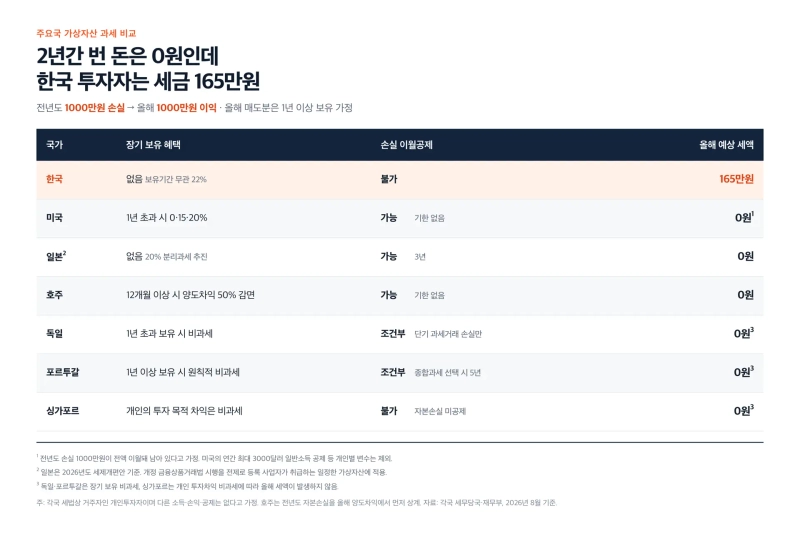
South Korea is five months away from implementing taxes on virtual assets, or cryptocurrencies. Starting next year, investors with annual crypto gains above 2.5 million won ($1,800) will pay 22% on the amount exceeding that threshold. While the headline rate is broadly in line with major markets, critics say the lack of tax breaks for long-term holders and the absence of loss carryforwards will leave investors with a much heavier effective burden.
The National Tax Service said income from the transfer or lending of virtual assets will be separately taxed as other income starting Jan. 1. Annual gains and losses will be netted to calculate profit, after which a basic deduction of 2.5 million won ($1,800) will be applied. The remaining tax base will be subject to a 22% levy, made up of 20% income tax and 2% local income tax. An investor with annual profit of 10 million won ($7,200), for example, would owe tax on 7.5 million won ($5,400), for a total bill of 1.65 million won ($1,200).
Unrealized gains generated before the tax takes effect will not be taxed. To calculate the tax base, authorities plan to use whichever is higher between the market price at the end of this year and the actual acquisition price as the purchase cost.
South Korea Applies 22% Regardless of Holding Period While Major Markets Reward Long-Term Holding

South Korea will apply the same 22% rate to gains above the basic deduction no matter how long the asset was held. An investor who holds for a day will face the same tax treatment as one who holds for years. In many major overseas markets, by contrast, crypto tax systems include benefits for long-term holders.
In the US, tax rates vary by holding period. Investors who hold virtual assets for more than a year qualify for long-term capital gains rates of 0%, 15% or 20%, depending on income. Assets held for a year or less are taxed with ordinary income at rates of as much as 37%.
Australia also gives individual investors a 50% reduction in capital gains if they hold virtual assets for at least 12 months. If net profit after combining gains and losses is 10 million won ($7,200), tax would apply to only half that amount, or 5 million won ($3,600). Rather than cutting the tax rate itself, the system halves the taxable amount and materially lowers the effective burden.
Germany and Portugal offer even bigger incentives for long-term holding. In Germany, individual investors pay no tax on gains from selling virtual assets after holding them for more than a year. Even if they sell within a year, no tax is due when annual trading gains, including crypto, are less than 1,000 euros. Portugal imposes a 28% rate on gains from assets held for less than a year, but excludes gains from assets held for at least a year from taxation.
Singapore does not distinguish by holding period. If an individual's crypto trading is considered ordinary investing rather than a business, capital gains are not taxed. If the activity is deemed professional trading based on factors such as frequency and scale, however, it may be taxed as business income.
No Loss Carryforward Means Tax Even if an Investor Only Breaks Even

Another criticism of South Korea's crypto tax regime is that it does not allow loss carryforwards. The system lets investors deduct losses incurred in one year from profits earned in later years, helping taxes reflect cumulative gains and losses over multiple years.
South Korea allows investors to net only gains and losses generated within the same year. If an investor loses 10 million won ($7,200) in the first year and earns 10 million won ($7,200) in the second year, merely recovering the original principal, tax would still apply. Over the two years, the investor would record no cumulative profit but still owe 1.65 million won ($1,200).
Japan, by contrast, included in this year's tax revision proposal a plan to allow unapplied losses from crypto transactions to be carried forward for three years. That would let investors deduct first-year losses from profits in later years and be taxed on an amount closer to their actual cumulative gain or loss.
Japan is also pursuing a plan to separately tax gains on certain virtual assets handled by registered businesses at 20%, in the same way as stocks. If introduced alongside the revised Financial Instruments and Exchange Act, the system would lower the tax rate while also allowing loss carryforwards. South Korea, meanwhile, is moving to a similar 22% separate tax without recognizing past losses.
Japan is not alone in allowing loss carryforwards. The US, UK, Germany and Portugal also let investors reflect losses from virtual-asset investing in profits from later years, though the deductible scope and carryforward period differ. The approach accounts for crypto's volatility by using cumulative gains and losses over several years as the tax base.
In the US, crypto losses can be offset against gains from other capital assets such as stocks. If losses remain, up to $3,000 a year can be deducted from ordinary income, with the rest carried forward until fully used.
The UK also allows reported capital losses to be deducted from future gains on crypto or stocks. Germany allows losses from short-term crypto trades to be offset against gains from other private asset sales, with any remainder reflected in the previous or future tax years. Portugal also allows losses to be carried forward for five years if the taxpayer opts for comprehensive taxation.
The government has taken a cautious stance on introducing loss carryforwards for crypto taxes. Deputy Prime Minister Koo Yun-cheol, who also serves as finance minister, said on Aug. 29 that stock investments also do not allow loss carryforwards. He added that the government would first proceed with implementation next year after the current grace period expires at the end of this year, then make changes later if needed.

Doohyun Hwang
cow5361@bloomingbit.ioKEEP CALM AND HODL🍀