Japan Stocks Whipsawed by Samsung, SK Hynix as Nikkei Tracks Kospi
Forecast Trend Report by Period


Nikkei’s Linkage to Kospi Deepens
Leveraged ETFs on Samsung and SK Hynix Add Swings
Kioxia and Other Japanese Chip Stocks Rattled
Tokyo Electron and Materials Suppliers Move in Tandem
Korean Chip Capex Becomes a Key Market Driver
In Marunouchi, Tokyo’s financial district and home to many securities firms, analysts have lately been starting each morning by checking South Korea’s stock market first.
The reason is a growing phenomenon in which the Nikkei 225 moves in step with the Kospi. Sharp swings in Samsung Electronics Co. and SK Hynix Inc. are reverberating through Japanese equities. Market participants say investor flows tied to South Korea are increasingly overshadowing company-specific factors in Japan such as earnings and valuations.
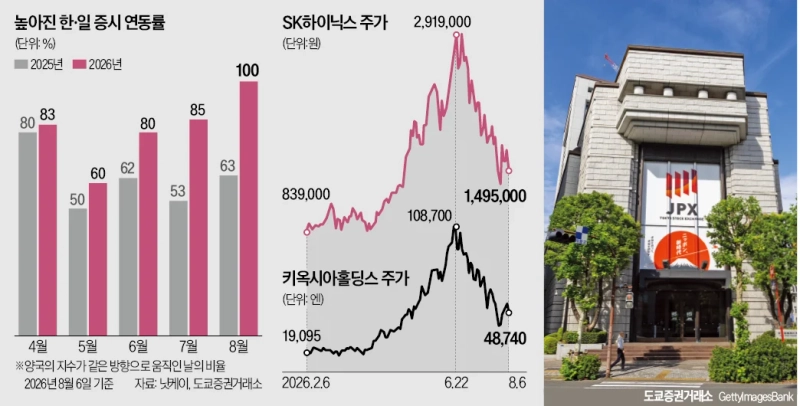
Korea-Japan Market Synchronization Reaches 85%
According to the Tokyo Stock Exchange, the Kospi and the Nikkei 225 have moved in the same direction on 85% of trading days this year. That compares with 58% from June 2025 through Aug. 6, 2026.
Nikkei reported that overseas investors are effectively treating South Korean and Japanese stocks as the same basket because both markets have heavy exposure to artificial intelligence and semiconductor shares. When the Korean market swings sharply on supply-and-demand factors, Japanese stocks have repeatedly moved hard in the same direction, the newspaper wrote.
The pattern was visible again on Aug. 5. As the Kospi trimmed its intraday gain, the Nikkei 225 also lost momentum.
Volatility in Japan has also picked up. The Nikkei 225’s intraday volatility rate, measured by dividing the gap between the session high and low by the previous day’s close, has topped 2% for three straight months. It is the first such stretch since 2008 during the global financial crisis. The persistence of elevated volatility without a clear financial-market shock has raised concern.
In Tokyo, market participants point to leveraged single-stock exchange-traded funds that track twice the moves in Samsung Electronics and SK Hynix as one factor behind the bigger swings. Japanese semiconductor-related shares, including Kioxia Holdings Corp., which became Japan’s largest company by market capitalization in early June, as well as Tokyo Electron Ltd. and Fujikura Ltd., are increasingly moving in line with Samsung and SK Hynix.
Some Japanese investors are voicing frustration with the Korea linkage. They say it has become harder to make investment decisions based on the earnings, growth prospects and valuations of individual Japanese listed companies.
An analyst at a major Japanese brokerage said the reduced market influence of bellwether companies such as Toyota Motor Corp. and Sony Group Corp. has also made the Korea linkage more pronounced. Whether the market breaks from that pattern and returns to trading driven by fundamentals will help determine the course of Japanese equities in the second half, the analyst added.
Japanese Investors Focus More Closely on SK Hynix
The phenomenon has also sharply increased Japanese investor interest in Korean companies. A clear example came on July 30, when Nikkei gave prominent front-page coverage to SK Hynix earnings.
The report highlighted the company’s record results and the share-price decline on the day of the announcement. On the same day, Hitachi Ltd. forecast record net profit and Tokyo Electric Power Co. released earnings after the restart of nuclear reactors, but both stories were eclipsed by SK Hynix.
Nikkei used SK Hynix’s earnings to gauge whether investment in AI data centers and demand for high-bandwidth memory, or HBM, will continue. The article said Japanese investors increasingly view SK Hynix’s results and share performance, alongside Nvidia Corp., as a leading indicator for the global AI semiconductor cycle.
Japan’s close industrial links with South Korea are another reason for the growing interest. Capital spending by Samsung Electronics and SK Hynix affects not only chip-equipment makers such as Tokyo Electron and Advantest Corp. but also material suppliers including Shin-Etsu Chemical Co. For Japanese investors, SK Hynix’s investment plans have become an important gauge for the outlook for Japan’s semiconductor-related shares.
A Korean business executive who has operated in Japan since the 1980s said the shift was striking. Shares of Korean companies that once lagged far behind Japan’s corporate giants are now shaking the entire Japanese stock market, the executive said.
Choi Man-su, Tokyo correspondent, Hankyung.com, bebop@hankyung.com

Korea Economic Daily
hankyung@bloomingbit.ioThe Korea Economic Daily Global is a digital media where latest news on Korean companies, industries, and financial markets.