South Korea’s First-Half Exports Top Japan for First Time on AI Chip Surge
Summary
- South Korea’s exports surpassed Japan’s for the first time in the first half, driven by a surge in shipments of AI semiconductors, integrated circuits, and HBM.
- South Korea, led by Samsung Electronics and SK Hynix, and Taiwan, anchored by TSMC, could effectively join the top four global exporters by expanding shipments of AI semiconductors and advanced memory.
- Strong semiconductor exports are lifting South Korea’s economic growth rate and per-capita GDP, raising the possibility that it will exceed $40,000, while Japan’s income gap is widening amid the weak yen and slower growth.
Forecast Trend Report by Period


South Korea $496.3 billion; Japan $384.4 billion
AI semiconductors widen export gap
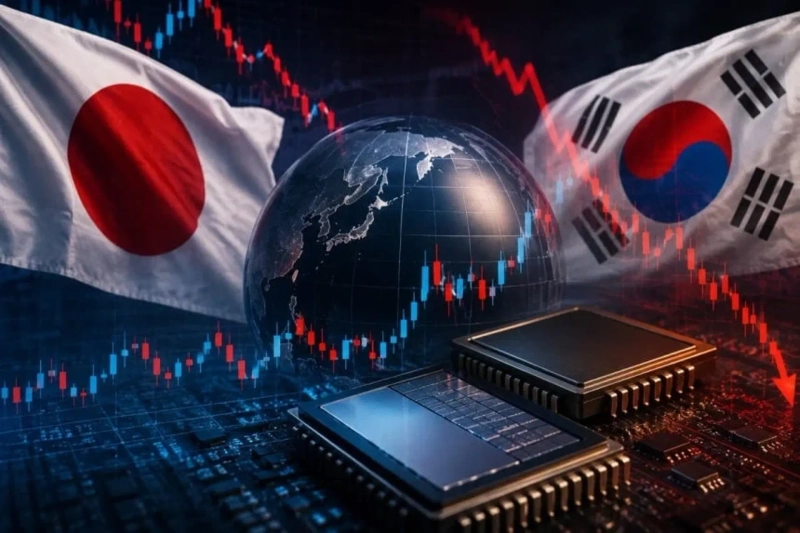
South Korea’s exports exceeded Japan’s in the first half for the first time on record. Surging demand for artificial intelligence semiconductors drove a sharp increase in shipments from South Korea, led by Samsung Electronics Co. and SK Hynix Inc., while Japan’s export gains were constrained in part by the weak yen. If the trend continues, South Korea could effectively become the world’s fourth-largest exporter, behind China, the US and Germany.
Nikkei on Aug. 7 published an analysis by Mitsubishi UFJ based on trade data for South Korea, Japan and Taiwan, as well as figures from the Japan External Trade Organization and the United Nations trade database. South Korea’s exports totaled $496.3 billion from January through June, $111.9 billion more than Japan’s $384.4 billion.
Taiwan’s exports also surpassed Japan’s for the first time, reaching $416.6 billion. Japan’s exports rose nearly 10% from a year earlier, but South Korea and Taiwan each posted growth of almost 50%, widening the gap.
AI semiconductors were the main driver of South Korea’s export growth. Global big tech companies expanded investment in AI data centers, fueling demand for advanced memory products including high-bandwidth memory, or HBM. South Korea’s integrated-circuit exports reached $149 billion in the first half, or about 30% of total exports. The increase was so steep that first-half shipments alone exceeded last year’s full-year total.
Taiwan also sharply increased exports of advanced semiconductors, centered on Taiwan Semiconductor Manufacturing Co. Taiwan’s integrated-circuit exports totaled $133.2 billion in the first half, accounting for about 30% of total exports. By contrast, Japan’s integrated-circuit exports were just $21.2 billion, or about 5% of its total exports. The figures show how Japan, which led the global chip market in the 1980s, has fallen behind South Korea and Taiwan in producing advanced semiconductors.
Japan still holds strong competitiveness in semiconductor equipment and materials. Tokyo Electron Ltd., Advantest Corp. and Lasertec Corp. have secured large shares of the global market. Japan’s semiconductor equipment exports reached $15 billion in the first half, well above South Korea’s $5.2 billion and Taiwan’s $3.5 billion. Japanese equipment makers also benefited from the AI boom as global chipmakers increased capital spending.
Still, materials and equipment expanded more slowly than the market for advanced semiconductors, the final product. South Korea and Taiwan, which directly produce AI chips with higher added value and faster-growing demand, reaped a bigger export boost.
“Even if countries expand semiconductor exports, shipments of parts, materials and manufacturing equipment are unlikely to increase as rapidly as finished products,” Kenta Maruyama, a researcher at Mitsubishi UFJ Research and Consulting, said.
The weak yen also reduced the dollar value of Japan’s exports. But the won and the Taiwan dollar also weakened against the US currency, making it difficult to explain the export gap between South Korea and Japan through exchange rates alone.
Japan’s export weakness is not just a temporary effect of the AI boom. Excluding price changes, Japan’s export volume index has effectively moved sideways since peaking before the global financial crisis.
Japan built itself into a manufacturing power after World War II by supplying products that met rapidly growing global demand, including textiles, steel, automobiles and electronics. But after the digital transition, it failed to establish leadership in new growth markets such as smartphones, advanced semiconductors and platforms.
South Korea, by contrast, has embedded itself in the core supply chain for the AI industry through memory chips and HBM, while Taiwan has done so through foundry manufacturing. That has tied investment competition among global big tech companies directly to export growth in South Korea.
South Korea’s per-capita GDP may top $40,000, widening gap with Japan
The AI semiconductor boom is also widening the growth gap between South Korea and Japan. South Korea’s government last month announced its economic growth strategy for the second half and raised its forecast for real growth this year to 3.0% from 2.0%, reflecting strong semiconductor exports and increased capital investment.
If chip exports keep rising, actual growth could exceed the government’s forecast. Taiwan’s statistics agency in May projected economic growth of 9.64% this year. That outlook could rise above 10% if orders for AI servers and advanced semiconductors remain stronger than expected.
Japan is moving in the opposite direction. Japan’s Cabinet Office lowered its forecast for real gross domestic product growth in fiscal 2026 to 0.9% from 1.3% at a meeting of the Council on Economic and Fiscal Policy on July 30. The revision reflected higher energy import costs as international crude prices rose amid instability in the Middle East.
Differences in growth and exchange rates are also set to show up in per-capita GDP. South Korea’s per-capita GDP this year is estimated at $39,164. If growth continues and the won-dollar exchange rate stabilizes, it could top $40,000 for the first time.
Japan’s per-capita GDP, by contrast, is likely to remain around $35,000 because of the weak yen. If the won strengthens and the yen remains weak, the income gap between South Korea and Japan in dollar terms could widen faster than the gap in actual growth.
Choi Man-su, Tokyo correspondent, Hankyung.com, bebop@hankyung.com

Korea Economic Daily
hankyung@bloomingbit.ioThe Korea Economic Daily Global is a digital media where latest news on Korean companies, industries, and financial markets.