AI Hardware Stocks Surge as Much as 430.2%, Challenging the Magnificent Seven
Summary
- Some M7 members in the US are losing momentum and representative status as they struggle to keep up with the expansion of AI infrastructure and face weakening cash flow.
- By contrast, AI hardware and P7 companies such as SanDisk, Dell and Micron have surged by as much as 430.2% this year, emerging as new market leaders.
- Wall Street is using monetization potential and revenue growth to explore alternatives such as the AI Big 10, MANGOS and P7, while adjusting exposure to the traditional M7.
Forecast Trend Report by Period


M7 Loses Steam. Is This the Era of the P7?
Tesla, Meta Fall Behind as AI Returns Lag
SanDisk, Dell and Other Hardware Stocks Rise
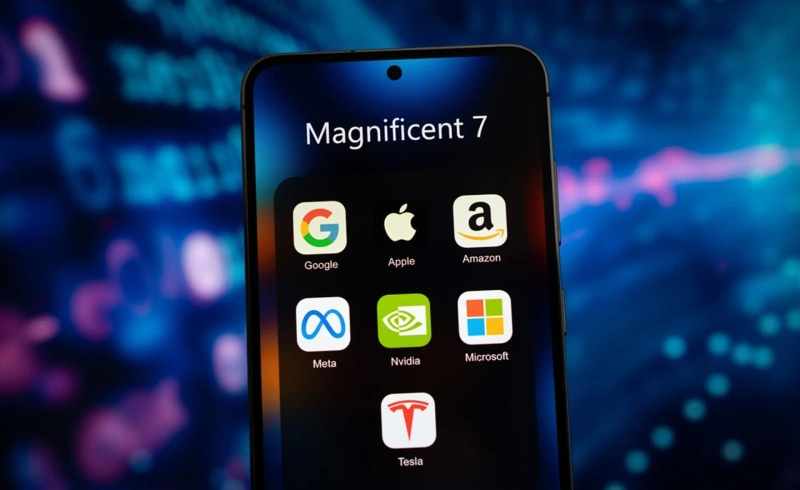
The dominance of the seven US tech giants known as the Magnificent Seven, or M7, is no longer what it was. Nvidia, Apple, Alphabet, Microsoft, Amazon, Meta and Tesla led US equities over the three years through 2025. But some have failed to capitalize on the expansion of the artificial intelligence ecosystem, allowing companies once viewed as a tier below them, including TSMC and Broadcom, to move ahead in market value.
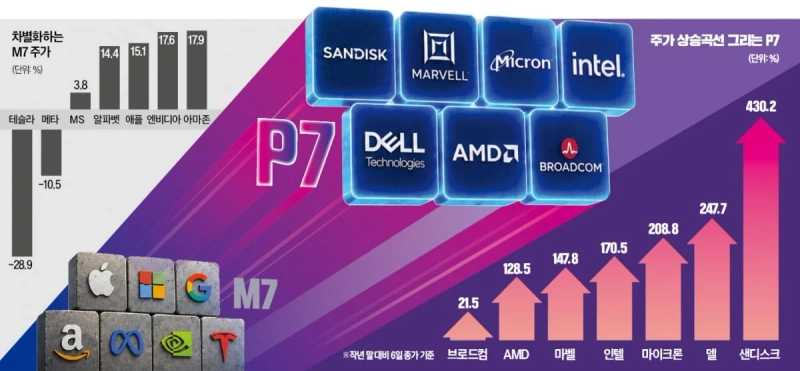
The M7 label is derived from the Western film The Magnificent Seven. As of Aug. 6, Meta shares were down 10.5% from the end of last year and Tesla had fallen 28.9%. Even Amazon, the best performer in the group, was up only 17.9%. That pales beside gains of 430.2% for SanDisk and 247.7% for Dell, two AI hardware plays.
The shift is also evident in market capitalization. Meta, valued at $1.502 trillion, and Tesla, at $1.261 trillion, had fallen to 10th and 11th place. Ahead of them stood TSMC at $2.168 trillion, Broadcom at $2 trillion and SpaceX at $1.513 trillion.
The Financial Times wrote that the M7 are "no longer magnificent." Investors are increasingly looking to the so-called P7, with the P standing for parabolic. The group includes AI infrastructure companies such as SanDisk, Marvell, Micron, Intel, Dell, AMD and Broadcom.
As the AI Spending War Drains the M7, Wall Street Shifts to the P7
US Market Leadership Shows Signs of Change
From 2023, when the term Magnificent Seven first emerged, through last year, investors broadly bet big tech would dominate the AI era. The reasoning was straightforward: companies pouring hundreds of billions of dollars a year into AI infrastructure would likely seize the upper hand. Sentiment shifted as those companies depleted cash reserves and began borrowing to fund investment. As M7 cash flow weakened, investors started looking for companies that could generate profits immediately. That helps explain the widening performance gap within the M7 and the growing focus on hardware makers in semiconductors and servers.
The M7 Is Being Asked to Prove Profitability
The term M7 first appeared in a report by Michael Hartnett, Bank of America's chief strategist. He grouped the seven companies together because they were large, well-managed and dominant technology businesses. The M7 continued to lead the market as they ramped up AI investment. Their average annual stock gains reached 111.3% in 2023, 60.2% in 2024 and 22.4% in 2025.
That standing began to weaken this year as the market's patience with AI spending wore thin. Investors eager to find AI companies that already make money began dividing the M7 by one measure: monetization potential.
Nvidia, which dominates the AI accelerator market, and Microsoft and Amazon, whose data-center spending is translating into results, have been viewed as the strongest names. Concern has mounted over Alphabet and Meta as their financial positions worsened, and over Tesla as it failed to deliver major progress in robotics and autonomous driving.
Alternative AI Winners Begin to Emerge
As the M7 lost momentum, AI infrastructure companies began to rise. They include hardware manufacturers in power equipment, semiconductors and servers that have benefited from the M7's heavy spending. Memory-chip companies easily accessible to US investors, including SanDisk and Micron, led the market through Aug. 6, with shares up 430.2% and 208.8%, respectively, this year.
The emergence of new stars in the AI industry, including OpenAI, Anthropic and SpaceX, is also eroding the M7's dominance. SpaceX, which went public on June 12, raised $85 billion behind Chief Executive Officer Elon Musk's vision for space and AI. Anthropic is expected to go public in October 2026, while OpenAI is expected to list in 2027.
'MANGOS' and 'AI Big 10' Spring Up
The term M7 is unlikely to disappear entirely, but its representative status is expected to weaken as growth slows.
Reuters reported that the M7's quarterly revenue growth, measured from a year earlier, is forecast to slow from 35.1% in the third quarter of 2026 to 23.1% in the fourth quarter and 7.1% in the first quarter of 2027. In the fourth quarter, the group is also forecast to lag the 26.3% revenue growth expected for S&P 500 companies excluding the M7.
The search for alternatives is already well under way. Bank of America recently proposed an "AI Big 10" that adds AMD, Broadcom and Micron to the M7. Another label drawing attention is "MANGOS," a variation on the M7. In that grouping, Microsoft, Alphabet and Nvidia remain, while Anthropic, OpenAI and SpaceX are added.
A framework gaining traction more recently is the P7, proposed in June by Ben Emons, chief investment officer at FedWatch Advisors. The name refers to the parabolic rise in AI hardware shares this year. The group includes SanDisk, Marvell, Micron, Intel, Dell, AMD and Broadcom. Most share a common trait: they design custom chips or produce memory semiconductors, allowing them to turn big tech's enormous investment directly into revenue.
▶P7
The term refers to seven semiconductor, memory and server companies whose revenue is rising on the back of big tech's AI spending. The "P" stands for parabolic, referring to the sharp rise in their share prices. The group includes SanDisk, Marvell, Micron, Intel, Dell, AMD and Broadcom.
Hwang Jeong-su, New York correspondent / Son Ju-hyung, reporter, hjs@hankyung.com

Korea Economic Daily
hankyung@bloomingbit.ioThe Korea Economic Daily Global is a digital media where latest news on Korean companies, industries, and financial markets.