Tougher Delisting Rules Could Put 479 Korean Listed Companies at Risk Next Year
Summary
- The number of companies falling short could rise to 479, or 18.6%, when the minimum market capitalization threshold is raised next year to 50 billion won for the Kospi and 30 billion won for the Kosdaq.
- Penny stocks totaled 200, or 7.8%, in July, while 103 companies that traded below 1,000 won for 30 consecutive trading days face possible designation as closely monitored issues and potential delisting procedures.
- Stricter financial soundness and disclosure penalty point standards have increased the burden of listing-eligibility reviews for companies in full capital impairment or with disclosure violations, and the risk of designation as closely monitored issues could widen if share-price recovery or paid-in capital increases fail in the second half.
Forecast Trend Report by Period


192 Korean stocks already fall short as tighter delisting standards take effect
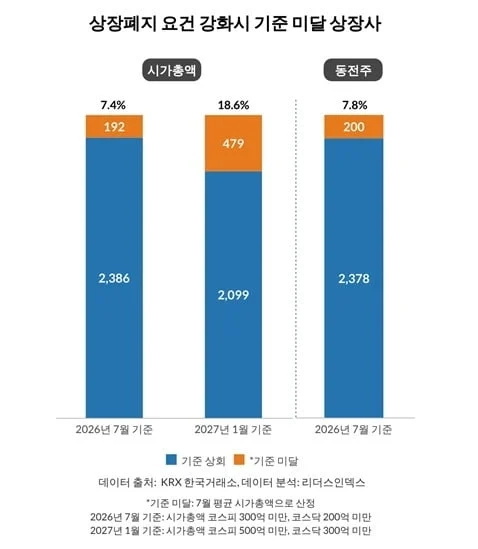
More than 7% of South Korea’s listed companies failed to meet market-capitalization requirements within a month of tougher delisting standards taking effect, a new analysis showed. If the minimum market-value threshold rises again next year, the number of companies falling short could reach 479, about 2.5 times the current level. Tighter rules on share prices, financial health and disclosure penalty points are also increasing pressure on marginal companies trying to remain listed.
Corporate research firm Leaders Index said on August 11 that it analyzed 2,578 listed companies as of the end of July, including 833 on the Kospi and 1,745 on the Kosdaq. It found 192 companies, or 7.4% of the total, had average market capitalizations in July below listing-maintenance requirements.
Market capitalization is a key measure of a company’s value in the market. If it remains below a certain level for an extended period, the company is considered to have trouble meeting listing standards. Under delisting rules that took effect on July 1, the minimum market cap was raised to 30 billion won for Kospi companies and 20 billion won for Kosdaq companies. The study found that 152 Kosdaq-listed companies, or 8.7%, and 40 Kospi-listed companies, or 4.8%, fell short. Based on the latest 30 consecutive trading days, 88 companies remained below the threshold, including 22 on the Kospi and 66 on the Kosdaq.
By sector, services had the largest number of companies below the standard at 38, followed by IT electronics at 36 and household goods at 30. The household goods sector had the highest share, with 16.9% of its 177 companies falling below the market-cap threshold.
The bigger test comes next year. If the minimum market cap is raised to 50 billion won for the Kospi and 30 billion won for the Kosdaq, the number of at-risk companies would rise sharply. Based on average July market capitalizations, 479 companies, or 18.6%, would fall below the standard. Based on the latest 30 consecutive trading days, 368 companies, or 14.3%, would face the risk of being designated as closely monitored issues.
Warning signs also emerged under the share-price rule. So-called penny stocks, defined as companies with an average July closing price below 1,000 won, totaled 200, or 7.8% of all listed firms. Another 103 companies traded below 1,000 won for 30 consecutive trading days. If a common stock closes below 1,000 won for 30 straight trading days, it is designated as a closely monitored issue. If it then fails to remain above 1,000 won for 45 consecutive trading days within the next 90 trading days, delisting procedures begin.
Financial-soundness standards also became stricter. Based on annual reports as of the end of last year, 12 companies were in full capital impairment and 38 had capital impairment ratios of at least 50%. Starting in July, full capital impairment on a half-year basis, not just at year-end, was also included in the substantive review for listing eligibility. That raises the possibility that more companies will be added after they submit their latest half-year reports.
Reviews of disclosure violations have also tightened. Sixteen companies accumulated at least 10 disclosure penalty points over the past year. Since July, the threshold for disclosure penalty points triggering a substantive listing-eligibility review has been lowered to 10 from 15, increasing the burden on those companies.
A Leaders Index official said the number of companies exposed to the risk of being designated as closely monitored issues could increase further next year if share prices do not recover in the second half or if companies fail to lift their market value through rights offerings or other capital expansion measures.
Kang Kyung-ju, Hankyung.com reporter qurasoha@hankyung.com

Korea Economic Daily
hankyung@bloomingbit.ioThe Korea Economic Daily Global is a digital media where latest news on Korean companies, industries, and financial markets.