US Treasury Yield Spike Puts South Korea’s Chip-Heavy Stock Market on Edge
Summary
- A sharp rise in US Treasury yields is increasing pressure on global capital flows and the South Korean stock market, particularly sectors with heavy semiconductor exposure.
- If the US 10-year Treasury yield rises above 5%, higher funding costs for big tech could curb AI investment and semiconductor demand, raising the risk of a decline in the domestic stock market.
- The won-dollar exchange rate, the yen, and Korean government bond yields are adding pressure to corporate funding costs and household spending power, though analysts say the recent rise in domestic government bond yields is being driven more by South Korea’s economic growth and its benchmark rate hike cycle.
Forecast Trend Report by Period


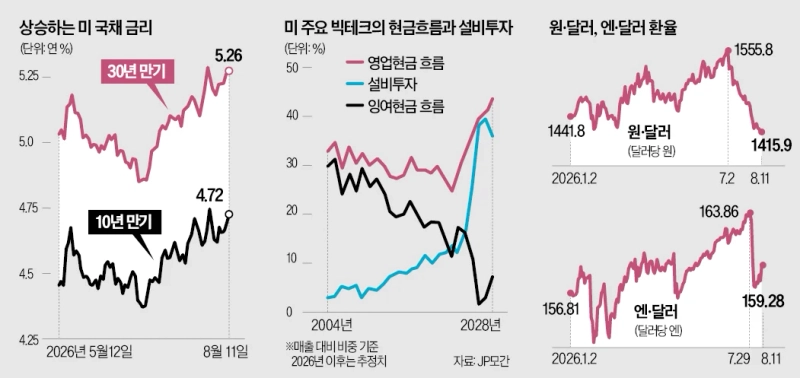
A jump in US Treasury yields to their highest levels in 19 years is rattling South Korea’s economy, from retail investors to households and companies. Investors worry that if the sharp rise in yields persists, higher funding costs for US tech giants could curb capital spending and hit South Korea’s stock market, where semiconductor shares dominate. Higher US yields can also pull global money out of South Korea, lifting local government bond yields and the won-dollar exchange rate. For now, however, the impact on domestic macroeconomic indicators appears limited.
US Treasury yields have surged amid fears the move could weigh on South Korean equities.
The 30-year US Treasury yield traded at 5.28% as of about 5 p.m. on Aug. 11. It also reached 5.28% on July 31, its highest level since July 2007, and has now climbed back to that mark. The 10-year Treasury yield stood at 4.73%.
Higher US Treasury yields are a negative for South Korean stocks because they can trigger a global shift in capital flows. When the dollar, a traditional safe-haven asset, also offers higher returns, global money parked in emerging markets tends to head back to the US. That can lead to broad selling in heavyweight stocks and growth shares that are more vulnerable to rising rates. “Excluding the exceptional period of the pandemic, rising interest rates have always been the key trigger for downturns in the Korean stock market over the past decade,” Kim Hak-kyun, head of research at Shinhan Securities, said.
South Korea’s stock market is particularly exposed because its two leading chipmakers account for nearly half of the market. Demand for Korean semiconductors is closely tied to artificial intelligence spending by US tech giants, and rising US yields increase those companies’ borrowing costs.
US tech companies have been pouring huge sums into AI data centers in a bid to secure leadership in the sector, pushing free cash flow toward the floor. JPMorgan estimates capital spending this year by Alphabet, Amazon, Meta, Microsoft and Oracle at $75.8 billion, up 82% from $41.6 billion last year. As capital expenditure outstrips cash flow, dependence on external funding such as corporate bond issuance is also increasing.
“The higher long-term yields go, the faster borrowing costs for big tech can rise,” Kim Yu-mi, an investment strategist at Kiwoom Securities, said. “If the 10-year Treasury yield breaks above the psychological threshold of 5%, questions could grow over the chip-buying power of financially weaker big tech companies such as Oracle, and the Korean stock market could also lose momentum.” When the 10-year Treasury yield rose above 5% in October 2023, the Kospi index fell 6% over a month.
The impact on exchange rates and bond yields remains limited for now.
There are also concerns that the won-dollar exchange rate, which has fallen sharply this month, could start rising again. Higher US yields boost returns on dollar assets and can draw global capital back to the US. Recently, the won has shown a clear strengthening trend. Dollars raised through SK Hynix’s American depositary receipt issuance have been sold into the market, while exporters have also been selling dollars. A stronger yen, supported by forceful intervention by the US and Japanese governments, has also helped the won.
Still, the yen has reversed course as surging crude oil prices and concerns over Japan’s expansionary fiscal stance resurfaced. After the dollar-yen rate fell into the 155-yen range earlier this month, it rose above 159 yen on Aug. 11. The won gained 2.4 won to 1,416.0 per dollar, but the market remained on edge.
South Korean government bond yields also tend to track US Treasury yields. On Aug. 11, yields on three-year and 10-year Korean Treasury bonds stood at 3.808% and 4.301%, respectively, up 0.066 percentage point and 0.037 percentage point from the start of this month. Yields on 30-year and 50-year bonds rose to 4.666% and 4.563%, the highest levels since those maturities were first issued in 2012 and 2016. Higher government bond yields raise borrowing costs for companies and reduce households’ spending power, potentially slowing economic growth.
Some analysts say the recent rise in South Korean government bond yields is not primarily being driven by US Treasuries. “The recent uptrend in Korean government bond yields has been influenced more by strong domestic economic growth and the resulting cycle of benchmark rate hikes,” Min Ji-hee, an analyst at Mirae Asset Securities, said.
Experts say the path of US Treasury yields will depend on whether the war in the Middle East comes to an end. “If the war ends and eases concerns over the US’s widening fiscal deficit and inflation pressure from high oil prices, US Treasury yields should also stabilize,” Kim added.
Shim Sung-mi, Hankyung.com reporter smshim@hankyung.com

Korea Economic Daily
hankyung@bloomingbit.ioThe Korea Economic Daily Global is a digital media where latest news on Korean companies, industries, and financial markets.