PiCK
AI Pays Better Than Bitcoin as US Miners Pivot to Data Centers
Summary
- As Bitcoin mining profitability worsens, U.S. Bitcoin miners are shifting into the AI and HPC data center business.
- Riot signed a 20-year long-term contract worth about $9.1 billion to lease a 191-megawatt data center to an AI company, and its shares surged more than 25% in after-hours trading.
- Bernstein said data center contracts between Bitcoin miners and AI and cloud companies have exceeded $135 billion, and the mining industry is being reshaped into a power infrastructure business.
Forecast Trend Report by Period


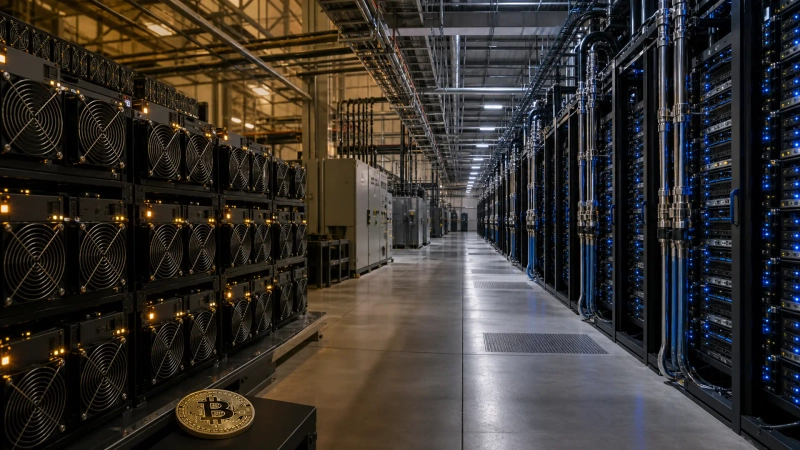
U.S. Bitcoin miners are rapidly shifting into artificial intelligence and high-performance computing data centers as falling Bitcoin prices and tougher mining economics erode profitability, while demand from AI companies for data centers and power surges.
Bitcoin has recently traded around $63,000 to $65,000, about half the record high near $125,000 reached last year. Even if miners produce the same amount of Bitcoin, their revenue inevitably declines.
Shrinking mining rewards are adding to the pressure. Following the halving in April 2024, the reward for mining a block fell to 3.125 Bitcoin from 6.25 Bitcoin. At the same time, network mining difficulty, which reflects the computing race among miners, remains elevated at about 127 trillion. Miners are spending more computing power and electricity while earning less Bitcoin.
Hashprice, a gauge of daily revenue per unit of computing power, has recently remained in the $30 range per PH/s. That leaves miners using older machines in regions with high electricity costs struggling to break even. CoinShares estimates that some operators running older equipment in markets where power prices exceed 6 cents per kilowatt-hour are losing money.
With their core business becoming less profitable, miners are increasingly reinventing themselves as AI infrastructure providers. Riot Platforms is one of the clearest examples. On Aug. 10, the company signed a 20-year agreement to lease 191 megawatts of data center capacity at its Rockdale, Texas, facility to an AI company. The contract is worth about $9.1 billion. If all extension options are exercised, the total could rise to $16.1 billion.
Riot did not disclose the counterparty, though foreign media reports identified it as likely Anthropic, the developer of the generative AI model Claude. Riot shares jumped more than 25% in after-hours trading after the deal was announced.
Riot had earlier signed a data center lease agreement with chipmaker Advanced Micro Devices. Including the latest contract, its total AI and HPC leasing capacity stands at 241 megawatts, with about $9.8 billion in long-term contract revenue. The company is seeking steadier cash flow through long-term leases instead of relying on mining, where performance swings with Bitcoin prices.
Bitdeer is also expanding its AI business. Its second-quarter AI cloud revenue increased about tenfold from a year earlier. In Norway, the company signed an AI data center contract that could generate about $4.7 billion in revenue over 16 years. It is also converting some U.S. mining facilities for AI use.
Some companies are leaving mining altogether. Clym Infrastructure, formerly Bitfarms, will shut down all of its U.S. Bitcoin mining operations and convert those sites into AI and HPC data centers.
From April through Aug. 7, Clym sold 1,085 Bitcoin for about $75 million to secure funding for AI data center development. The company's second-quarter revenue fell 50% from a year earlier, and it posted a net loss of $141 million.
"HPC creates far greater value from the same amount of power, and that value can remain predictable for years," Chief Executive Officer Ben Gagnon said. "That is why it is difficult to make additional investments in Bitcoin mining."
Bitcoin miners had signed 19 data center agreements with AI and cloud companies worth more than $135 billion as of mid-July, Bernstein said. S&P Global projects AI and HPC businesses will account for about 70% of total revenue this year at companies including IREN, Core Scientific and TeraWulf.
The industry increasingly views Bitcoin mining as a power infrastructure business. AI companies, which need vast amounts of electricity, typically spend years securing new sites and obtaining grid permits. Miners, by contrast, already have sites, large-scale grid connections and cooling systems in place, allowing them to begin operating data centers as soon as servers are installed.
"It takes about 50 months to secure 1 gigawatt of new power in the U.S.," Bernstein Research wrote. "Bitcoin miners with large sites already connected to the grid are bound to have an advantage in the AI data center market."

Doohyun Hwang
cow5361@bloomingbit.ioKEEP CALM AND HODL🍀