South Korea Crypto Trading Drops 62% From January, Far More Than Global Decline
Summary
- Monthly trading value on South Korea’s five largest crypto exchanges fell 61.6% from January, a steeper contraction than the global decline.
- Deposits fell 29.5% to 5.5 trillion won ($3.99 billion) in May from 7.8 trillion won ($5.65 billion) in January, suggesting demand for risk assets shifted from cryptocurrencies to equities.
- The sharp drop in domestic spot trading is leaving exchanges facing weaker fee revenue and the possibility of their worst-ever quarterly loss.
Forecast Trend Report by Period


Crypto Winter Deepens
Monthly turnover plunges 62% from the start of the year
Global spot trading falls 44%
Crypto once traded at three times Kospi volume
Now it is down to one-third of Kosdaq turnover
South Korea’s digital-asset market is sinking deeper into a slump. Weak global trading and a rally in local equities have combined to hit domestic volumes harder than overseas. The downturn is also exposing the limits of a market dominated by retail spot trading, adding pressure on local exchanges’ earnings.
Korea Bears the Brunt of the Volume Slump
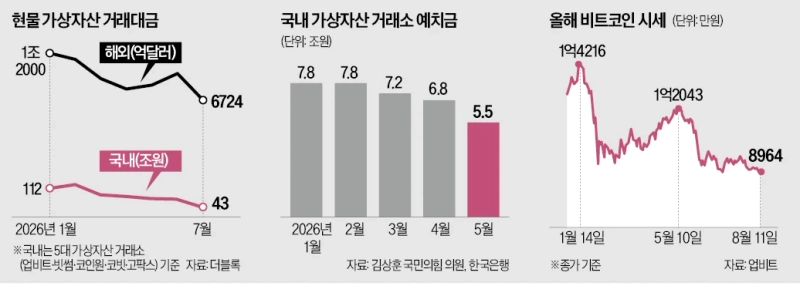
Monthly trading on South Korea’s five largest crypto exchanges — Upbit, Bithumb, Coinone, Korbit and Gopax — totaled 43 trillion won ($31.2 billion) last month, according to the crypto industry on Aug. 12. Average daily turnover was about 1.4 trillion won ($1.01 billion). Monthly trading was down 61.6% from 112 trillion won ($81.2 billion) in January. It was the lowest level since May 2023, when crypto winter pushed volume to 41 trillion won ($29.7 billion).
The slide in monthly turnover has been steep since February. Trading climbed to 126 trillion won ($91.4 billion) in February, then fell 30.2% to 88 trillion won ($63.8 billion) the following month. It then remained below 100 trillion won ($72.5 billion) for five straight months, ending at 43 trillion won ($31.2 billion) last month. That is the longest such stretch since the eight-month run from March through October 2023, when monthly trading also stayed below 100 trillion won.
The slump in spot crypto trading is global, but South Korea’s decline has been markedly sharper. Global spot turnover fell 44% to $672.4 billion last month from $1.2 trillion in January, according to crypto platform The Block. Global trading has dropped to a little more than half its January level. In South Korea, it has shrunk to about one-third.
Kim Kyu-jin, chief executive officer of Tiger Research, said the domestic market is structurally dominated by retail investors and heavily dependent on altcoin trading. Overseas markets have institutional flows and Bitcoin exchange-traded funds helping support volume. South Korea lacks that buffer, so when retail sentiment cools, trading drops directly with it.
Exchanges Brace for a Big Shift in Money Flows
The trend stands in sharp contrast to South Korea’s stock market. Domestic crypto trading hit a monthly peak in December 2024, when turnover reached 527 trillion won ($382.1 billion). That was about three times the 174.7 trillion won ($126.7 billion) traded on the Kospi that month, according to the Korea Exchange and the Bank of Korea’s economic statistics system. By last month, however, spot trading on the five exchanges had fallen to about one-third of the 134.6 trillion won ($97.5 billion) traded on the Kosdaq.
That suggests demand for risk assets has shifted from crypto to equities. Data the Bank of Korea submitted to the office of People Power Party lawmaker Kim Sang-hoon showed customer deposits at the five exchanges stood at just 5.5 trillion won ($3.99 billion) in May. That was down 29.5% from 7.8 trillion won ($5.65 billion) in January. The deposits are effectively cash waiting to be deployed into crypto investments.
Weaker sentiment toward crypto is also showing up in Bitcoin, the market’s bellwether asset. Bitcoin has failed to close above 100 million won ($72,500) in South Korea for more than two months. It ended at 89.64 million won ($65,000) on Upbit on Aug. 11, marking its first close in the 80 million won range this year. Kim Min-seung, head of research at Korbit, said the decline is smaller than in past downturns and the market structure has shifted toward institutional flows. Still, there is no clear catalyst in South Korea that could decisively revive trading volume.
The sharp drop in domestic spot trading is also flashing warning signs for exchange earnings. Unlike overseas venues, which can rely on futures trading and institutional investors, South Korean exchanges depend almost entirely on retail spot-trading fees for revenue. The exchanges are seeking new growth through mergers and acquisitions and equity investments, but a near-term hit to profitability appears unavoidable.
An industry official said fears are growing that the sector could post its worst quarterly loss on record because conditions are so weak. For now, there are few countermeasures available, the person added.
Park Si-on

Korea Economic Daily
hankyung@bloomingbit.ioThe Korea Economic Daily Global is a digital media where latest news on Korean companies, industries, and financial markets.