US 30-Year Treasury Auction Yield Hits 25-Year High as $40 Trillion Debt Load Fuels Supply Fears
Summary
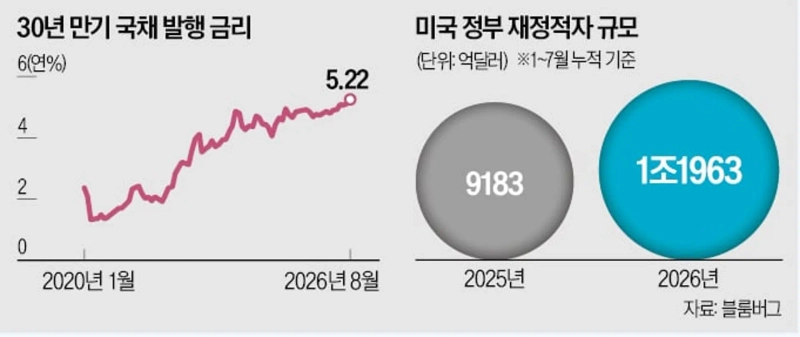
- The U.S. 30-year Treasury auction yield rose to 5.22%, the highest in 25 years, as investors demanded higher yields.
- A rising term premium on long-term Treasuries, driven by the $40 trillion U.S. national debt, a widening fiscal deficit and concern over heavier debt issuance, is making it harder for Treasury yields to fall quickly.
- While the U.S. Treasury has signaled reduced long-term debt issuance and increased short-term borrowing, the market says pressure on Treasury yields will persist without budget tightening.
Forecast Trend Report by Period



The yield on a new 30-year U.S. Treasury bond auction rose to its highest level in 25 years, diverging from a broader decline in market rates driven by hopes of easing inflation. Analysts say investors are demanding a bigger premium for long-dated government debt on expectations that the U.S. will have to keep increasing issuance because of its nearly $40 trillion debt load. In the market, concerns are growing that Treasury yields will not fall easily without budget tightening and measures to reduce the fiscal deficit.
◇ Strong Auction Demand, but at Higher Yields
The U.S. Treasury said the yield at its $25 billion auction of new 30-year bonds on Aug. 13 was set at 5.22%. That was the highest since 5.52% in August 2001. It was 0.16 percentage point above last month’s 5.06% and 0.31 percentage point higher than 4.91% in January 2025, just before Donald Trump took office as U.S. president. At the Treasury’s $42 billion auction of 10-year notes on Aug. 12, the yield came in at 4.68%, the highest since 2007.
The 30-year auction’s bid-to-cover ratio, which measures total bids relative to the amount offered, was 2.39, above the 2.36 average for the previous six sales. Indirect bids, a gauge of overseas demand, were 66.8%, slightly below the recent average of 67.0%. Gennadiy Goldberg, TD Securities’ head of U.S. rates strategy, said demand for long-dated bonds remains in place, but investors want higher yields.
◇ Worries Grow Over More Long-Term Debt Supply
Trading in the secondary market for outstanding Treasuries told a different story. Inflation worries eased after July consumer price index and producer price index data showed stable readings. The 30-year Treasury yield, based on the U.S. Treasury’s 3:30 p.m. fixing, fell 0.03 percentage point from the previous day to 5.21%, while the 10-year yield dropped 0.05 percentage point to 4.63%. The move reflected growing expectations that the Federal Reserve will leave its benchmark rate unchanged in September and through the end of the year.
Even so, the elevated auction yield underscored investor concern about longer-term uncertainty. The term premium, or extra compensation investors demand to hold long-term Treasuries, is increasing.
The clearest driver is the size of the U.S. national debt, which stood at $39.9419 trillion as of Aug. 11. The fiscal deficit is also widening. Through July, the cumulative shortfall reached $1.1963 trillion as higher rates pushed up refinancing costs and as tariff refunds and defense spending increased. That was 30.2% more than a year earlier.
At the same time, the U.S. government has given no sign of fiscal restraint, reinforcing expectations that Treasury issuance will keep rising. Investors want yields to reflect the prospect of greater supply.
Inflation concerns have not been fully resolved, either. July core and headline personal consumption expenditures prices, due on Aug. 26 and closely watched by the Fed in setting rates, are expected to remain above 3%. A recent rebound in oil prices is also likely to feed into August inflation. When investors anticipate faster price growth, they demand higher yields on long-term bonds.
Within the Fed, concern is also growing that competition in artificial intelligence investment could stoke inflation. Cleveland Fed President Beth Hammack, widely regarded as a hawk, said in a speech on Aug. 13 that companies are showing signs of overheating investment through fundraising and borrowing. That is adding to upward pressure on prices, she said.
◇ Treasury’s Burden Grows
That is adding directly to the Treasury Department’s financing burden. The department signaled on Aug. 5 that it could reduce long-term debt issuance in response to concerns about oversupply, indicating it would rely more on short-term bills to raise funds.
Issuing more short-term debt would reduce the government’s immediate interest burden on long-term borrowing. But it would also force the Treasury to refinance more frequently, leaving it more vulnerable to swings in interest rates. John Pass, a partner at BTG Pactual Asset Management, told Bloomberg on Aug. 13 that the only clear solution is budget tightening by the U.S. government. Adjusting the mix of short- and long-term debt would amount to an irresponsible stopgap, he said.
Hwang Jung-soo, New York correspondent, Korea Economic Daily, hjs@hankyung.com

Korea Economic Daily
hankyung@bloomingbit.ioThe Korea Economic Daily Global is a digital media where latest news on Korean companies, industries, and financial markets.