‘Should Have Listened’: Samsung Up Nearly 30-Fold, Seoul Apartment Prices Triple as Old Policy Calls Resurface
Forecast Trend Report by Period


Past remarks resurface online as stocks swing and home prices climb
Lee Myung-bak’s call to buy stocks would have yielded nearly 30-fold gains in Samsung Electronics
‘Just 30% more and you can buy a home’... Seoul apartment prices have roughly tripled
President Lee Jae-myung’s approval falls to 44%, with housing policy the top reason for disapproval
“If you buy stocks now, you will become rich within at least a year.” — former President Lee Myung-bak
“With jeonse prices at 70% of home sale prices, people need just 30% more to buy a home.” — then-Finance Minister Choi Kyung-hwan in the Park Geun-hye administration
Remarks that stirred controversy more than a decade ago are resurfacing online. Investors who bought Samsung Electronics when former President Lee Myung-bak talked up stocks during the global financial crisis would now be sitting on gains of nearly 30 times their money. Buyers who purchased a Seoul apartment in 2014, when the Park Geun-hye administration eased lending rules and encouraged home purchases, would have seen the average price roughly triple.
At the time, the comments drew criticism that the president was telling people to buy stocks and the government was urging households to take on debt to buy homes. Years later, the outcome looks very different. As Seoul home prices rise again and the stock market swings sharply, old clips are spreading across YouTube and online communities through recommendation algorithms. Responses include: “I should have listened back then,” and, “Only after the flowers fall do you realize they were flowers.”
The reaction is especially resonant among younger Koreans who feel they missed a chance to build wealth. Buying a home has become harder after property prices surged, while many who turned to stocks to grow their assets have recently been hit by market losses. At the same time, President Lee Jae-myung’s approval rating is falling. Support among voters in their 20s and 30s is weak, and backing from progressives, his core political base, has also dropped sharply. Housing policy ranked as the top reason for negative views of the president.
◇ ‘Buy Stocks and Get Rich’... Lee Myung-bak Video Resurfaces 18 Years Later
Lee made the remark in November 2008, when the global financial crisis was at its height. During a visit to Los Angeles, he told a reception for Korean expatriates that domestic stock prices had fallen sharply and that it was a time to buy rather than sell. “If you buy stocks now, you will become rich within at least a year.” He then added that he was not explicitly telling people to buy, but that stock prices had fallen too far relative to companies’ underlying value.
The comments quickly became controversial. Critics questioned whether it was appropriate for a sitting president to appear to recommend stock investing when no one could tell when the financial crisis would end.
Samsung Electronics was trading in the 400,000 won range at the time. Adjusted for the company’s 50-for-1 stock split in 2018, that works out to about 10,000 won a share on today’s basis. Lee did not specifically tell investors to buy Samsung Electronics. But anyone who bought and held the market bellwether for the long term would have seen the investment grow nearly 30-fold.
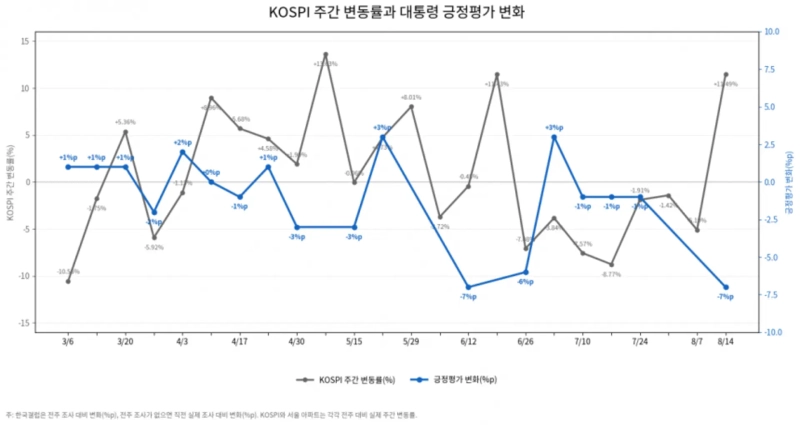
Recent stock investors have had the opposite experience. On July 28, the Kospi plunged 10.84% in a single day and fell another 5.98% on July 29. Circuit breakers were triggered on both days. The market lost 865 trillion won, or about $626 billion, in capitalization over the two sessions.
Young investors who borrowed to buy stocks appear to have been hit especially hard. An analysis in March of about 4.6 million retail accounts at two major South Korean brokerages found that investors in their 20s and 30s who used margin loans posted returns of minus 17.8% and minus 18.2%, respectively. That was more than twice the losses for peers who did not use margin, at minus 6.7% and minus 6.6%.
◇ ‘Just 30% More and You Can Buy a Home’... 12 Years Later
In the property market, policies from the Park Geun-hye administration are also being pulled back into view. Choi Kyung-hwan, who took office as finance minister in July 2014, said that with jeonse prices at 70% of sale prices, buyers needed only 30% more to purchase a home. The government later eased the loan-to-value ratio, or LTV, and debt-to-income ratio, or DTI.
The opposition at the time sharply criticized the policy as telling people to borrow to buy homes. Concerns also emerged that it would increase household debt and create more “house poor” owners if home prices fell.
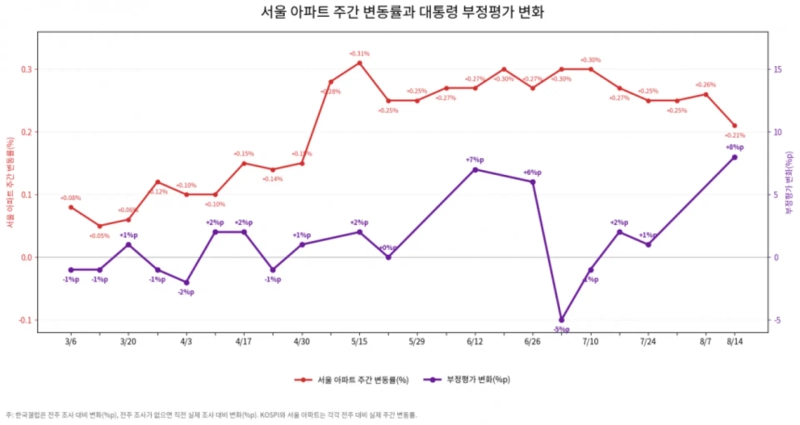
Seoul apartment prices then climbed for years. The average Seoul apartment, priced at about 500 million won in 2014, has recently risen to about 1.5 billion won, roughly three times as much. Choi also looked back on the policy in February, saying he still often hears from people thanking him and saying they were glad they bought a home then because they had listened to him.

By contrast, the barriers facing younger people who did not buy homes at the time have grown higher. In 2025, the homeownership rate among people age 39 and younger stood at 27.7%, below 30%. For those 60 and older, the figure was 68.5%, a gap of more than 40 percentage points. For homeowners, the rise in property prices over the past decade meant an increase in assets. For younger people without homes, it meant the amount needed to buy one rose by the same measure.
◇ Stocks Lost, Homes Out of Reach... Public Sentiment Wavers
The renewed attention on the two remarks reflects a widening generational wealth gap. Generations that bought homes when prices were relatively low benefited from the rise in property values. Younger people who came later to asset-building faced housing prices that had already surged. Many then turned to the stock market with relatively little starting capital, only to be hit by the recent selloff.
That sense of deprivation among younger voters may also be tied to the drop in President Lee’s approval. A Gallup Korea poll of 1,000 voters age 18 and older nationwide, conducted from August 11 to August 13 and released on August 14, found positive assessments of Lee’s job performance fell 7 percentage points from the previous poll to 44%. Negative assessments rose 8 percentage points to 46%. A comparison of the president’s approval rating with moves in the Kospi and the property market suggests they have recently moved in tandem.
Graphic: Shin Hyun-bo
Graphic: Shin Hyun-bo
A notable point is the erosion of Lee’s existing support base. Positive assessments of his job performance among progressives fell to 70% from 83% in the previous poll, a drop of 13 percentage points. That was the largest decline among ideological groups. Support among younger voters is also weak. With negative views of housing policy particularly high among people in their 20s and 30s, continued volatility in the property and stock markets could turn younger voters’ sense of deprivation into a political burden.
The survey cited in the article was conducted through interviewer-administered telephone polling using randomly selected virtual mobile numbers. The margin of error was plus or minus 3.1 percentage points at a 95% confidence level, and the response rate was 9.7%. More details are available on the website of the National Election Survey Deliberation Commission.
Shin Hyun-bo, Hankyung.com reporter greaterfool@hankyung.com

Korea Economic Daily
hankyung@bloomingbit.ioThe Korea Economic Daily Global is a digital media where latest news on Korean companies, industries, and financial markets.