KB Securities’ Lee Says AI Bubble’s Breaking Point Will Be Signaled by Rates
Summary
- Lee Eun-taek of KB Securities said the AI industry bubble is not yet near collapse.
- He said the signal that would put the brakes on hyperscalers’ CAPEX would be a sustained rise in interest rates and a break above 5.0% to 5.5% on the US 10-year Treasury yield.
- He said recent concerns over slowing AI demand and token costs are easing, while token optimization and price competition are underway.
Forecast Trend Report by Period


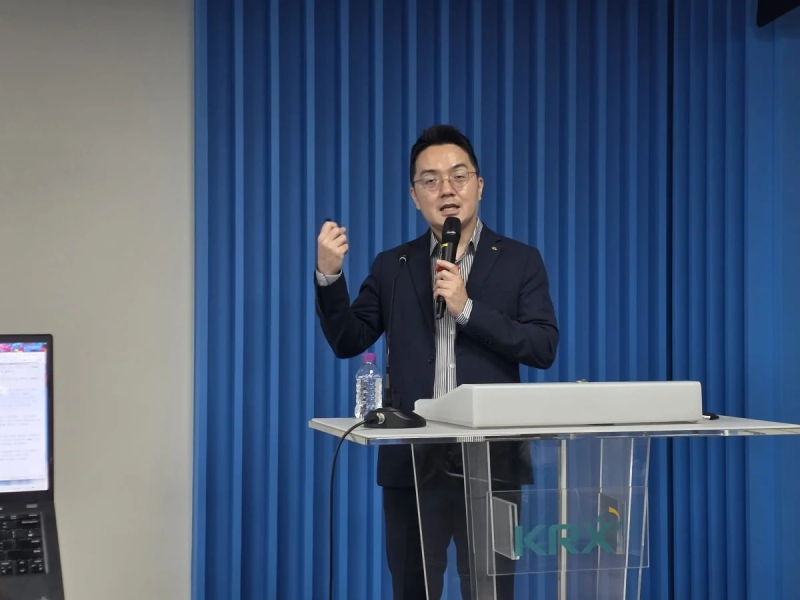
The stock-market bubble driven by enthusiasm for the artificial intelligence industry is not yet near collapse, according to Lee Eun-taek of KB Securities. Interest rates have not risen enough to force hyperscalers, or operators of large-scale data centers, to slam the brakes on capital spending.
The signal that the bubble is nearing its breaking point would be an irreversible rise in interest rates that curbs hyperscalers’ capital expenditure, he said.
Lee, a director at KB Securities, made the remarks at a briefing at the Korea Exchange on August 18. The parties that would ultimately halt AI investment are capital providers, he said, referring to creditors that fund hyperscalers’ AI infrastructure spending.
Big Tech companies are highly unlikely to stop investing on their own because they have already succeeded in enduring losses while continuing to spend and ultimately dominating markets, Lee said. Investment will stop only when capital providers such as banks, pension funds and venture capital firms, whose priority is recovering principal and collecting interest, detect risk and tighten funding.
If creditors start to sense danger through deteriorating free cash flow or rising credit-default swap premiums, the supply of capital could dry up and the bubble phase could end.
Lee cited a sustained rise in interest rates as the common denominator behind the three major bubble collapses of the past 130 years: the Great Depression of the 1930s, stagflation in the 1970s and the dot-com bubble in the 2000s. Short-term spikes in rates were mostly buying opportunities, he added. For a bubble to actually burst, two conditions must be met.
First, policymakers must want to cut rates but be unable to do so because inflation is surging, creating an irreversible “No Way Back” scenario, he said. Second, yields must jump to levels not seen in 10 to 20 years in a “Breaking to New Highs” move.
More specifically, Lee said the threshold for a bubble collapse would come into view if the yield on the US 10-year Treasury rises on a sustained basis above 5.0% to 5.5%. That would accelerate a shift into safe assets and mark a break above highs seen in 2002 and 2007.
The yield on the US 30-year Treasury rose above 5.3% overnight, surpassing its 2007 level. Lee called that noteworthy, but said it mattered less than moves in the benchmark 10-year yield.
He also said it is too early to worry about the recent debate over slowing AI demand and profitability. Concerns about token costs helped trigger a stock pullback, but those fears are now easing.
Lee said the stock correction from late June through July was driven by concern that demand for frontier AI models from OpenAI and Anthropic could weaken because of token-cost issues. Chinese AI models also drew attention as an alternative as questions mounted over the token costs of US frontier AI models.
Since then, operators of US frontier AI models have cut prices. Companies using frontier models have also reduced their reliance on top-tier systems and begun assigning simpler tasks to cheaper models as part of an optimization push.
Until this spring, the dominant approach was “token maxing,” or concentrating resources on high-performance models, Lee said. More recently, the paradigm has shifted to “token optimization,” which mixes high-performance frontier models with cheaper open-source models to control costs. Short-term concerns stemming from intensifying price competition, including the rise of Chinese AI models and OpenAI’s price cuts, have already been largely priced into stocks.
Han Kyung-woo, Hankyung.com reporter case@hankyung.com

Korea Economic Daily
hankyung@bloomingbit.ioThe Korea Economic Daily Global is a digital media where latest news on Korean companies, industries, and financial markets.