Fidelity Loses $513 Million in Korea Fund Assets in Six Months as Market Share Falls to 0.29%
Summary
- Fidelity Asset Management’s fund assets in South Korea fell by $513 million in six months, pushing its domestic market share down to 0.29%.
- Fidelity funds are being shunned by major distributors and investors because their returns were 84.4% over three years, below rivals while total fees stand at 1.019%.
- The flagship Fidelity Global Technology Securities Investment Trust and Fidelity Asia Securities Investment Trust (Equity) A posted weak returns versus benchmarks and rivals, driving pronounced outflows.
Forecast Trend Report by Period


Fidelity Asset Management, the world’s third-largest asset manager after BlackRock and Vanguard Group, is struggling in South Korea. Even as strong gains in domestic and global stock markets fueled demand for higher-return funds in the first half, Fidelity recorded negative growth as sales through major brokerages and banks slumped. Industry officials say the firm’s relatively weak fund performance, combined with high fees, has turned investors away.
◇ Fund Sales Slump Despite Market Rally
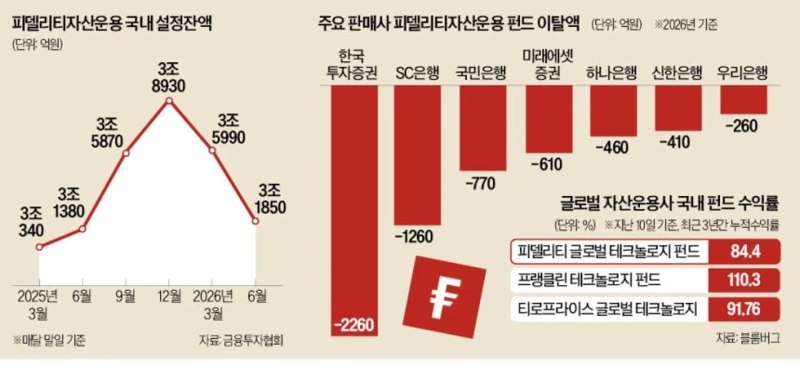
Data from the Korea Financial Investment Association show that funds launched by Fidelity in South Korea had 3.185 trillion won ($2.3 billion) in assets under management as of the end of June. The total had climbed to 3.893 trillion won ($2.8 billion) at the end of last year, but fell to 3.599 trillion won ($2.6 billion) by the end of March as outflows gathered pace.
Assets dropped by 708 billion won ($513 million) in the first six months of the year from the end of 2025, pulling Fidelity’s market share in South Korea down to 0.29% from 0.39%. That stood in contrast to the broader Korean fund market, where total assets rose to 1,061.843 trillion won ($769.5 billion) in the second quarter from 990.385 trillion won ($717.7 billion) in the fourth quarter of last year.
Fidelity’s shrinking footprint in South Korea reflects weakening demand across major distribution channels, including local securities firms and banks. Korea Financial Investment Association data show fund assets fell across Fidelity’s top 10 sales channels.
At Korea Investment & Securities, assets in Fidelity funds fell to 902 billion won ($653 million) at the end of June from 1.128 trillion won ($817 million) at the end of last year, a decline of 226 billion won ($164 million) in six months. At KB Kookmin Bank, assets fell to 400 billion won ($290 million) from 477 billion won ($346 million). Hana Bank saw assets drop to 317 billion won ($230 million) from 363 billion won ($263 million). Standard Chartered Korea recorded a decline of 126 billion won ($91 million), while Mirae Asset Securities, Shinhan Bank and Woori Bank posted decreases of 61 billion won ($44 million), 41 billion won ($30 million) and 26 billion won ($19 million), respectively.
◇ Investors Shun Underperforming Products
Fund industry officials say Fidelity’s relatively low returns and fee structure have weighed on demand. The outflows were especially notable in the first half, when money poured into exchange-traded funds during a rally in domestic and overseas equities, weakening the position of traditional publicly offered funds. One brokerage official said Fidelity’s fund structure tends to produce relatively weaker returns, prompting investors in a rising market to move into products better positioned to benefit.
One example is the Fidelity Global Technology Securities Investment Trust, one of the company’s flagship products in South Korea. Bloomberg data show the fund returned 84.4% over the past three years as of Aug. 10. That lagged Franklin Templeton’s rival technology fund, which posted a 110.3% return in the Korean market. One fund manager said Fidelity products carry a heavy weighting in TSMC but lack exposure to Nvidia, which has driven the stock rally. Rival technology funds have aggressively added key artificial-intelligence beneficiaries such as Nvidia, and that gap in portfolio strategy has translated into a wider long-term performance gap.
Another key product, Fidelity Asia Securities Investment Trust (Equity) A, has also underperformed. According to FUN ETF, the fund posted a cumulative three-year return of 23.02%, trailing its benchmark by 50.83 percentage points. The benchmark returned 73.85%.
Industry officials say Fidelity’s weak performance, paired with relatively high fees, has further discouraged investors. Korea Financial Investment Association data show Fidelity’s total fee, including management, sales, custody and administrative charges, stood at 1.019% at the end of June, above the 0.808% average for foreign asset managers.
Bae Seong-su, Hankyung.com reporter baebae@hankyung.com

Korea Economic Daily
hankyung@bloomingbit.ioThe Korea Economic Daily Global is a digital media where latest news on Korean companies, industries, and financial markets.