Kospi Turnover Slumps to 25.7 Trillion Won as Samsung, SK Hynix Lead Rebound
Forecast Trend Report by Period


Average daily trading value this month drops to 25.7 trillion won, the lowest this year
About half the level in May and June, when turnover topped 50 trillion won
Retail investors pull back after last month’s sharp selloff
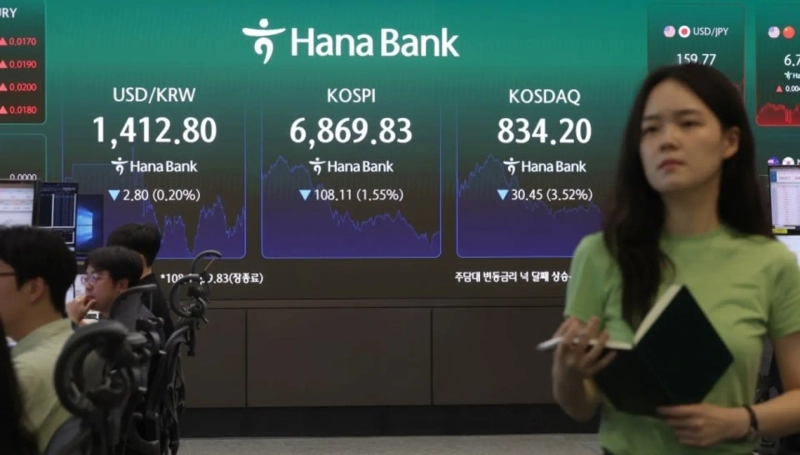
Trading volume and turnover on the Kospi have fallen to their lowest levels this year, pointing to a loss of momentum beneath the benchmark index’s rebound. Average daily trading value has shrunk to 25.745 trillion won this month, about half the level seen in May and June when it exceeded 50 trillion won, while volume has retreated to levels last seen in August 2025. The drop suggests retail investors have turned cautious after suffering heavy losses in last month’s selloff.
Data from the Korea Exchange showed average daily trading value on the Kospi at 25.745 trillion won so far this month, the lowest this year. Average daily trading volume also fell to a yearly low of about 321 million shares, returning to the August 2025 level of 318 million shares. Trading value remains above last year’s Kospi daily average of 12.4 trillion won, but is well below the levels reached during this year’s market surge.
The Kospi’s average daily trading value was 27.056 trillion won in January, 32.234 trillion won in February, 30.143 trillion won in March and 29.551 trillion won in April. It then jumped to 50.215 trillion won in May and 50.347 trillion won in June, topping 50 trillion won for two straight months as the index climbed sharply. Turnover fell to 36.875 trillion won in July as volatility intensified, and has dropped further to the 25 trillion won range this month. Trading value has effectively been cut in half in a little over two months.
The index itself has been recovering. After sliding into the 5,000 range during July’s selloff, the Kospi has rebounded since last week, led by Samsung Electronics and SK Hynix. It was trading around the 7,000 level intraday on Aug. 18.
The divergence between the index and trading activity appears to reflect weaker retail investor sentiment. Individual investors, who drove the sharp rise in trading volume and value in the first half, have held back after last month’s market rout and losses on leveraged positions. The recent rebound has been driven in large part by foreign buying of heavyweight semiconductor shares.
A drop in trading activity alone does not mean the market’s advance has run its course, analysts said. Still, they cautioned it is too early to call the rebound a sustained upswing backed by a broader recovery in sentiment. “The index is rebounding, but it is hard to view this as a trend reversal accompanied by a recovery in sentiment,” Huh Jae-hwan, an analyst at Eugene Investment & Securities, said. It is evidence that investors remain uneasy, he added.
Huh said expectations for the semiconductor industry remain high, but earnings forecasts for chipmakers are no longer being revised higher as quickly as before. Higher interest rates are also weighing on US stocks, he said.
Sustained foreign inflows will be crucial if the Kospi is to climb further from current levels. Foreign investors were net buyers of 9.4915 trillion won on the Kospi over five straight trading sessions from Aug. 11 through Aug. 18. They turned into heavy sellers after the index first rose above 7,000 on May 7 and remained net sellers through Aug. 10 by a cumulative 116.7235 trillion won, or 1.7957 trillion won a day on average.
“Each time uncertainty eased, foreign investors led the index higher with net buying of large semiconductor stocks,” Lee Jae-won, an analyst at Yuanta Securities, said. “That confirms once again that strong foreign flows are the main driver of gains in the Kospi.”
Lee said a return to sustained foreign net buying will be important for the Kospi to extend its uptrend. Easing rate concerns tied to moderating inflation and a recent decline in the Kospi 200 Volatility Index, or VKOSPI, have created a favorable backdrop for foreign investors to return. The gauge, often called South Korea’s version of the fear index, closed at 56.97 on Aug. 18, staying in the upper-50s.
Kang Kyung-ju, Hankyung.com reporter, qurasoha@hankyung.com

Korea Economic Daily
hankyung@bloomingbit.ioThe Korea Economic Daily Global is a digital media where latest news on Korean companies, industries, and financial markets.