PiCK
Kospi Slides 5.8% as 30-Year Treasury Yield Shock Rekindles Fears of a July-Style Rout
Summary
- Experts said a surge in the US 30-year Treasury yield sparked a broad selloff in South Korea's large-cap semiconductor stocks, pushing the Kospi back into the 6,400 range.
- Brokerages said the shock's impact may be limited because the US 10-year Treasury yield remains below 5% and the Kospi's 12-month forward PER has already fallen.
- Han Ji-young said a July-style market rout is unlikely to be repeated, citing the Kospi's forward PER of 5.6 times and companies' underlying strength.
Forecast Trend Report by Period


Will a Treasury Yield-Driven Triple Slump Return? A July-Style Meltdown Is Unlikely, Analysts Say
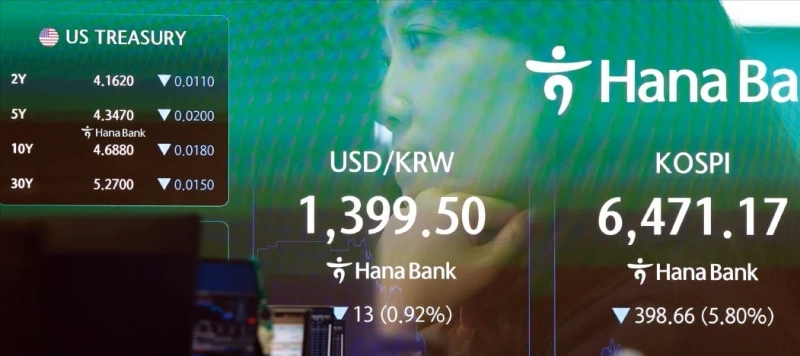
Until recently, the 30-year US Treasury yield had not been a major concern for equity investors. Markets were focused instead on whether the Federal Reserve would raise rates, second-quarter earnings from Big Tech and chipmakers, and ceasefire talks between the US and Iran. But after a synchronized global equity selloff, the 30-year Treasury yield, which climbed to its highest level in 19 years, has emerged as a focal point. Yields in South Korea, Japan and Germany also jumped, weighing on local stock markets.
On Aug. 19, the Kospi closed down 5.80% at 6,471.17. The benchmark fell sharply from the open, prompting the Korea Exchange to trigger a sell-side sidecar that halted the effect of program sell orders on the main board for five minutes. It was the second such measure in eight trading days, after one was triggered on Aug. 6.
Semiconductor heavyweights led the rout. Samsung Electronics fell 7.82%, SK Hynix lost 9.75% and SK Square dropped 11.54%. After touching 7,000 on Aug. 18, the Kospi slipped back into the 6,400 range. The Kosdaq closed down 1.17% at 824.46.
Rising long-term US Treasury yields were a key drag on equities. Overnight, the 30-year Treasury yield climbed to 5.33%, the highest since 2007. Sentiment deteriorated sharply in US stocks, especially in semiconductors, with the Philadelphia Semiconductor Index sliding 4.98%. Kim Ki-baek of Shinhan Securities said rising long-term yields across the US, Japan and Europe had increased discount-rate pressure on growth stocks and revived concerns over capital spending, leaving technology shares under pressure.
The won strengthened to 1,397.7 per dollar as of 3:30 p.m., gaining 14.1 won from the previous session. It was the first time in about 10 months that the exchange rate had returned to the 1,300-won range.
Kospi Crumples Near 7,000. Where Does the Market Go Next?
US Fiscal Deterioration Is the Root Cause, but Korean Stocks Are More Sensitive to the 10-Year Yield
Historically, the US Treasury yield that has had the most direct impact on South Korean equities has been the 10-year note. A notable example was 2023, when the 10-year yield rose above 5% on concern that US monetary tightening would last longer. At the time, Korean stocks, bonds and the won all fell together in a so-called triple slump. The Kospi slid from the 2,600 range to the 2,200 range.
The near-6% drop in the Kospi on Aug. 19, however, was unusually tied to the 30-year yield. The 30-year bond typically has less influence on equities than the 10-year note. This time, it amplified concern over financing costs, a key variable for artificial-intelligence stocks, and dragged down large-cap names such as Samsung Electronics and SK Hynix.
Rate Shock Hits Nvidia Too
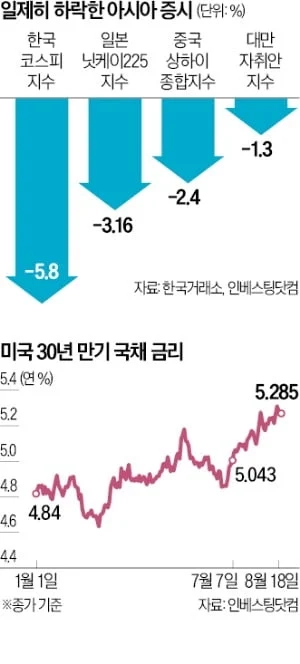
The Kospi closed at 6,471.17 on Aug. 19, down 5.80% from the previous session. Bellwether stocks including Samsung Electronics, down 7.82%, and SK Hynix, down 9.75%, led the decline. Other large-cap shares also fell broadly, including SK Square, down 11.54%, Samsung Electro-Mechanics, down 3.68%, and Hyundai Motor, down 4.83%.
The main driver was a chain reaction in government bond yields across major economies. Overnight, the 30-year US Treasury yield rose as high as 5.33%, its highest level since 2007. It later eased slightly to close at 5.285%, but that was still above the 4.8% range at the start of the year. The rise in long-dated US yields spread to Japan, Germany and France. Nvidia fell 2.34% and Micron Technology dropped 7.02%. Pressure also mounted just before Asian markets opened, when Pennsylvania's governor signed an executive order requiring environmental and community approval for AI data center construction, raising concerns about delays.
Experts point to three reasons for the surge in long-term Treasury yields. The immediate trigger was higher oil prices. With US-Iran ceasefire talks breaking down and a vessel struck overnight in the Strait of Hormuz, Brent crude futures for October delivery remained above $90 a barrel for a second straight day. That fueled concern that rising oil prices could stoke inflation and push the Federal Reserve toward further rate hikes, intensifying selling in long-dated bonds. A more fundamental cause is worsening US fiscal conditions. Federal government debt has recently reached $40 trillion, prompting investors to demand a higher risk premium on long-term Treasuries.
'Kospi Has Already Corrected, So the Impact May Be Limited'
Another key factor was corporate bond issuance by Big Tech. The five largest hyperscalers — Amazon, Microsoft, Google, Meta Platforms and Oracle — sold $159 billion of corporate bonds in the first half alone to build AI data centers. That has already exceeded last year's total.
As investors shift from US Treasuries into high-grade corporate debt yielding 6% to 7%, markets are demanding higher yields on government bonds as well. Concern is also growing that Japan, the largest foreign holder of US Treasuries, could sell some of its holdings as rising yields on its own long-dated bonds make domestic debt more attractive. Park Sang-hyun of iM Securities said the chances were increasing that a rate shock similar to the one seen in the UK during Liz Truss's tenure as prime minister in 2022 could become reality if Japanese government bond yields rise further.
For South Korean stocks, brokerages see higher long-term Treasury yields as a clear burden, but one whose impact may be limited. The rationale is that the 10-year US Treasury yield, which has a more direct effect on Korean equities, was still below 5% at 4.706% as of Aug. 18. Another factor is valuation. After July's correction, the Kospi's 12-month forward price-to-earnings ratio has already fallen enough to ease valuation pressure.
Han Ji-young of Kiwoom Securities said the Kospi's forward PER was in the low- to mid-7 times range when the 30-year US Treasury yield traded above 5% in the first half. It now stands at just 5.6 times. Given companies' underlying strength, that should provide downside support for the market.
Kang Jin-kyu, Lee Sun-a and Park Ju-yeon, Korea Economic Daily reporters josep@hankyung.com

Korea Economic Daily
hankyung@bloomingbit.ioThe Korea Economic Daily Global is a digital media where latest news on Korean companies, industries, and financial markets.