China’s Unitree Jumps 460% in Shanghai Debut, Pressuring Korean Robot Stocks
Summary
- Unitree’s market capitalization reached about 341.8 billion yuan after the stock surged 460.34% from its IPO price on its first day on the STAR Market.
- Unitree’s valuation rose 26-fold from the fundraising stage as it posted strong profitability, with a 210x PSR, 278.2 million yuan in net income, and a 60.5% gross margin.
- Korean robot stocks are facing concerns over a rerating because of gaps in PSR and profitability, while U.S. import restrictions on Chinese-made robots could create spillover benefits for Korean companies such as Robotis.
Forecast Trend Report by Period


Humanoid leader raises 6.1 billion yuan in STAR Market listing
Valuation jumps 26-fold from last fundraising round
Mass-production capacity and steady earnings stand out
Korean robot makers seen as overvalued despite losses
U.S. curbs on Chinese robots may still aid Korean peers

Unitree, the world’s largest humanoid robot maker, listed on the Shanghai Stock Exchange’s STAR Market. The stock briefly rose to more than seven times its offering price after trading began. Investors hunting for the next growth industry piled into the shares, drawn by a humanoid robot maker with both mass-production capacity and earnings. Korean robot stocks, however, fell on Aug. 19 amid concerns that they look expensive relative to Unitree. Some brokerages said Korean companies could still benefit if the U.S. tightens import restrictions on Chinese-made robots.
World’s biggest humanoid robot maker surges on debut
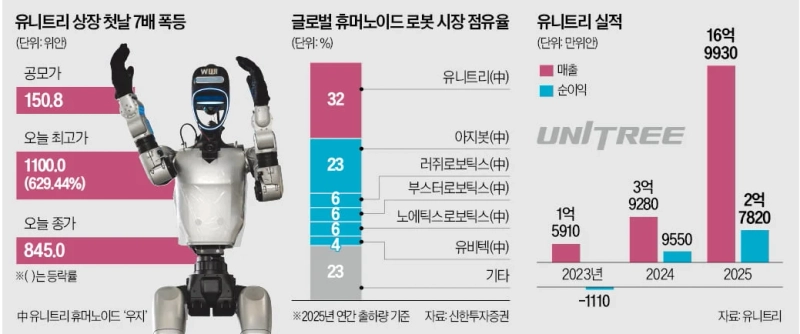
Unitree closed at 845 yuan on Aug. 19 after listing on Shanghai’s STAR Market, the exchange’s technology board. The IPO price was 150.8 yuan, leaving the stock up 460.34% at the close.
The shares climbed as high as 1,100 yuan, or about $153, shortly after trading opened. That marked a 629.44% jump from the offering price before the stock gave back some of its gains late in the session.
The company raised about 6.1 billion yuan, or roughly $849 million, in the offering. Its market capitalization reached about 341.8 billion yuan, or roughly $47.5 billion, based on the closing price. That is more than 26 times its 12.7 billion yuan valuation at the pre-IPO Series C fundraising stage.
The listing makes Unitree the first humanoid robot maker to go public on mainland China’s stock market. Another Chinese humanoid robot company, UBTECH, is listed in Hong Kong.
Investor appetite was strong even before the listing because Unitree held the largest share of the global humanoid market last year, at about 32%. About 9.78 million accounts took part in the online subscription. The final allotment rate was 0.01809759%, the lowest ever recorded on the STAR Market.
Pressure on Korean robot makers
Most Korean robot stocks fell on Aug. 19. Rainbow Robotics closed down 1.60% at 462,500 won. Other major names also posted sharp declines, with Doosan Robotics down 3.90% and Robotis falling 4.30%.
The concern is that Unitree’s listing could weigh on valuations for Korean robot manufacturers. EpicAI, an artificial intelligence-based investment information platform, puts Unitree’s price-to-sales ratio at about 210.
Unitree posted net income of 278.2 million yuan, or about $38.7 million, last year. Its gross margin was 60.5%, above the industry average of 44.4%.
Rainbow Robotics, a loss-making Korean humanoid robot company, trades at a price-to-sales ratio of 236.9, higher than Unitree’s despite Unitree’s stronger profitability.
Doosan Robotics, at about 139.5, and Robotis, at 100.2, trade at lower multiples than Rainbow Robotics. Even so, concerns are rising that both could face a rerating because their profitability lags far behind Unitree’s.
Brokerages also say Korean companies could benefit as the U.S. government steps up restrictions on Chinese-made robots. The Federal Communications Commission recently added humanoid and quadruped robots to a list subject to import restrictions, blocking further expansion by Chinese-made robots.
Some analysts have highlighted Robotis as a company that could benefit in both China and the U.S. The company has been rapidly increasing sales in China with its QDD actuator, which is optimized for lower-cost humanoid robots.
Lee Sang-soo, an analyst at iM Securities, said additional orders tied to supply-chain realignment in North America could drive sharp revenue growth. He added that Robotis’s plant in Uzbekistan is due to begin full-scale operations in the fourth quarter, increasing production capacity fivefold from current levels and lowering costs in the actuator assembly process.
Oh Hyun-ah, reporter / Kim Eun-jung, Beijing correspondent 5hyun@hankyung.com

Korea Economic Daily
hankyung@bloomingbit.ioThe Korea Economic Daily Global is a digital media where latest news on Korean companies, industries, and financial markets.