Forecast Trend Report by Period


Board to Decide by End of August
Record Special Dividend May Be Included
Samsung Electronics Co. plans to unveil a shareholder return package worth about 150 trillion won ($108.4 billion) this month, which would mark the largest such plan by a South Korean listed company.
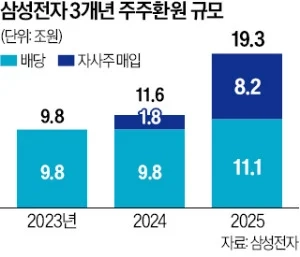
Industry officials said on Aug. 20 that Samsung plans to convene its board this month to approve a shareholder return proposal centered on share buybacks and a special dividend. The package is expected to total about 150 trillion won ($108.4 billion) this year. Some investors had speculated the figure could be as high as 200 trillion won ($144.5 billion), but the company is expected to stick to its policy of returning 50% of free cash flow to shareholders. A senior company official said cash generation has improved sharply as the memory-chip market recovers and that the company will announce a measure investors can clearly feel.
Investors expect Samsung's package to include a large special dividend, unlike SK Hynix Inc.'s approach of focusing on share buybacks and cancellations. SK Hynix announced on Aug. 19 a 40 trillion won ($28.9 billion) share buyback and retirement plan aimed at supporting its stock price. Samsung is also expected to disclose a buyback plan tied to more than 30 trillion won ($21.7 billion) in special performance bonuses for employees this year. A brokerage official said aggressive shareholder returns from Samsung, following SK Hynix, would provide strong momentum for efforts to boost valuations in South Korea's stock market.
Buybacks and Special Dividend: Samsung Steps Up Push to Raise Shareholder Value
Memory Boom Drives Record Free Cash Flow as Tougher Return Rules Come Into Focus
Samsung is preparing a record shareholder return package worth about 150 trillion won ($108.4 billion) this year. The main driver is robust cash generation from the memory-chip supercycle. The company is forecast to post annual operating profit of 380 trillion won ($274.6 billion) this year, putting it on track for the largest free cash flow in its history. Brokerage estimates put annual free cash flow at 263 trillion won ($190.1 billion).
A large special dividend is emerging as the centerpiece of the plan. Based on brokerage estimates, Samsung's cumulative free cash flow for 2024 through 2026 would total about 319 trillion won ($230.6 billion). Under the company's policy of returning 50% of free cash flow, that leaves about 160 trillion won ($115.6 billion) available for shareholder returns. After deducting 39.1 trillion won ($28.3 billion) already paid or scheduled, nearly 120 trillion won ($86.7 billion) would remain. Market participants expect much of that balance to be returned through a one-time special dividend on top of the regular annual dividend of 1,668 won ($1.21) a share.
A large share buyback is also under consideration. The move is intended to offset the impact on market supply from more than 30 trillion won ($21.7 billion) in special performance bonuses to be paid under this year's labor-management agreement. Samsung plans to repurchase shares in line with the timing of those bonus payments.
There is also speculation that Samsung could strengthen its shareholder return framework itself. SK Hynix on Aug. 19 raised its payout standard from within 50% of cumulative free cash flow to 50% or more. That has fueled expectations Samsung could lift its current 50% free-cash-flow guideline to above 50% or otherwise raise its minimum payout threshold.
Brokerages estimate combined shareholder returns from Samsung and SK Hynix this year could reach as much as 250 trillion won ($180.7 billion). SK Hynix announced a 40 trillion won ($28.9 billion) buyback and cancellation plan on Aug. 19. Including additional measures that may be announced with third-quarter earnings, SK Hynix's total annual shareholder return could reach 100 trillion won ($72.3 billion).
An industry official said the move reflects a willingness to share with shareholders the gains generated during the semiconductor supercycle. Large-scale shareholder returns backed by strong cash generation would help lift corporate value and provide a powerful boost to the broader South Korean stock market, the person added.
Kim Chae-yeon and Won Jong-hwan, Hankyung reporters why29@hankyung.com

Korea Economic Daily
hankyung@bloomingbit.ioThe Korea Economic Daily Global is a digital media where latest news on Korean companies, industries, and financial markets.