SK Hynix, Samsung Lead Kospi's 5.9% Surge on Shareholder Return Push
Summary
- After SK Hynix announced a 40 trillion won ($28.9 billion) share buyback and retirement, SK Hynix and Samsung Electronics surged, helping the Kospi close 5.9% higher.
- Brokerages said SK Hynix’s FCF-based shareholder-return capacity is estimated at 181.5 trillion won to 211 trillion won ($130.8 billion to $152 billion), raising the prospect of a re-rating for the memory industry.
- Expanded share buybacks and dividends could intensify the shareholder-return competition between SK Hynix and Samsung Electronics, creating a new driver for their stocks and potentially supporting the won.
Forecast Trend Report by Period


Closes at 6,852.58; 24th buy-side sidecar this year is triggered
After announcement of a 40 trillion won ($28.9 billion) share buyback and retirement
SK Hynix jumps 12.7% in one day
JPMorgan sees room for 181.5 trillion won ($130.8 billion) more in shareholder returns
“40 trillion won is only the beginning.”
SK Hynix’s biggest-ever share buyback and retirement plan has raised expectations for broader shareholder returns. The larger-than-expected move signaled that memory makers are willing to return more cash to investors as the AI-driven supercycle strengthens confidence in their long-term cash-generation capacity.
Brokerages in South Korea and overseas estimate SK Hynix could allocate at least 180 trillion won ($129.7 billion), and as much as 210 trillion won ($151.3 billion), to additional shareholder returns. Samsung Electronics is also planning a program of about 150 trillion won ($108.1 billion), setting up a shareholder-return race between the two companies as cash piles up from the AI memory boom.
SK Hynix Moves Quickly on Buybacks
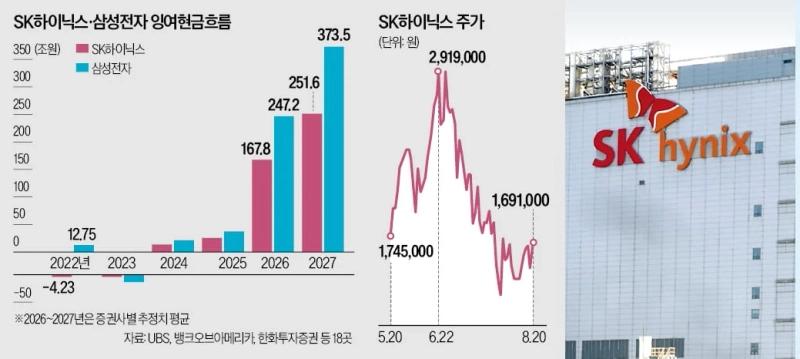
On Aug. 20, SK Hynix rose 12.7% to close at 1.691 million won. The rebound came a day after the stock slumped 10% on higher long-term interest rates and concern over AI revenue.
SK Square, SK Hynix’s largest shareholder, also jumped nearly 12%, while Samsung Electronics and Samsung Electronics preferred shares each gained about 10%.
The Kospi rose 5.9% to 6,852.58 as the two chipmakers rallied. A buy-side sidecar, a curb on program trading, was triggered early in the session for the 24th time this year. Foreign investors were net buyers of 1.7117 trillion won ($1.23 billion), helping lift the index despite net selling of 2.2791 trillion won ($1.64 billion) by individual investors.
The trigger for the rally was SK Hynix’s surprise announcement after the market closed on Aug. 19 of a 40 trillion won ($28.9 billion) share buyback and retirement plan. Investors also responded positively to news that labor and management had reached a tentative collective bargaining agreement to pay 60% of bonuses in treasury shares. The arrangement would spread out cash payments and could create demand for additional buybacks later.
SK Hynix moved immediately, starting share purchases on Aug. 20 with 650,000 shares. That was about 68% more than the daily average of 388,000 shares implied by evenly buying 24.07 million shares over three months. The pace suggested management sees the stock as undervalued and wants to move fast from the outset.
'At Least 181.5 Trillion Won to 211 Trillion Won More Can Be Returned'
Brokerages said the move could become the starting point for a re-rating of the memory industry. As cash generated by AI investment begins flowing back to shareholders in earnest, investors may look beyond the sector’s cyclicality and peak-out concerns and focus more on shareholder value.
SK Securities wrote that the key point is that the company can increase investment for growth while still securing overwhelming capacity for shareholder returns, and that management has begun turning that capacity into concrete returns. Wider adoption across the sector is only a matter of time, the firm added.
Wall Street has focused on SK Hynix’s decision to raise its shareholder-return policy for cumulative free cash flow in 2025-2027 from “up to 50%” to “50% or more.” That means the ceiling on funds available for shareholder returns has effectively increased.
JPMorgan estimates SK Hynix can provide at least 181.5 trillion won ($130.8 billion) in additional shareholder returns by 2027. The figure is based on 50% of the bank’s projected cumulative free cash flow of 475 trillion won ($342.3 billion) over three years, or 237.5 trillion won ($171.1 billion), minus about 56 trillion won ($40.4 billion) in already announced buybacks, share retirement and dividends.
The total could increase if the memory cycle lasts longer, the company’s cash generation grows further or the payout ratio rises above 50%. The average forecast from 18 domestic and overseas brokerages that updated SK Hynix free cash flow estimates over the past month points to 167.8 trillion won ($120.9 billion) in 2026 and 251.6 trillion won ($181.2 billion) in 2027. UBS, the most aggressive forecaster, projects 188 trillion won ($135.4 billion) this year and 320 trillion won ($230.6 billion) next year. On that basis, additional shareholder-return capacity would reach 211 trillion won ($152 billion).
A large-scale buyback could also support the Korean won. If SK Hynix repatriates part of its overseas dollar holdings to fund share repurchases, that would create demand to sell dollars and buy won.
Bin Nan-sae, Hankyung.com reporter binthere@hankyung.com

Korea Economic Daily
hankyung@bloomingbit.ioThe Korea Economic Daily Global is a digital media where latest news on Korean companies, industries, and financial markets.