Exclusive: President Lee Holds Private Dinner With SK's Chey, Discusses Chip Investment
Summary
- President Lee Jae-myung held a private dinner meeting with SK Group Chairman Chey Tae-won and discussed pending issues including semiconductor fab construction and US pressure for semiconductor investment, according to the report.
- Lee is also arranging a series of meetings with the heads of South Korea's four largest conglomerates, including Lee Jae-yong and Koo Kwang-mo, as he steps up direct communication on the strategic value of domestic semiconductor companies in the artificial intelligence (AI) era.
- The business community is concerned about a worst-case scenario surrounding Samsung Electronics and SK hynix's 800 trillion won ($578.8 billion) new fab investment in Gwangju, South Jeolla Province and US demands for local semiconductor investment.
Forecast Trend Report by Period


Semiconductor fab construction and other pending issues discussed
Meetings with Samsung's Lee Jae-yong and LG's Koo Kwang-mo also being arranged
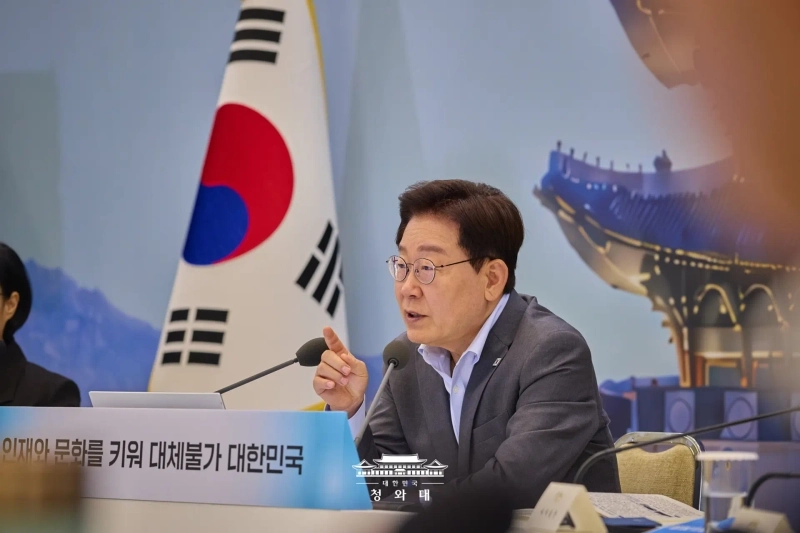
President Lee Jae-myung held a private dinner meeting with SK Group Chairman Chey Tae-won on Aug. 20, according to the presidential office and industry officials. The meeting came two months after the two held a closed-door session ahead of the administration's June announcement of three mega projects, including the Honam semiconductor cluster. Officials are also coordinating a series of meetings with other top business leaders, including Samsung Electronics Chairman Lee Jae-yong and LG Group Chairman Koo Kwang-mo.
Lee and Chey met over dinner at an undisclosed location on Aug. 20, the officials said. It was their second meeting in about three weeks after they attended an artificial intelligence summit in San Francisco during Lee's US trip in late July. The details of their conversation were not disclosed. They were widely expected to exchange views on semiconductor fab projects in Yongin and Gwangju, pressure from the US to invest in chip production there, and the strategic value of semiconductors in the AI era.
The meeting came as the Donald Trump administration increased pressure for semiconductor investment in the US. Howard Lutnick, the US commerce secretary, said last month that he wanted Samsung Electronics and SK hynix to come to the US and build factories. The presidential office denied a separate report that Washington had recently asked for semiconductors to be designated as the first project for Korean investment in the US.
President Lee Steps Up Direct Outreach to Heads of the Four Largest Conglomerates
Since taking office in June 2025, Lee has maintained steady contact with the heads of South Korea's four largest conglomerates. In July 2025, about a month after his inauguration, he separately hosted Samsung's Lee Jae-yong, Hyundai Motor Group Executive Chair Chung Euisun and LG's Koo Kwang-mo for dinner at the presidential residence in Hannam-dong, Seoul. The latest round of meetings, beginning with Chey, appears intended to hear candid views from business leaders in private rather than at formal events such as roundtables.
The strategic importance of South Korea's semiconductor companies has risen in the AI era. That has prompted analysis that Lee is seeking ideas for state affairs through close communication with executives such as Chey. Debate is also intensifying over the semiconductor boom cycle and a planned 800 trillion won ($578.8 billion) new fab investment by Samsung Electronics and SK hynix in Gwangju, South Jeolla Province. Labor groups are demanding a share of semiconductor profits. Samsung Electronics' labor union argues that a decision to invest in the Honam semiconductor cluster should itself be subject to collective bargaining.
US demands for chip investment are also a pressing issue. "If the US, after watching Samsung Electronics and SK hynix announce astronomical domestic investments, now asks them to invest in America, that would be the worst-case scenario for us," a business official said. In a recent CNBC interview, Chey said every country wants semiconductor plants built within its borders. But a chip fab depends on an ecosystem supported by 600 to 700 materials and parts suppliers, and the key question is whether that ecosystem can be replicated.
Kim Hyung-kyu / Han Jae-young

Korea Economic Daily
hankyung@bloomingbit.ioThe Korea Economic Daily Global is a digital media where latest news on Korean companies, industries, and financial markets.