Line Next, Payletter Hold Stablecoin Payments Seminar; Unify Pay Tops 100 Wallet Integrations
Summary
- Line Next said it held a seminar with Payletter and shared views on stablecoin payments, global settlement procedures, and the market outlook.
- Line Next said Unify Pay has secured more than 100 wallet payment integrations, and that stablecoin payments account for more than 30% in some services.
- Line Next said it plans to expand support from USDT and JPYC to stablecoins based on major Asian currencies, with the goal of building payment infrastructure that can serve users across Asia through a single integration.
Forecast Trend Report by Period


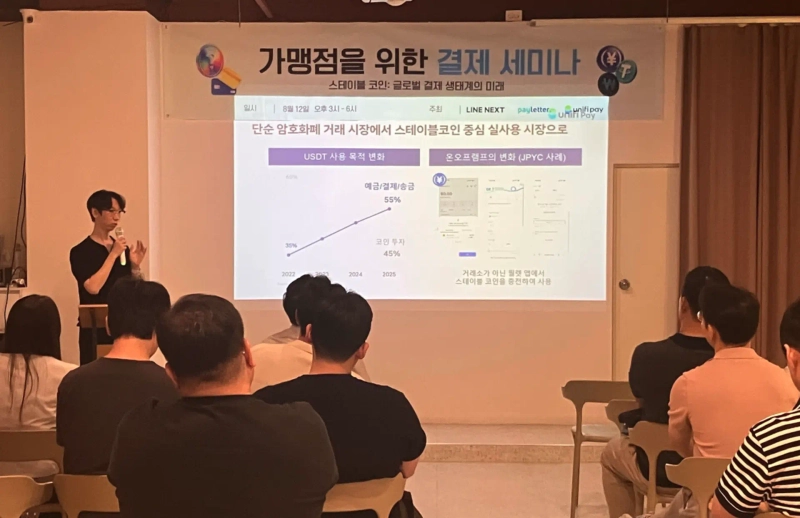
Line Next said Aug. 21 that it had jointly hosted a seminar with Payletter on Aug. 12 in Seoul's Yeoksam-dong titled “The Future of the Global Payments Ecosystem.” The event covered stablecoin payment adoption structures, global settlement procedures and market prospects.
About 50 representatives from companies involved in overseas payments attended the seminar. It was organized as more businesses weigh adopting stablecoin payments and seek to discuss implementation models and regulatory requirements.
Kim Dong-young, a team leader at Line Next, presented changes in the stablecoin payments market and Unify Pay's strategy. He said the share of USDT use tied to holding, payments and remittances rose to 55% in 2025 from 35% in 2022. He added that regulatory developments in major Asian countries could lead to the formation of local stablecoin payment markets linked to each country's currency.
Line Next said Unify Pay has secured more than 100 wallet payment integrations. In services including game B2C and C2C, stablecoin payments accounted for more than 30% versus cash. Unify Pay is a stablecoin-based wallet and payments infrastructure service developed by Line Next.
“If merchants have to hold and manage stablecoins directly, there is no reason to consider adoption,” Kim said. “Unify Pay is designed so users can pay with stablecoins while merchants keep their existing settlement structure and simply add another payment option.”
Payletter, in a separate presentation, outlined the country-specific regulatory requirements companies need to review when adopting overseas payments. The company supports more than 100 local payment methods, including global cards and PayPal, and provides services in more than 20 countries. Its total payment volume last year was 2.4 trillion won ($1.74 billion), and its cumulative merchant base reached 20,000 companies.
Choi Yoon-je, a director on Payletter's overseas business team, said companies should review anti-money laundering obligations under the Act on Reporting and Use of Certain Financial Transaction Information, as well as merchant screening requirements set by global card companies, when introducing overseas payments. Because separate regulatory requirements apply by country and industry, market-specific responses are needed, he said.
Ryan Yoon, a director at Tiger Research, said stablecoins could eventually complement existing financial infrastructure in payments and settlement. Fiat currency-based payment systems are not set to disappear immediately, but stablecoin settlement could emerge as a separate channel, giving merchants more choice over settlement methods.
Line Next plans to gradually expand support beyond USDT and JPYC to stablecoins based on major Asian currencies. Kim said the company aims to build payment infrastructure that lets merchants reach users across Asia through a single integration, without having to respond to each country separately.

Minseung Kang
minriver@bloomingbit.ioBlockchain journalist | Writer of Trade Now & Altcoin Now, must-read content for investors.