PiCK
Kakao to Split Into KakaoAI and KakaoX, Targeting $11.6 Billion in 2030 Revenue
Summary
- Kakao said it will split into KakaoAI and KakaoX, using separate management systems to speed decision-making and win better recognition of its corporate value.
- Kakao said it is targeting more than $4.3 billion in revenue at KakaoAI and more than $7.2 billion in key-business revenue at KakaoX by 2030, for a combined $11.6 billion.
- Kakao said it will deploy substantial investment capacity, including $1.7 billion, into future businesses such as virtual assets (cryptocurrencies), while also announcing a $217 million share cancellation plan and putting the group’s potential value at $24.8 billion.
Forecast Trend Report by Period


Kakao Corp. will split into two companies, separating its artificial intelligence platform business from a future-business investment arm. The company will carve out a new entity, KakaoAI, focused on KakaoTalk and AI, while the surviving company, KakaoX, will be turned into an investment company overseeing its finance, content and mobility affiliates. Kakao said the move is designed to speed decision-making by putting two distinct businesses under separate management systems and to win better market recognition of their value.
Kakao said on Aug. 21 that its board approved a spinoff into KakaoAI and KakaoX. The split ratio, based on net asset book value, will be 0.36 for the new KakaoAI entity and 0.64 for the surviving KakaoX. Existing shareholders will receive shares in both companies based on that ratio.
Kakao plans to complete the split on Jan. 1, 2027, after an extraordinary shareholders meeting on Dec. 17, 2026. KakaoAI is scheduled to relist on Jan. 27, 2027, while KakaoX will seek a modified listing on the same day.
Kakao to Separate KakaoTalk and AI Business; CEO Chung to Lead KakaoAI
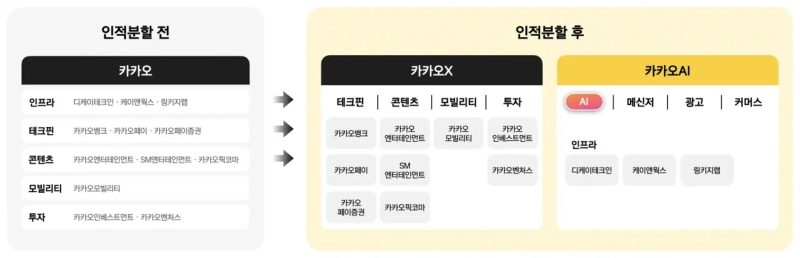
The split is centered on putting Kakao’s KakaoTalk-led platform business and its affiliate and investment operations under entirely different management structures.
KakaoAI will house KakaoTalk as well as the company’s AI, advertising and commerce businesses. Current Kakao Chief Executive Officer Chung Shin-a is set to lead KakaoAI. Operating subsidiaries including DK Techin and K-Nworks will also come under KakaoAI.
Kakao has defined KakaoAI’s role as an “AI Core Company.” It plans to turn KakaoTalk, which has about 50 million users, from a simple messenger app into an “Agentic AI Interface” that understands each user’s intent and context.
Under that model, users will send a message describing what they want, and a personalized AI agent will connect them to the needed services and specialist agents, handling everything from search and recommendations to purchases and payments. Kakao plans to use the user relationships, conversations and service network KakaoTalk has built over the past 15 years as the foundation for its AI services.
The company also laid out specific targets. KakaoAI aims to secure more than 20 million daily active AI users by 2030 and increase time spent on its platform by more than 50%. It also plans to expand AI advertising, agentic commerce and subscriptions, driving average annual revenue growth of about 20% through 2030 and lifting total revenue to more than $4.3 billion.
Kakao said AI-related revenue will account for a double-digit share of KakaoAI’s total revenue by 2028 and top $725 million by 2030.
Chung said the split is intended to reshape Kakao for the AI era with a structure built for speed and accountability. KakaoAI and KakaoX will each establish strategies and capital allocation principles tailored to their businesses, execute more quickly, and communicate their results to the market more transparently, she added.
KakaoX to Pursue Future Businesses With $1.7 Billion
Kakao’s main affiliates in finance, content and mobility will remain under KakaoX.
KakaoX will oversee tech-finance affiliates including KakaoBank Corp., Kakao Pay Corp. and Kakao Pay Securities, as well as content businesses including Kakao Entertainment, SM Entertainment Co. and Kakao Piccoma, and mobility platform Kakao Mobility.
Kim Do-young, chief executive of Kakao Investment and head of group investment strategy at Kakao’s CA Council, has been nominated to lead the company.
KakaoX is not intended only to manage existing affiliates. Kakao has defined it as a “future value investment company,” with a role of supporting growth at core affiliates while identifying new businesses and companies that can become the next KakaoBank, Kakao Pay or Kakao Mobility.
Areas under review include virtual assets, physical AI and global fandom.
KakaoX also has ample investment capacity. It plans to use about $1.7 billion secured through asset monetization. Its subsidiaries also have investment capacity of about $3.0 billion.
Kakao said that would help lift revenue at KakaoX’s key businesses by an average annual 13.3% through 2030 and expand it to more than $7.2 billion. Combined with KakaoAI’s target of more than $4.3 billion, the two companies are aiming for more than $11.6 billion in key-business revenue by 2030.
Why Split? Kakao Puts Potential Value at $24.8 Billion Versus $12.2 Billion Market Cap
The breakup reflects Kakao’s concerns about its corporate valuation.
Kakao expanded rapidly in the mobile era and built a group spanning finance, content and mobility. But as the company grew and its business structure became more complex, it concluded that a single decision-making system could no longer effectively manage businesses with different characteristics at the same time.
Its push over the past two years to dispose of non-core businesses and reduce the number of affiliates appears to have paved the way for this restructuring. This time, Kakao is separating its KakaoTalk and AI platform operations from its affiliate and investment business so each can move under different operating speeds and capital allocation principles.
Based on the average sum-of-the-parts consensus from domestic and foreign brokerage research centers in August 2026, Kakao Group’s potential value stands at $24.8 billion. That is $12.6 billion higher than Kakao’s average market capitalization of $12.2 billion over the past three months.
Kakao said the split reflects its view that the market has not fully recognized the value of its individual businesses and subsidiaries. After the separation, each entity will disclose earnings and investment performance separately, which the company says should make business-specific valuations clearer.
Shareholder return policies will also differ by company. KakaoAI plans to use 20% to 35% of adjusted free cash flow on a stand-alone basis as its base source for shareholder returns. KakaoX plans to allocate 30% of dividends received from subsidiaries and 30% of investment gains to shareholder returns.
Kakao also announced a plan to buy back and retire $217 million of treasury shares using gains from its recent sale of a stake in Dunamu.
Founder Kim Beom-su said Kakao changed users’ daily lives by moving first into uncharted areas in the mobile era. The AI era demands a different level of agility, and Kakao will redesign its growth structure around two engines, KakaoAI and KakaoX, so the results benefit shareholders, users and employees, he said.
Kakao said it will maintain employment, working conditions and benefits after the split. Services, businesses, staff, assets, technologies and models transferred to KakaoAI will continue to operate with continuity from existing operations.
Hong Min-sung, Hankyung.com reporter mshong@hankyung.com

Korea Economic Daily
hankyung@bloomingbit.ioThe Korea Economic Daily Global is a digital media where latest news on Korean companies, industries, and financial markets.