US 30-Year Treasury Yield Rebounds to 5.27% Despite Buyback Push
Summary
- The yield on the US 30-year Treasury rebounded to 5.27% even after the Treasury announced an expansion of its buyback program.
- About $8.5 trillion of Treasuries issued during the low-rate era will be refinanced at rates 2 percentage points higher, raising the annual interest burden by $170 billion.
- Hedge funds and stablecoin issuers are emerging as major buyers of US Treasuries as demand from foreign central banks declines, shifting Treasuries from a safe-haven asset toward one bought for returns.
Forecast Trend Report by Period


How the US Treasury Market’s Funding Model Is Changing
Expanded Buybacks Worked for Only a Day
Low-Rate-Era Bonds Are Nearing Maturity
They Will Be Rolled Over at Rates 2 Percentage Points Higher
Long-Term Debt Is Being Shifted Into Shorter Maturities
That Leaves the Market More Exposed to Rate Volatility
Foreign Buyers That Once Absorbed Supply Are Pulling Back
A sharp drop in long-dated US Treasury yields after the Treasury Department’s surprise move to expand buybacks was largely erased within a day. The reversal reinforced concerns that temporary measures alone cannot ease the structural forces pushing US yields higher. It also adds to the view that changes in Treasury funding and market demand are weakening their role as a safe-haven asset.
◇US Treasury Yields Rebound Within a Day
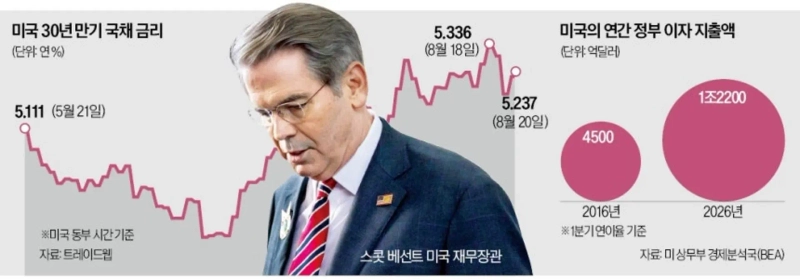
According to data from the Federal Reserve Bank of St. Louis’s FRED database, the yield on the 30-year US Treasury rose 0.07 percentage point during trading on Aug. 20 and at one point reached 5.27%. That was near the level seen before the Treasury said on Aug. 19 that it would double each buyback operation to $4 billion from $2 billion.
The 30-year yield briefly fell to about 5.18% immediately after the buyback announcement. But most of that decline was reversed within a day, turning the market mood. Treasury Secretary Scott Bessent said on Aug. 20 that officials would monitor developments because they have many policy tools available. He also said Treasury yields are not properly reflecting underlying economic conditions. Bessent added that the administration would announce this week or early next week measures with a stronger focus on fiscal discipline.
Markets are concerned that any action by the US government will amount to little more than a short-term fix. One pressure point is the fiscal outlook itself. A large volume of debt issued during the low-rate era is approaching maturity. The Treasury estimates that about $8.5 trillion of fixed-rate US government debt will mature between 2026 and 2028.
Most of that debt will be refinanced at rates 2 percentage points higher than before. Even if the government takes on no additional debt, its annual interest burden would still rise by about $170 billion. The rate shock created by the end of the low-rate era that followed the global financial crisis, and then reversed after the Covid-19 pandemic, is now surfacing in the Treasury market as well.
◇Shift to Short-Term Debt Could Backfire
That has pushed the US government to shorten the maturity of its debt. Short-term securities carry lower issuance costs than long-term bonds, reducing interest expense in the near term. Under the latest buyback plan, the Treasury also intends to replace existing long-dated bonds with medium- and short-term debt.
Treasury bills with maturities of less than one year accounted for 84% of new US government debt issuance last year. The approach resembles a household relying on cash advances to keep up with credit-card bills.
The immediate interest burden may fall, but future rate risk rises. A 30-year bond locks in borrowing costs for three decades. Three-month or one-year debt must be refinanced at prevailing market rates whenever it matures. On paper, the debt is fixed-rate. In practice, it behaves more like floating-rate borrowing that is repriced over and over. Inflation shocks, war or shifts in central bank policy can immediately raise the government’s funding burden. That can amplify volatility across Treasury yields and further weaken their safe-haven appeal.
Changes in the makeup of major Treasury buyers are also adding structural upward pressure on yields. After the global financial crisis, foreign central banks and government-backed investors were key buyers of US Treasuries. That demand has weakened in recent years. Treasuries held by foreign official institutions in custody at the New York Fed fell to about $2.7 trillion by the end of 2025 from about $3 trillion in 2021. Net foreign purchases of US government bonds in June totaled $6.8 billion, down 88% from $56.6 billion in May.
Hedge funds and stablecoin issuers such as Tether have emerged as major buyers instead. While they help support demand for short-term paper, they cannot replace foreign central banks that had absorbed supply in the 10- to 30-year sector.
Taken together, the shift suggests the nature of US Treasuries as an asset class is changing. In the past, investors were willing to buy them even at lower yields than other financial products because they were seen as safe. But as Treasury issuance has surged, investors are increasingly demanding extra compensation in the form of higher yields. Ricardo Caballero, a professor at the Massachusetts Institute of Technology, said about 0.75 percentage point of the 2.5-percentage-point rise in US Treasury yields since 2015 reflects investors’ demand for added compensation. He said investors are increasingly buying Treasuries for returns rather than safety.
Kim Joo-wan, Hankyung.com reporter kjwan@hankyung.com

Korea Economic Daily
hankyung@bloomingbit.ioThe Korea Economic Daily Global is a digital media where latest news on Korean companies, industries, and financial markets.