Summary
- A majority of economists in the Hankyung Economist Club, 63%, said the Bank of Korea's August Monetary Policy Board meeting would raise the benchmark interest rate by 25 basis points to 3.0%.
- Some 52.6% of respondents said the terminal interest rate in the current tightening cycle would be 3.50%, implying at least three additional rate increases.
- About 78% of economists said this year's growth rate would come in at 3.2% or higher, and many said South Korea's economic expansion remains heavily dependent on semiconductors.
Forecast Trend Report by Period


Hankyung Economist Club survey points to growth above 3.2% this year
37% expect a pause this month
Strong economy and elevated core inflation support case for hike
Terminal rate seen at 3.5% by end of next year
A majority of economists in the Hankyung Economist Club expect the Bank of Korea to raise its benchmark interest rate by 25 basis points to 3.0% on Aug. 27. The view reflects stronger-than-expected second-quarter gross domestic product growth and elevated core inflation.
Still, 37% of respondents said another increase after July would be premature and forecast no change this month. The largest share of economists also picked 3.5% as the final rate in the current tightening cycle.
"Terminal rate seen at 3.50%"
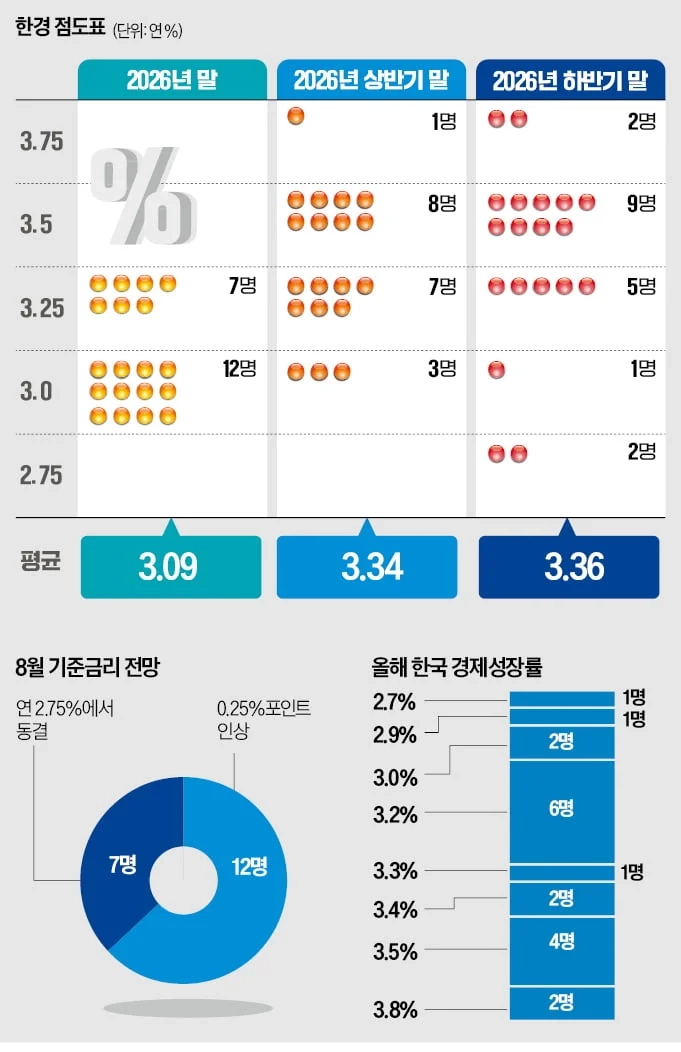
A survey of 19 economists in the Hankyung Economist Club conducted by the Korea Economic Daily found 63.2%, or 12 respondents, expect the BOK to raise the base rate by 25 basis points at its August Monetary Policy Board meeting. In the newspaper's previous survey, only three economists, or 15%, expected an August increase.
Views shifted after GDP rose 0.6% in the second quarter from the previous quarter, following 1.8% growth in the first quarter. Core inflation also remained elevated, with the core consumer price index rising 2.6% in July. Together, those figures suggest the BOK has room to raise rates for a second straight month.
Cho Yong-gu, a research fellow at Shinyoung Securities, said second-quarter GDP and gross domestic income were strong. Real-economy indicators such as semiconductor exports and the current-account balance also remained solid.
Lee Yoon-soo, a professor at Seoul National University's Graduate School of International Studies, said the economy had proved stronger than expected. That raises the possibility that the neutral rate is higher than previously assumed.
Seven respondents, or 36.8%, forecast the BOK would leave rates unchanged in August. Kang Tae-soo, a visiting professor at KAIST's Graduate School of Finance, cited relative stability in the won-dollar exchange rate and international oil prices.
Twelve economists, or 63.2%, said the benchmark rate would be 3.0% at the end of this year. The other seven, or 36.8%, forecast 3.25%. Separately, 52.6% of respondents said the terminal rate in the current hiking cycle would be 3.50%, implying at least three additional increases.
"Growth next year seen at 2.5%"
Economists also raised their growth forecasts. About 78% said South Korea's economy would expand by at least 3.2% this year. The largest share, 31.6%, projected 3.2% growth. Another 21.1% saw 3.5%, while 10.5% expected 3.8%.
For next year, 2.5% was the most common forecast at 31.6%. Lee Seung-hoon, an economist at Meritz Securities, said semiconductor-led growth would continue into next year, though momentum would ease somewhat. Growth in capital investment is also set to slow, while private consumption should improve with a lag as gross domestic income surges.
Many respondents said growth would weaken sharply without semiconductors. About 47.4% said this year's growth would be just 1.5% to 2.0% excluding the chip sector. Another 79.0% said the economy's expansion had yet to spread from semiconductors to other industries.
The BOK's rate path will hinge on whether the semiconductor boom broadens into economy-wide growth and how much inflation pressure it creates. Some 57.9% of respondents said a preemptive rate increase was needed to address demand-side inflation pressure even amid uneven growth.
Lee Nam-gang, an economist at Korea Investment Holdings, said operating profit of about $72.5 billion from Samsung Electronics and SK Hynix would flow back into nominal GDP next year through shareholder returns, corporate tax payments, bonuses and capital spending. That would create sizable demand-side inflation pressure.
Another 36.8% said the BOK could wait until demand-side inflation pressures are confirmed before raising rates, given the economy's widening divergence. Min Ji-hee, a researcher at Mirae Asset Securities, said growth excluding semiconductors remained below the potential rate, while the exchange rate had also regained stability.
Shim Seong-mi, Korea Economic Daily reporter smshim@hankyung.com

Korea Economic Daily
hankyung@bloomingbit.ioThe Korea Economic Daily Global is a digital media where latest news on Korean companies, industries, and financial markets.