Nvidia to Raise AI Chip Prices at Least 15% as Memory Surge Boosts Samsung, SK Hynix Leverage
Summary
- Nvidia told customers it would raise AI chip prices by at least 15% for shipments starting early next year, reflecting the recent surge in memory prices in product pricing.
- Contract prices for server DRAM rose 53% to 58% in the second quarter from the previous quarter and are forecast to climb further in the third quarter, strengthening the pricing leverage of the three major memory makers, including Samsung Electronics and SK Hynix.
- Price increases by Nvidia, Apple and Qualcomm have raised expectations for stronger profitability at Samsung Electronics and SK Hynix, while also fueling concerns that a spike in AI data-center construction costs could lead to a slowdown in AI investment.
Forecast Trend Report by Period


Nvidia to lift AI server prices more than 15% as chip inflation bites
Memory shortage to affect shipments from next year
Nvidia has told major customers it plans to raise prices for artificial intelligence chips by more than 15%, industry officials said on August 23. The move reflects a sharp increase in memory-chip prices.
Bloomberg reported the same day that Nvidia had notified customers it would raise AI chip prices by at least 15% for shipments starting early next year. The increase will cover next-generation AI accelerators including Vera Rubin and Grace Blackwell. The main driver is a surge in memory prices. AI chips require large amounts of high-performance memory, and a global boom in AI data-center construction has tightened supply. Apple and Qualcomm also raised product prices in June and July, respectively, for the same reason.
The shift is strengthening the pricing power of memory-chip suppliers such as Samsung Electronics and SK Hynix, according to industry officials. At the same time, rising costs for AI data-center construction are fueling concerns about a broader market slowdown.
Server DRAM prices jumped 53% to 58% in the second quarter as top three memory makers face supply limits
Next year's HBM and DRAM supply is selling out early; a slowdown in AI-center construction could trigger a sharp cooldown
After Apple and Qualcomm, Nvidia's decision to raise prices is adding to expectations that profitability at memory-chip makers such as Samsung Electronics and SK Hynix will improve further. But there is also concern that if higher AI chip prices hurt the broader AI data-center ecosystem, the semiconductor industry could come under pressure as well.
Memory becomes Nvidia's bottleneck
Industry officials said on August 23 that Nvidia's price increase stems from a shortage of memory supply. Nvidia's flagship products are AI accelerators, semiconductor packages used for training and inference. They are essential for processing vast amounts of data at high speed. To operate at full performance, AI accelerators require high-bandwidth memory, or HBM, a high-performance chip built by stacking multiple DRAM layers to move data quickly.
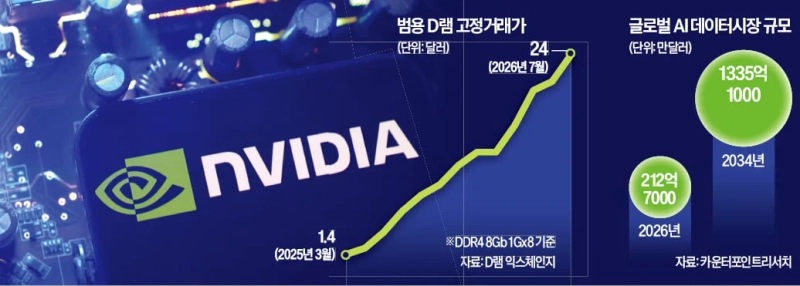
Supply shortages in HBM and DRAM have intensified as global tech companies race to build AI data centers. TrendForce said contract prices for server DRAM rose 53% to 58% in the second quarter from the previous quarter. They are forecast to rise another 13% to 18% in the third quarter. The global HBM market is dominated by Samsung Electronics, SK Hynix and Micron, making it difficult to boost supply quickly. Samsung Electronics and SK Hynix have announced a series of capacity-expansion plans to increase output as fast as possible, but the supply crunch is likely to persist for some time.
Industry officials said Nvidia's decision to raise prices after Apple and Qualcomm is significant. Nvidia is highly profitable, with a gross margin of 75%. The fact that even Nvidia is passing costs on to customers suggests memory suppliers have gained bargaining power. Memory supply has also become a key variable in determining AI chip output and pricing.
Samsung and SK Hynix cement their status as dominant suppliers
Profitability at memory makers such as Samsung Electronics and SK Hynix is set to remain strong for now, as big tech companies continue to expand AI data-center construction and AI chip development. Amazon, Microsoft, Google and Meta are also developing in-house AI chips to reduce dependence on Nvidia. That effort requires securing large volumes of HBM and DRAM.
HBM is difficult to manufacture, and new entrants face high barriers because customer qualification takes time. Samsung Electronics and SK Hynix have also announced aggressive plans to expand memory production. Samsung is building both Pyeongtaek P5 Fab 1 and Fab 2, formerly known as P6, while moving ahead with plans to construct six new semiconductor plants in Yongin, Gyeonggi Province, by the end of this year. SK Hynix is also expanding fabs in Yongin and Cheongju, North Chungcheong Province.
Still, there are concerns that if cost pressures across the AI ecosystem intensify, the effect could boomerang back on memory-chip makers. The Information, a US technology publication, reported that some server manufacturers were told AI chip prices could rise by about 17%. In that case, construction costs for a 1-gigawatt data center would increase by at least $5 billion. The AI investment boom has pushed memory prices higher, but those higher prices could in turn raise the cost of AI investment and weaken appetite for further spending.
Won Jong-hwan and Lee Hye-in, Hankyung.com reporters won0403@hankyung.com

Korea Economic Daily
hankyung@bloomingbit.ioThe Korea Economic Daily Global is a digital media where latest news on Korean companies, industries, and financial markets.