South Korea Pledges $4.3 Billion to Speed Honam Chip Hub, Targets First Output in June 2030
Summary
- The government said it is accelerating development of the Honam semiconductor megacluster after approving $4.3 billion in support and an exemption from the preliminary feasibility study for water infrastructure.
- It said the Gwangju military airport site can accommodate four semiconductor fabs as well as suppliers and research facilities, with production infrastructure supported by a 170% power self-sufficiency rate and a phased expansion of water supply.
- It said it will shorten the development timeline by changing the construction method, with the goal of starting fab construction in 2028, achieving the first-phase completion of two fabs in 2029, and beginning initial output in June 2030.
Forecast Trend Report by Period


Mass production targeted for June 2030
Water infrastructure exempted from feasibility review
Core infrastructure timeline to be shortened
First-phase completion of two fabs targeted for 2029
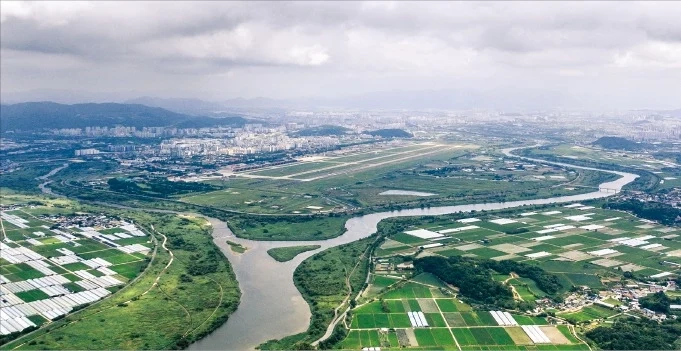
SK Hynix executives visited the Gwangju military airport site in the planned integrated Jeonnam-Gwangju special city on Aug. 24 to inspect the land and surrounding conditions for a semiconductor fab project. It was SK's third trip to Gwangju. The executives were reportedly satisfied with the site's flat terrain and its access to transport, power and water.
The 800 trillion won ($578 billion) Honam semiconductor megacluster is moving from blueprint to execution. The government aims to break ground on fabs in 2028 and produce the first chips in June 2030. After the Cabinet on Aug. 25 approved an exemption from a preliminary feasibility study for water infrastructure and mapped out 6 trillion won ($4.3 billion) in government support, the focus has shifted from attracting investment to speeding up development.
Power and Water Support the Project, While Earthquake Risk Is Relatively Low
The integrated Jeonnam-Gwangju special city said on Aug. 26 that limits in the Seoul metropolitan area have helped turn the Gwangju military airport site into a new production base candidate for South Korea's chipmakers. Semiconductor plants require vast land and large, stable supplies of power and water. Gwangju can secure a single 8.26 million-square-meter site by repurposing the military airport slated for relocation. That would leave enough room for Samsung Electronics and SK Hynix to each build two fabs, along with suppliers, research facilities and additional production capacity.
Power and water availability also strengthen Gwangju's case. Four fabs would require 6.3 gigawatts of power and 650,000 metric tons of water a day. The Jeonnam-Gwangju region has a power self-sufficiency rate of about 170%, and the government says nuclear and renewable energy can provide the needed generation. The key task is building transmission lines that can reliably deliver electricity to the industrial complex. Authorities are pursuing a plan to connect the zone to the Sinjangseong and Singwangju substations, cutting the usual power-supply lead time from about nine years to around four.
The Cabinet's Aug. 25 decision brought the project a step closer to securing water. The plan calls for supply to begin at 150,000 metric tons a day by the end of 2029 and rise to 650,000 metric tons by 2033.
The site's seismic stability has also drawn attention after a recent earthquake in Kumamoto, Japan, halted operations at a local TSMC plant. In the semiconductor industry, which relies on ultra-precision equipment, earthquakes and micro-vibrations are directly tied to production safety. An analysis of Korea Meteorological Administration earthquake records using the Gwangju airport runway reference point found that the strongest earthquake within a 50-kilometer radius was a magnitude-3.2 event in 2013, 3 kilometers east of Dong-gu in Gwangju. No quake of magnitude 4.0 or higher has been recorded. That does not mean the area is free of seismic risk, but it is considered relatively stable for a large semiconductor production site.
Government Backs Faster Development
Government support is also gathering speed. Of up to 20 trillion won ($14.5 billion) in aid tied to the Jeonnam-Gwangju integration, 6 trillion won ($4.3 billion) is set to go to semiconductors from 2027 through 2030. An enforcement decree under the Special Semiconductor Act gives priority to non-capital regions when designating new clusters and allows broader support for core infrastructure such as electricity and water.
Authorities also plan to change the construction method to save time. LH, or Korea Land & Housing Corp., estimates that building the entire national industrial complex at the former military airport would take 46 months. Under the conventional model, fabs would be built only after the industrial complex is fully prepared, making a 2030 production start difficult. LH instead plans to prepare the fab sites first while conducting soil and environmental studies, design work and permitting in parallel. The company plans to choose a design contractor in September and begin design work in October.
The government and the Jeonnam-Gwangju city government plan to sign an occupancy agreement for the national industrial complex in October and begin planning, design, permitting and site preparation in 2027. Their goal is to start fab construction as soon as the Gwangju military airport site is handed over in 2028, complete the first phase of two fabs in 2029 and begin initial output in June 2030.
A Jeonnam-Gwangju city official said the Honam semiconductor megacluster is not simply a project to relocate a few factories outside the Seoul metropolitan area. The official added that the city aims to build a new semiconductor industry axis by combining the site's land, power, water and relatively low earthquake risk with materials, parts and equipment suppliers, research and development, and residential and education functions.
Jeonnam-Gwangju — Lim Dong-ryul, Hankyung.com reporter exian@hankyung.com

Korea Economic Daily
hankyung@bloomingbit.ioThe Korea Economic Daily Global is a digital media where latest news on Korean companies, industries, and financial markets.